Over the past five years,
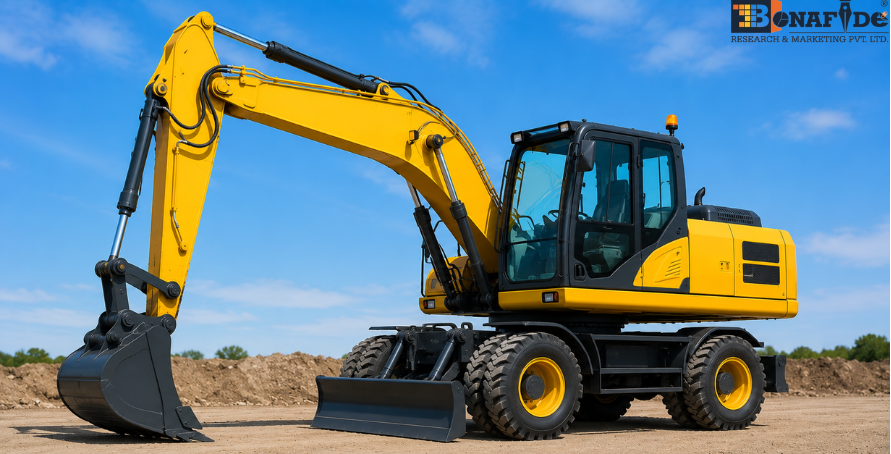
wheeled excavator adoption has expanded significantly in major urban centers such as London, Tokyo, Dubai, and New York, where mobility between congested and space-constrained job sites is essential for efficient construction operations. Leading manufacturers including Caterpillar, Komatsu, Volvo
Construction Equipment, Liebherr, and Hitachi have introduced advanced wheeled
excavator models featuring enhanced hydraulic efficiency, improved operator comfort, and compliance with stringent emissions regulations such as EU Stage V and US EPA Tier 4 Final standards. The global wheeled excavators market encompasses a wide range of
mobile earthmoving equipment used in urban construction, road development, rail infrastructure, utility maintenance, and industrial site projects across regions including North America, Europe, Asia Pacific, and the Middle East. Product categories include compact wheeled excavators, mid-sized units, material handlers, and short-radius machines equipped with attachments such as hydraulic breakers, augers, and grading systems. Regulatory requirements are increasingly shaped by environmental and operational safety standards, including Japan’s MLIT construction equipment guidelines, OSHA safety regulations in the United States, and noise and emissions policies enforced across Europe. Urban low-emission initiatives in cities such as Paris, Singapore, and Los Angeles are also accelerating the adoption of electric and hybrid excavators. Technological innovation in the sector is increasingly focused on electrification, automation, and AI-driven fleet optimization, with modern machines integrating 3D machine control systems that can improve excavation precision by nearly 25 percent in large infrastructure projects, while AI-based telematics solutions help reduce fleet idle time by approximately 18 percent. In addition, advanced hydraulic technologies are improving fuel efficiency by up to 15 percent, and
predictive maintenance systems are reducing equipment downtime, supporting higher productivity and operational reliability across global construction and infrastructure activities.
According to the research report "Global Wheeled Excavator Market Outlook, 2031," published by Bonafide Research, the Global Wheeled Excavator market was valued at more than USD 18.27 Billion in 2025, and expected to reach a market size of more than USD 27.10 Billion by 2031 with the CAGR of 6.81% from 2026-2031. The global wheeled excavators market is being driven by rapid urbanization, smart city initiatives, and ongoing infrastructure modernization projects such as highway construction, metro rail expansion, and water distribution network upgrades. Market growth is further supported by the replacement of aging diesel-powered fleets manufactured before 2016 as governments worldwide implement stricter emissions regulations and sustainability policies. Demand remains particularly strong in rental-intensive regions such as Europe and North America, where contractors increasingly favor flexible equipment access for short-term and project-based operations. Long-term demand forecasting remains stable due to major infrastructure investments in China, India, and the United States, including transportation corridors,
renewable energy installations, and flood resilience developments. Global supply chains depend heavily on the movement of components and finished machinery from manufacturing leaders such as Japan, Germany, South Korea, Sweden, and the United States, while major production hubs are concentrated in China, India, and Europe. The industry ecosystem includes OEM manufacturing facilities, hydraulic system suppliers, rental operators, and maintenance service networks that collectively ensure equipment availability across construction and infrastructure sectors. Strategic ports such as Rotterdam, Singapore, Los Angeles, and Shanghai function as major global distribution centers, while export activity increasingly includes the transfer of used machinery from developed economies to rapidly growing infrastructure markets in Africa, Southeast Asia, and Latin America. The competitive landscape is led by major OEMs such as Caterpillar, Komatsu, Volvo Construction Equipment, Hitachi, and Liebherr, alongside regional distributors and rental providers including United Rentals in North America and Loxam in Europe. Investment opportunities are increasingly concentrated in smart infrastructure, renewable energy construction, and large-scale transportation projects across Asia Pacific and the Middle East, while competitive differentiation is increasingly based on fuel efficiency, telematics integration, and machine reliability in dense urban operating environments with minimal downtime.
Medium wheeled excavators are the most widely used category because they effectively meet the operational demands of construction environments where mobility, versatility, and efficiency are more important than maximum digging capacity. These machines are well suited for applications such as trenching, road maintenance, utility installation, and light demolition, offering a practical balance between compact units with limited capability and large tracked excavators that are less adaptable in urban settings. Cities such as Paris, Berlin, and Milan rely heavily on this segment for sewer upgrades, metro expansions, and road resurfacing projects where equipment must frequently move between confined job sites, while contractors in the United States prefer these machines for highway and suburban infrastructure work because they can travel on paved roads without transport trailers, reducing downtime and
logistics costs. Leading manufacturers such as Caterpillar, Komatsu, and Volvo Construction Equipment concentrate much of their product development around this mid-sized category due to its compatibility with widely used attachments like breakers, grapples, and tilt rotators, as well as its strong balance of hydraulic power and fuel efficiency. Rental companies across North America and Europe also prioritize medium wheeled excavators because they achieve
high utilization across municipal works, drainage projects, and utility repairs, while emerging economies such as India, Brazil, and Indonesia increasingly favor them for infrastructure development due to their cost efficiency, ease of maintenance, and suitability for distributed construction activities.
Electric wheeled excavators are experiencing rapid adoption as global decarbonization initiatives and stricter regulations on diesel-powered machinery accelerate the transition toward cleaner construction equipment. Cities such as Oslo, Amsterdam, Paris, and Shenzhen have implemented low-emission construction policies that restrict diesel equipment in urban areas, prompting contractors to adopt electric alternatives for municipal and infrastructure projects. These machines produce zero direct exhaust emissions and operate at significantly lower noise levels, often below 70 decibels, making them ideal for residential and nighttime construction activities. Manufacturers such as Volvo Construction Equipment and JCB are deploying
battery-powered models in applications including road maintenance, utility excavation, and tunneling support across Europe and Asia. Electric systems are especially effective in wheeled excavators because urban projects require frequent relocation between job sites where charging infrastructure can be integrated into centralized fleet depots. Improvements in
lithium-ion battery technology have extended operating times to several hours per charge, making these machines increasingly practical for short-duration tasks such as trenching and cable installation. Governments in the European Union and parts of North America are also supporting adoption through subsidies, emissions regulations, and green procurement programs tied to public infrastructure contracts. In addition, rental companies are expanding electric fleets to reduce fuel consumption and maintenance expenses associated with
diesel engines, while major OEMs continue to introduce regenerative braking and hybrid-assist technologies that further improve battery efficiency and overall machine performance.
The 101 to 200 horsepower segment represents the most widely utilized category of wheeled excavators because it provides the ideal balance between performance, efficiency, and operational versatility for both mid-scale and large-scale construction projects. This power range is well suited for applications such as road construction, drainage installation, bridge maintenance, and urban redevelopment across global markets. In Germany and France, contractors working on highway refurbishment and metro expansion projects favor this segment because it delivers the hydraulic power required for concrete breaking and heavy material handling while still maintaining maneuverability in dense urban environments. Across North America, federally funded highway reconstruction and infrastructure modernization projects rely heavily on this category due to its ability to operate efficiently across multiple sites without excessive fuel consumption. Major manufacturers such as Volvo Construction Equipment, Komatsu, and Caterpillar concentrate many of their wheeled excavator offerings within this horsepower range because it supports compatibility with commonly used attachments including augers, crushers, and tilt buckets required across diverse construction tasks. The 101 to 200 HP category also helps reduce operating and maintenance costs compared to larger, higher-powered machines, making it especially attractive for rental fleets serving municipal projects, utility maintenance, and short-term infrastructure contracts. In emerging economies such as India and Brazil, this segment continues to dominate due to its cost-effectiveness, ease of servicing, and capability to manage mixed workloads across both urban and semi-urban construction environments.
The category labeled as others in application segmentation is growing fastest because it includes a wide range of non traditional excavation uses such as telecom installation, water pipeline maintenance, drainage cleaning, street
lighting installation, and landscaping projects. These applications are highly fragmented and occur frequently across urban and semi urban environments, creating consistent demand for wheeled excavators. Cities undergoing rapid infrastructure upgrades such as Bangalore, S?o Paulo, and Istanbul require continuous utility expansion and repair work that relies on compact, mobile excavation equipment. Wheeled excavators are particularly suitable because they can move quickly between short distance job sites, often completing multiple tasks within a single working day. Municipal authorities increasingly outsource these services to contractors who rely on flexible machinery rather than dedicated
heavy equipment fleets. Rental penetration is especially high in this segment, allowing contractors to access machines for daily or weekly use without ownership costs. Additionally, infrastructure digitization, including fiber optic cable expansion and smart city
sensor installation, has increased the frequency of underground utility work in dense urban areas. OEMs have responded by offering specialized attachments such as vacuum excavators, compact trenchers, and precision grading tools that expand application versatility.
The others application segment is emerging as the fastest-growing category in the wheeled excavator market because it encompasses a broad range of non-traditional excavation activities, including telecom installation, water pipeline maintenance, drainage cleaning, street lighting deployment, and landscaping projects. These tasks are highly fragmented yet occur frequently across urban and semi-urban areas, generating continuous demand for versatile and mobile excavation equipment. Rapidly developing cities such as Bangalore, S?o Paulo, and Istanbul require ongoing utility expansion and maintenance work that depends heavily on compact wheeled excavators capable of moving efficiently between multiple nearby job sites within a single workday. Municipal agencies are increasingly outsourcing these services to contractors who prefer flexible machinery over maintaining dedicated heavy equipment fleets, further boosting demand in this segment. Rental adoption is also particularly strong, enabling contractors to use equipment on short-term daily or weekly contracts without the financial burden of ownership. At the same time, growing investments in infrastructure digitization, including fiber-optic cable networks and smart city sensor systems, are increasing the volume of underground utility work in densely populated areas. In response, OEMs are introducing specialized attachments such as vacuum excavation systems, compact trenchers, and precision grading tools that enhance the adaptability and application range of wheeled excavators across these expanding non-traditional use cases.
















 We are friendly and approachable, give us a call.