The Global
Decorative Concrete Market is gaining momentum as architects, contractors, developers, homeowners, and property owners increasingly seek concrete surfaces that combine visual appeal, durability, customization, and practical performance. Decorative concrete is used across stamped, stained, colored, polished, exposed aggregate, engraved, overlay, epoxy, and other specialty finishes for floors, driveways, patios, pool decks, sidewalks, courtyards, walls, fa?ades, public spaces, and architectural surfaces. Demand is supported by residential construction, remodeling, commercial development, hospitality, retail, institutional projects, industrial facilities, infrastructure, landscaping, and urban redevelopment. Asia-Pacific represents the largest regional market, supported by extensive construction activity, urban expansion, housing development, infrastructure investment, and growing use of finished architectural surfaces across China, India, Southeast Asia, Japan, South Korea, and Australia. North America and Europe have strong renovation and refurbishment markets, while South America is supported by housing, infrastructure, tourism, and commercial development. The Middle East and Africa are creating opportunities through hospitality, tourism, luxury residential projects, public-realm development, infrastructure, and large-scale urban projects. Across regions, customers are increasingly looking for surfaces that can reproduce the appearance of natural stone, brick, slate, wood, and other premium materials without requiring the same material systems. This is supporting continued interest in stamping, staining, polishing, overlays, decorative coatings, and specialty finishing systems. At the same time, demand is gradually shifting toward products that are easier to install, more durable, lower maintenance, and suitable for specific climatic and project conditions. Sustainability is also becoming more relevant as manufacturers and project owners consider lower-carbon concrete systems, lower-emission coatings, recycled materials, environmental documentation, and longer-lasting
surface solutions.
According to the research report, "Global Decorative Concrete Market Outlook, 2031," published by Bonafide Research, the Global Decorative Concrete Market Outlook was valued at more than USD 20.47 Billion in 2025, and expected to reach a market size of more than USD 28.73 Billion by 2031 with the CAGR of 5.96% from 2026-2031. The Global Decorative Concrete Market is being shaped by continuing construction activity, renovation, urban development, architectural design trends, and increasing demand for specialized surface-finishing systems. Competition in the Global Decorative Concrete Market is becoming increasingly focused on product performance, design flexibility, technical support, manufacturing capabilities, and the ability to provide complete surface-finishing systems. International construction-chemical companies compete alongside regional manufacturers, pigment suppliers, concrete specialists,
flooring companies, and specialized decorative-concrete producers. The competitive landscape is also moving toward broader construction-finishing portfolios covering pigments, stains, sealers, flooring systems, overlays, waterproofing, surface preparation, concrete repair, and related technologies. Recent industry activity illustrates this direction, including Sika's investment in Concria, expansion of construction-chemical production capabilities, Saint-Gobain's acquisition of Interstar Materials, and Sudarshan Chemical Industries' acquisition of Heubach. These developments indicate growing interest in pigment technology, flooring systems,
specialty chemicals, and localized manufacturing capabilities. Raw materials remain important to the economics of decorative concrete.
Cement and aggregates are generally sourced relatively close to construction markets because of transportation costs, while pigments, polymers, acrylic binders, epoxy components, chemical admixtures, sealers, densifiers, and specialty additives may rely on wider regional or international supply chains. Freight costs, energy prices, exchange-rate movements, availability of specialty chemicals, and local manufacturing capacity can therefore influence product costs and project economics. Manufacturers are increasingly strengthening regional production and distribution networks to improve supply reliability and respond more quickly to local project requirements. Technology development is moving toward improved pigmentation, realistic stamping, advanced polishing, surface densification, resin flooring, low-emission coatings, rapid-curing systems, improved surface preparation, and lower-carbon formulations. The competitive advantage is increasingly shifting toward suppliers capable of combining product quality, application expertise, design flexibility, technical service, and reliable regional availability.
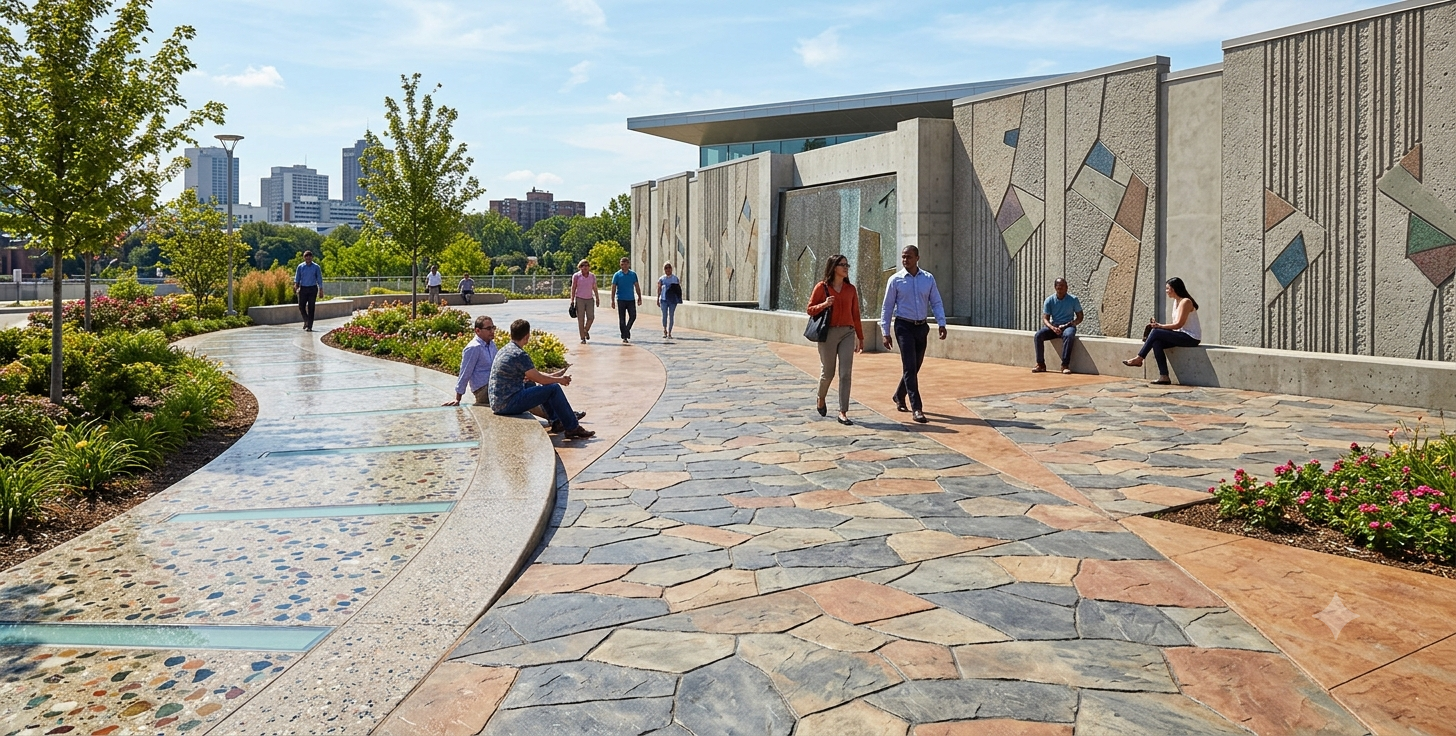
Stamped concrete represents the largest type segment globally, supported by its broad suitability for residential, commercial, hospitality, landscaping, and public-realm applications and its ability to reproduce the appearance of premium materials. Stamping technology allows contractors to create patterns resembling natural stone, brick, slate, cobblestone, wood, and other surfaces using specialized molds, pigments, release agents, stains, and sealers. The segment benefits from strong residential demand for patios, driveways, pool decks, walkways, courtyards, outdoor kitchens, and entertainment areas, while commercial and hospitality projects use stamped surfaces for entrances, pedestrian areas, restaurants, resorts, pool environments, and landscaped spaces. Regional demand patterns differ, with North America benefiting strongly from remodeling and outdoor-living investment, Europe from renovation and architectural refurbishment, Asia-Pacific from new residential and urban development, South America from housing and tourism-related construction, and the Middle East and Africa from hospitality, luxury developments, public spaces, and large-scale projects. Improvements in stamping molds, color systems, release agents, stains, sealers, and surface-protection technologies are allowing contractors to create increasingly realistic finishes. The availability of established contractor networks and application equipment also supports adoption. Stamped concrete provides designers with substantial flexibility while retaining the structural characteristics of concrete, making it suitable for projects where appearance and durability need to be balanced. Manufacturers are increasingly developing integrated systems that combine coloring, stamping, texturing, staining, and sealing technologies. This broader product ecosystem is strengthening the position of stamped concrete as the leading decorative-concrete type globally.
Floors represent the largest application segment globally, supported by the broad adoption of polished concrete, epoxy systems, stained concrete, overlays, decorative coatings, and other surface treatments across residential and non-residential buildings. Decorative concrete flooring is increasingly used in homes, offices, retail stores, restaurants, hotels, warehouses, factories, healthcare facilities, educational buildings, entertainment venues, transportation facilities, and public buildings because it can combine architectural appearance with durability and relatively low maintenance. Regional drivers vary considerably. North America benefits from commercial refurbishment, residential renovation, garages, retail, hospitality, and outdoor-to-indoor design continuity; Europe has strong renovation and modernization requirements; Asia-Pacific benefits from industrial, commercial, residential, and infrastructure development; South America is supported by commercial, industrial, housing, and hospitality construction; and the Middle East and Africa are creating demand through hotels, resorts, retail, luxury residential properties, industrial facilities, and large-scale developments. Polished concrete is gaining attention for seamless contemporary interiors, while epoxy and resin flooring systems are suited to environments requiring resistance to abrasion, chemicals, moisture, vehicles, and frequent cleaning. Overlays provide another renovation opportunity because existing concrete surfaces can be renewed without complete replacement. Manufacturers are also improving grinding, densification, surface preparation, pigmentation, coating, and curing technologies to increase installation consistency and finished-surface performance. The combination of aesthetic flexibility, durability, refurbishment potential, and suitability for high-traffic environments gives flooring the broadest application base within the global decorative-concrete industry.
Residential construction represents the largest end-use industry globally, supported by new housing, remodeling, urban expansion, multifamily development, landscaping, outdoor-living investment, and demand for customized residential surfaces. Decorative concrete is incorporated into driveways, patios, pool surrounds, walkways, courtyards, garages, outdoor entertainment areas, residential floors, walls, and architectural features. Asia-Pacific provides the largest residential construction base because of its extensive housing requirements and continuing urban development, while North America and Europe benefit substantially from renovation and refurbishment of existing housing. South America is supported by housing programs, urban construction, and residential investment, while the Middle East and Africa are creating opportunities through villa construction, housing communities, private compounds, tourism-linked residential projects, and master-planned developments. Residential remodeling provides recurring demand because homeowners can upgrade existing concrete through staining, stamping, overlays, polishing, coloring, and coatings without necessarily replacing the underlying surface. Outdoor-living trends are particularly important in markets where patios, pool areas, driveways, courtyards, and landscaped spaces form significant parts of residential properties. At the same time, polished and stained concrete are gaining relevance in contemporary interiors, while epoxy systems provide opportunities in garages, utility spaces, and high-use areas. Manufacturers are responding with broader color ranges, easier-to-apply systems, durable sealers, improved surface preparation products, and application-specific solutions. Demand for low-maintenance and visually differentiated surfaces is also encouraging homeowners and developers to consider decorative concrete as an alternative to more expensive natural materials. The combination of new housing, renovation, landscaping, and multiple residential applications gives the segment a broad and recurring customer base.
Asia-Pacific represents the largest regional market for decorative concrete, supported by its extensive construction base, urbanization, housing development, infrastructure expansion, industrial investment, commercial construction, tourism, and growing architectural use of finished concrete surfaces. China provides a major demand and manufacturing center, while India is supported by residential development, infrastructure investment, commercial construction, and urban expansion. Southeast Asian markets, including Indonesia, Vietnam, Thailand, Malaysia, and the Philippines, offer opportunities through housing, tourism, industrial facilities, mixed-use development, and urban infrastructure. Japan, South Korea, and Australia provide more mature opportunities associated with renovation, specialized flooring, building maintenance, architectural design, and higher-performance finishing systems. North America remains strongly influenced by residential remodeling, outdoor living, commercial refurbishment, and established decorative-concrete contractor networks. Europe is characterized by renovation, urban regeneration, architectural refurbishment, sustainability requirements, and demand for premium seamless finishes. South America is supported by housing construction, infrastructure, tourism, commercial development, and growing interest in resin-based and specialty flooring systems. The Middle East and Africa are increasingly influenced by hospitality, tourism, luxury residential development, infrastructure, public-realm projects, and major urban developments, with Saudi Arabia representing the largest market within the region. Across these regions, market requirements differ according to construction maturity, climate, project type, contractor expertise, and regulatory expectations. This creates opportunities for manufacturers that can localize formulations, strengthen regional production, provide technical training, and adapt decorative-concrete systems to local conditions. The global market is therefore not developing through a single demand pattern but through a combination of mature-market renovation, emerging-market urbanization, infrastructure development, hospitality investment, and increasingly sophisticated architectural requirements.













 We are friendly and approachable, give us a call.