The Global
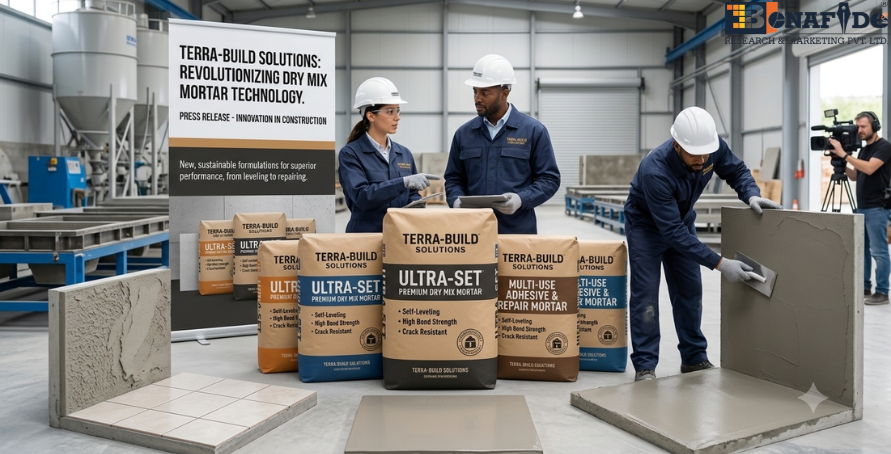
Dry Mix Mortar Market is gaining momentum as contractors, developers, building-material suppliers, and project owners increasingly move toward factory-produced construction materials that offer consistent quality and easier application. Dry mix
mortar is used across masonry, plastering, rendering, tile installation,
flooring, waterproofing, grouting, repair,
insulation, and other finishing activities, making it an important material throughout the construction process. Demand is supported by residential development, commercial construction, infrastructure projects, industrial facilities, and renovation activity across both developed and emerging economies. Asia-Pacific remains the largest regional market, supported by its large construction base and continuing urban development, while Europe has a strong renovation and building-modernization market. North America benefits from residential construction, commercial projects, and infrastructure repair, while the Middle East is supported by large-scale urban, hospitality, tourism, and mixed-use developments. South America and Africa are creating additional opportunities through housing construction and infrastructure investment. Contractors are increasingly looking for products that can be mixed and applied with less preparation at the job site, particularly where labor availability and construction schedules are major concerns. At the same time, project requirements are becoming more specific, creating demand for mortars designed for particular substrates, tile formats, climatic conditions, and installation methods. Sustainability is also becoming more relevant, with manufacturers working on lower-
cement formulations, alternative raw materials, lightweight products, reduced
packaging waste, and formulations that improve material efficiency. These changes are gradually shifting the market away from basic commodity mortar toward products that combine reliable performance, easier installation, and greater suitability for modern construction methods.
According to the research report, "Global Dry Mix Mortar Market Outlook, 2031," published by Bonafide Research, the Global Dry Mix Mortar Market Outlook was valued at more than USD 48.72 Billion in 2025, and expected to reach a market size of more than USD 65.88 Billion by 2031 with the CAGR of 5.29% from 2026-2031. Competition in the Global Dry Mix Mortar Market is becoming increasingly focused on product performance, local availability, technical support, and the ability to provide complete construction systems. International construction-chemical companies compete alongside regional producers, cement manufacturers, and smaller specialists that have strong relationships with local contractors and distributors. Raw materials remain central to the economics of the industry. Cement, lime, aggregates, mineral fillers, polymers,
cellulose ethers, chemical admixtures, fibers, pigments, packaging, and energy all influence production costs and formulation performance. Heavy materials such as cement and aggregates are generally sourced close to manufacturing facilities because transporting finished mortar over long distances is expensive. This has encouraged manufacturers to establish production plants near major construction centers and strengthen regional distribution networks. Specialty additives and polymers can be more exposed to international supply chains, making freight costs, exchange rates, energy prices, and availability important considerations for producers. Companies are responding through local sourcing, manufacturing expansion, partnerships, acquisitions, and distribution investments. The competitive landscape is also changing as suppliers increasingly offer complete systems covering primers, adhesives, grouts, waterproofing, leveling compounds, repair products, and fa?ade solutions. Technology development is supporting this shift through automated batching, improved quality control, better mixing processes, automated packaging, and more precise formulation. Manufacturers are also developing low-dust products, rapid-setting mortars, lightweight formulations, polymer-modified systems, and products suitable for mechanized application. The focus is increasingly on solving specific construction problems rather than simply supplying a basic cementitious mixture. As a result, companies with strong formulation capabilities, dependable regional production, technical service, and broad product portfolios are gaining an advantage in an increasingly specialized global market.
Tile adhesives represent the largest product segment in the Global Dry Mix Mortar Market, supported by widespread use of ceramic, porcelain, and stone finishes across residential and commercial construction. Tile adhesives are used in bathrooms, kitchens, floors, walls, balconies, fa?ades, hotels, retail properties, healthcare facilities, offices, and public buildings. Asia-Pacific provides the largest volume base because of its extensive residential and urban construction activity, while Europe and North America generate substantial demand through renovation and refurbishment. The Middle East contributes through hospitality, luxury residential, and commercial developments, while South America and Africa provide additional demand through housing and urban construction. Product requirements are becoming more demanding as large-format porcelain, natural stone, and specialized tile products become more common. These installations often require stronger adhesion, better open time, improved flexibility, controlled setting, and greater resistance to moisture and movement. This is encouraging the use of polymer-modified and application-specific adhesives. Renovation is another important source of demand, particularly for bathroom, kitchen, flooring, and commercial interior upgrades. Contractors are also increasingly interested in complete installation systems that combine primers, adhesives, grouts, waterproofing, and leveling products. Such systems can simplify procurement and reduce compatibility issues between different materials. Manufacturers are therefore competing not only on
adhesive strength but also on workability, installation speed, substrate compatibility, and technical support. The continued popularity of tiled surfaces, combined with residential construction, commercial development, renovation, and increasingly complex installation requirements, is expected to keep tile adhesives at the forefront of the global dry mix mortar market.
Tile & Stone Installation represents the largest application segment globally, supported by the extensive use of tile and stone finishes across residential buildings, commercial properties, hospitality facilities, healthcare projects, offices, and public infrastructure. Residential bathrooms, kitchens, floors, and outdoor areas create a large base of recurring demand, while hotels, restaurants, shopping centers, airports, and institutional buildings add significant commercial consumption. The application is becoming more technically demanding as architects and developers increasingly use large-format porcelain, natural stone, thin tiles, and decorative surfaces. These materials require suitable substrate preparation and adhesives that can provide reliable
bond strength, flexibility, coverage, and movement accommodation. As a result, contractors are increasingly purchasing coordinated installation systems rather than treating adhesive, grout, waterproofing, and leveling materials as completely separate products. Renovation also plays an important role because existing bathrooms, kitchens, floors, and commercial interiors require regular modernization. In mature markets, renovation can provide a relatively stable source of demand even when new construction activity becomes weaker. Climate conditions also influence product selection. Cold regions require systems that can tolerate temperature changes, while hot and humid markets place greater emphasis on workability, moisture resistance, and appropriate setting behavior. Large construction projects are also creating opportunities for mechanized mixing and application, helping contractors improve consistency and reduce preparation time. Manufacturers are responding with flexible, rapid-setting, lightweight, and high-performance products designed around particular installation requirements. The growing complexity of tile and stone work is increasing the importance of technical support and contractor training as well. With tile remaining a widely used finishing material across global construction, the application continues to represent the broadest demand base for dry mix mortar products.
Residential construction remains the largest end-user segment in the Global Dry Mix Mortar Market, supported by new housing development, urbanization, government-backed housing programs, and ongoing renovation of existing properties. Dry mix mortar is required at several stages of residential construction, including masonry, plastering, rendering, tile installation, flooring, waterproofing, grouting, and
surface finishing. Asia-Pacific contributes the largest residential construction base, particularly through China, India, and Southeast Asia, while Latin America, Africa, and the Middle East continue to offer opportunities through urban growth and housing development. Mature markets provide another source of demand through remodeling and refurbishment. Kitchens and bathrooms are regularly upgraded, flooring is replaced, fa?ades require maintenance, and waterproofing systems need renewal. These activities support mortar consumption even when new residential construction slows. Factory-produced products are particularly useful in large residential developments because contractors can use standardized materials across multiple buildings and reduce the time spent proportioning materials on site. Cost remains important in affordable housing, where economical formulations and efficient packaging are preferred, while premium residential projects create opportunities for high-performance adhesives, decorative mortars, waterproofing systems, insulation products, and specialty repair materials. Labor availability is also influencing product selection because preblended mortar can reduce manual preparation and improve consistency. At the same time, manufacturers need to adapt products to different construction methods, climates, substrates, and local standards. The combination of new housing, apartment development, government-supported construction, private residential investment, and renovation gives residential construction the widest customer base in the global dry mix mortar industry. This broad and recurring demand supports its position as the largest end-user segment.
Technology development is becoming an important competitive factor in the Global Dry Mix Mortar Market, with manufacturers focusing on automation, formulation precision, lower-dust products, lightweight systems, rapid-setting materials, and solutions designed for faster application. Modern production facilities increasingly use automated weighing, batching, mixing, and packaging to maintain consistent product quality and reduce production variability. On the formulation side, polymers and chemical admixtures are being used to improve adhesion, flexibility, water retention, workability, setting behavior, and durability. Lightweight mortars are attracting attention because they can make handling easier and reduce the physical effort required during installation, while low-dust formulations can improve working conditions at construction sites. Mechanized plastering and spraying are also creating opportunities for products specifically designed for machine application, particularly on larger residential and commercial projects. Sustainability is influencing research and development as manufacturers investigate reduced-cement formulations, supplementary materials, recycled inputs, and more efficient use of aggregates without compromising performance. Another important change is the development of application-specific systems. Instead of relying on one
general-purpose mortar, contractors can increasingly select products designed for large-format tiles, difficult substrates, fa?ade insulation, waterproofing, rapid repair, flooring, or specialized construction conditions.
Digital product information and improved technical guidance are also helping contractors select and apply products more accurately. These developments are gradually changing the competitive basis of the industry. Manufacturing scale remains important, but companies increasingly need formulation expertise, application knowledge, reliable technical support, and the ability to adapt products to local construction practices. Technology is therefore supporting both product differentiation and improved construction productivity.
Asia-Pacific leads the Global Dry Mix Mortar Market, supported by its large construction industry, extensive housing requirements, rapid urbanization, infrastructure development, and strong regional manufacturing base. China represents a major production and consumption center, while India is becoming increasingly important as residential, commercial, industrial, and infrastructure construction expands. Southeast Asian countries, including Indonesia, Vietnam, Thailand, Malaysia, and the Philippines, are adding demand through urban development, manufacturing investment, tourism, and transport projects. Japan, South Korea, and Australia have more mature markets, where renovation, repair, building performance, and specialized products are increasingly important. The regional market is highly diverse, with volume-driven construction dominating many emerging economies while developed markets place greater emphasis on product performance, durability, and refurbishment. Asia-Pacific also has a strong supply-side advantage because cement, aggregates, mineral fillers, additives, packaging materials, and
construction equipment are widely available across major manufacturing economies. This allows producers to establish plants close to important construction markets and reduce the cost of transporting heavy finished products over long distances. Demand is also moving beyond traditional masonry and plastering toward tile adhesives, flooring compounds, waterproofing systems, repair mortars, insulation products, and other specialty solutions. Large contractors are increasingly seeking factory-produced materials that provide consistent quality and reduce preparation work at the site. Manufacturers are responding by investing in automated production, polymer-modified formulations, lightweight products, rapid-setting systems, and improved application technology. Environmental considerations are also becoming more relevant, although the pace differs substantially between individual countries. Asia-Pacific's combination of construction scale, housing demand, infrastructure investment, manufacturing capacity, and continuing urbanization gives the region a clear leading position and makes it the most important growth engine for the global dry mix mortar industry.










 We are friendly and approachable, give us a call.