The global edible films and coatings market is witnessing increasing development as food manufacturers, processors, and fresh-produce suppliers seek technologies that can improve food quality, extend marketable shelf life, and reduce deterioration across storage and distribution. Edible films and coatings are increasingly being evaluated as
functional food-preservation systems capable of controlling moisture transfer, oxidation, respiration, microbial deterioration, and
surface quality. Their application is particularly important for highly perishable products such as fruits and vegetables, fresh-cut produce,
meat,
poultry, and
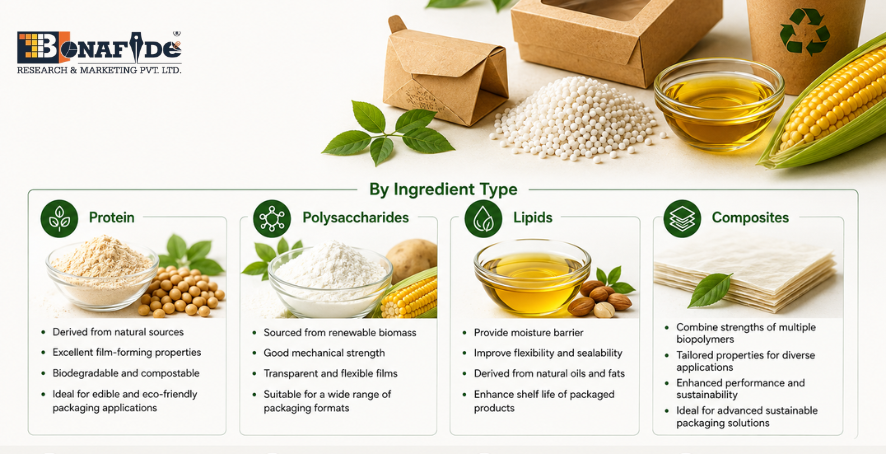
seafood, where quality can decline rapidly between harvesting or processing and final consumption. The market is also expanding into dairy, bakery, confectionery, and other processed-food applications as formulation technologies improve. Research and product development are increasingly focusing on polysaccharides, proteins, lipids, and
composite materials, while natural extracts, essential oils,
antioxidants, and antimicrobial compounds are being incorporated to provide additional preservation functionality. This transition is moving edible films and coatings beyond basic surface protection toward multifunctional systems designed around the specific preservation requirements of individual foods.
According to the research report "Global Edible Films and Coating Market Outlook, 2031," published by Bonafide Research, the Global Edible Films and Coating Market was valued at more than USD 4.52 Billion in 2025 and is anticipated to reach more than USD 6.27 Billion by 2031, expanding at a CAGR of 5.74% during 2026–2031. Regional market dynamics are shaping the development of the global edible films and coatings industry. Asia-Pacific represents the largest regional market, supported by its extensive agricultural production, large food-processing ecosystem, high volume of fresh and minimally processed foods, and strong research activity in food-preservation technologies. China, India, Japan, South Korea, Australia, Thailand, Vietnam, and Indonesia provide significant opportunities across fruits and vegetables, seafood, meat, dairy, bakery, and processed foods. North America maintains an important position through advanced food-processing infrastructure, established research capabilities, and increasing development of active and functional coating technologies. Europe is progressing through research into bio-based materials, sustainable food systems,
advanced packaging, and high-value food applications. South America benefits from its large fruit and agricultural production and export-oriented supply chains, while the Middle East is developing around dates, imported perishables, food-security requirements, and high-temperature storage conditions. Africa provides additional opportunities through post-harvest-loss reduction and agricultural modernization. These regional differences are encouraging manufacturers and researchers to develop commodity-specific coating formulations adapted to local climatic, processing, and distribution conditions.
The global market outlook is increasingly influenced by advances in composite, active, nano-enabled, and intelligent edible coating technologies. Composite formulations combining proteins, polysaccharides, and lipids are being developed to overcome the limitations of individual materials and provide improved mechanical strength, flexibility, moisture resistance,
oxygen-barrier properties, and coating stability. Active coatings are incorporating
plant extracts, essential oils, antioxidants, antimicrobial compounds, and other bioactive ingredients to provide targeted preservation functions. Research is also moving toward nanocellulose, nano-composites, controlled-release systems, multilayer structures, and advanced application methods to improve the performance and consistency of edible coatings. At the same time, agricultural and food-processing by-products are being investigated as sources of
starch,
cellulose, pectin, proteins, and other functional materials, creating opportunities for greater utilization of underused resources. These developments are increasing the technological scope of the market and creating new applications across fresh produce, protein foods, dairy, bakery, and minimally processed products. (sciencedirect.com)
The commercial outlook remains positive, although future market development will depend on overcoming several technical and operational barriers. Manufacturers need to improve moisture resistance, mechanical strength, coating uniformity, sensory compatibility, industrial-scale production, and integration with existing food-processing lines. Formulations that perform successfully under laboratory conditions must increasingly demonstrate consistent results during actual transportation, cold-chain storage, retail handling, and extended distribution. Regulatory requirements for novel active ingredients and advanced materials will also influence commercialization across international markets. Cost competitiveness will remain important, particularly where conventional
packaging and preservation systems are already well established. As a result, the next phase of market development is expected to focus on commercially scalable, application-specific, multifunctional, and performance-validated edible films and coatings rather than simply introducing new bio-based materials. The strongest opportunities are likely to emerge where coatings can demonstrate measurable improvements in food quality, reduction in product losses, preservation efficiency, and compatibility with existing supply-chain infrastructure.
Asia-Pacific is expected to maintain its position as the largest regional market, supported by its substantial agricultural production, expanding food-processing industries, large consumer base, and growing demand for fresh, convenience, and minimally processed foods. China and India remain major contributors, while Southeast Asian economies provide strong opportunities through tropical fruits, seafood, and other perishable products. The region's availability of starch, cellulose, chitosan,
seaweed-derived materials, plant proteins, and agricultural residues provides a broad raw-material
foundation for edible-film development. Continued research into composite coatings, active preservation systems, natural bioactive ingredients, and advanced application technologies is expected to strengthen the region's technological position. Meanwhile, North America and Europe are likely to remain important for higher-value and advanced functional applications, South America for export-oriented fresh produce, and the Middle East for dates, imported perishables, and food-security-related applications. Overall, the global market is moving toward higher-performance edible preservation systems that combine food quality protection, functional activity, material efficiency, and commercial scalability.

















 We are friendly and approachable, give us a call.