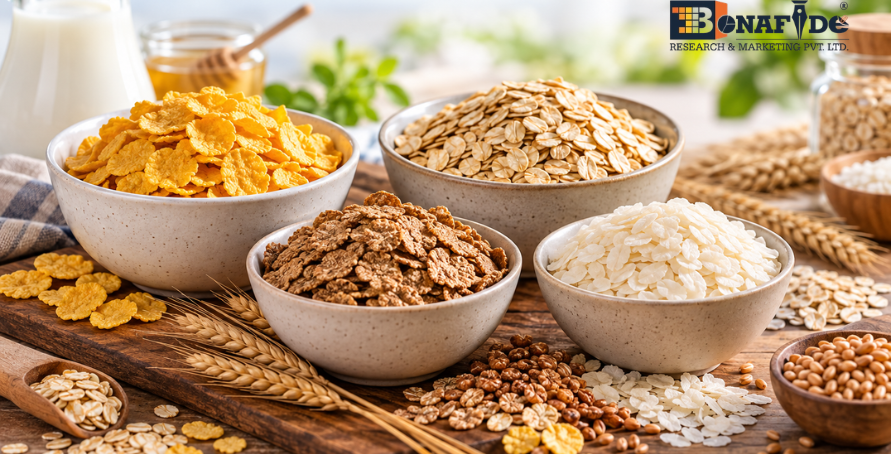
The global edible flakes market is witnessing steady development as changing breakfast habits, increasing demand for convenient food products, and growing consumer interest in grain-based nutrition reshape the packaged-food industry. Edible flakes include a broad range of grain-based products such as corn flakes,
rice flakes, wheat flakes, oat flakes, and other multigrain formulations. These products are increasingly positioned as convenient breakfast solutions that can be consumed with
milk,
yogurt, fruits, nuts,
seeds, and other complementary ingredients. The category is also benefiting from wider product availability across supermarkets, hypermarkets, convenience stores, specialty food retailers, and
online grocery platforms.
According to the research report "Global Edible Flakes Market Outlook, 2031," published by Bonafide Research, the Global Edible Flakes Market was valued at more than USD 29.57 Billion in 2025 and is anticipated to reach more than USD 39.94 Billion by 2031, expanding at a CAGR of 5.27% during 2026–2031. Consumer preferences are increasingly moving toward breakfast products that combine convenience with nutritional value, encouraging manufacturers to improve the formulation and positioning of edible flakes. Whole-grain ingredients, fibre, reduced-sugar formulations, fortification, organic ingredients, and multigrain combinations are becoming important areas of product development. At the same time, manufacturers are introducing a wider range of flavours and formats, including fruit, chocolate,
honey,
vanilla, nut, and other combinations, to attract consumers seeking greater variety. The expansion of these products beyond traditional breakfast occasions is also creating opportunities for manufacturers to position flakes as convenient snack and meal components.
By product type, Corn Flakes represent the largest category within the global edible flakes market, supported by their established consumer familiarity, broad retail presence, and long-standing position within the breakfast cereal category. Corn flakes can be consumed across different age groups and are commonly combined with milk, yogurt, fruits, nuts, and other breakfast ingredients. Manufacturers are also expanding the category through whole-grain, fortified, reduced-sugar, multigrain, organic, and flavoured formulations. The established production and distribution infrastructure for corn-based cereal products further supports their availability across mainstream grocery channels and provides manufacturers with opportunities to introduce differentiated variants while retaining the familiar flakes format.
By nature, Organic products represent the fastest-growing category as consumers increasingly pay attention to ingredient sourcing, natural food choices, clean-label positioning, and perceived product quality. Organic edible flakes are being developed using ingredients such as corn,
oats, wheat, rice, and other grains, allowing manufacturers to target consumers seeking alternatives to conventional cereal products. The category is also benefiting from the broader integration of health-oriented characteristics such as whole grains, fibre, reduced sugar, and minimal processing claims. Increasing availability of organic products through supermarkets, specialty retailers, health-food stores, and
e-commerce platforms is helping manufacturers reach consumers who actively search for products aligned with specific dietary and lifestyle preferences.
By distribution channel, Online Retail Stores represent the fastest-growing channel as consumers increasingly use
digital platforms to discover and purchase packaged breakfast products. Online grocery platforms provide access to a broader assortment of edible flakes, including organic, premium, imported, flavoured, fortified, and specialized products that may have more limited availability through traditional retail outlets. Consumers can compare ingredients, nutritional information, flavours, pack sizes, brands, and product reviews before making purchasing decisions. Digital channels are also providing smaller and emerging manufacturers with opportunities to reach targeted consumer groups, while subscription purchasing and direct-to-consumer models can support repeat consumption of frequently purchased breakfast products.
By flavor, Flavored products represent the fastest-growing category as manufacturers increasingly use flavour innovation to differentiate edible flakes and attract consumers looking for more variety in breakfast choices. Chocolate, honey, fruit, vanilla, nuts,
dried fruits,
cinnamon, and other flavour combinations are being incorporated into cereal formulations to appeal to children, families, younger consumers, and consumers seeking more indulgent breakfast experiences. Flavour development is increasingly being combined with nutritional positioning, allowing manufacturers to introduce products that incorporate whole grains, fibre, fortification, organic ingredients, or reduced-sugar formulations alongside differentiated taste profiles. Regional flavour preferences are also creating opportunities for localized product development.
Regional market dynamics continue to influence the global competitive landscape. North America represents a major regional market, supported by its developed packaged-food industry, established breakfast cereal consumption, advanced retail infrastructure, and strong presence of leading cereal manufacturers. Europe maintains a mature market supported by established breakfast cereal consumption, consumer interest in whole grains and fibre, product reformulation, and developed supermarket and hypermarket networks. Asia Pacific represents the fastest-growing regional market, supported by changing breakfast habits, rapid urbanization, expanding packaged-food consumption, increasing health awareness, and the development of organized retail and e-commerce. Traditional consumption of cereal-based foods, particularly rice and other grains, also provides manufacturers with opportunities to develop products adapted to local dietary preferences.
South America provides additional opportunities for edible flakes manufacturers as packaged breakfast consumption expands and modern retail networks develop. Brazil represents the largest country market in the region, supported by its large consumer base, established food-processing sector, broad supermarket and hypermarket network, and availability of grain-based food products. The Middle East & Africa market is developing through urbanization, expanding packaged-food consumption, modern grocery infrastructure, and increasing demand for convenient breakfast solutions. Saudi Arabia represents the largest country market in the region, supported by its developed modern retail sector, urban consumer base, and increasing availability of packaged cereal and grain-based products.
The supply landscape is supported by a wide range of cereal grains and food ingredients, including maize, rice, wheat, oats, millet,
barley, pulses, fruits, nuts, seeds,
sweeteners, fibres, and fortification ingredients. Raw-material quality, availability, processing characteristics, ingredient consistency, and supply-chain reliability remain important considerations for manufacturers. Flaking technology, drying, roasting, extrusion, flavour coating, fortification, and
packaging processes are increasingly important for maintaining product texture, taste, shelf stability, and nutritional characteristics. Manufacturers are also focusing on packaging formats that protect flakes from moisture and physical damage while improving convenience for consumers.
The competitive landscape is characterized by product innovation, flavour diversification, nutritional reformulation, organic product development, premiumization, and expansion across modern retail and digital distribution channels. Leading manufacturers are introducing new cereal combinations, limited-edition flavours, protein-oriented products, whole-grain formulations, fortified products, and reduced-sugar alternatives to respond to evolving consumer preferences. Companies are also expanding their product portfolios across different price points and pack formats, enabling edible flakes to reach mainstream households as well as consumers seeking specialized and premium breakfast options. Continued innovation in ingredients, processing, flavours, packaging, and distribution is expected to remain important for strengthening competitiveness in the global edible flakes market.


















 We are friendly and approachable, give us a call.