The Global
Standing Desk Market represents a growing segment within the broader
office furniture, ergonomic workplace, home-office, commercial infrastructure, and smart workspace ecosystem. Standing desks are designed to provide adjustable work surfaces that allow users to alternate between sitting and standing positions, supporting flexible working patterns across residential, commercial, industrial, educational, healthcare, and other professional environments. The market is supported by increasing awareness of workplace ergonomics, prolonged computer-based work, hybrid and remote working models,
corporate wellness initiatives, and modernization of office environments. Standing desks are increasingly being adopted by businesses and consumers seeking workstations that combine ergonomic functionality, productivity, flexibility, and contemporary design. The availability of electric, fixed, manual, and other standing desk configurations through
e-commerce platforms, brand websites, specialty
furniture stores, supermarkets, office-furniture dealers, and other distribution channels is improving accessibility across developed and emerging markets. Workplace guidance also increasingly recognizes the value of adjustable workstations, with the U.S. Occupational Safety and Health Administration identifying adjustable-height work surfaces as desirable for accommodating users and supporting changes in working posture.
According to the research report, "Global Standing Desk Market Outlook, 2031," published by Bonafide Research, the Global Standing Desk Market Outlook was valued at more than USD 8.32 Billion in 2025, and expected to reach a market size of more than USD 11.37 Billion by 2031 with the CAGR of 5.48% from 2026-2031.
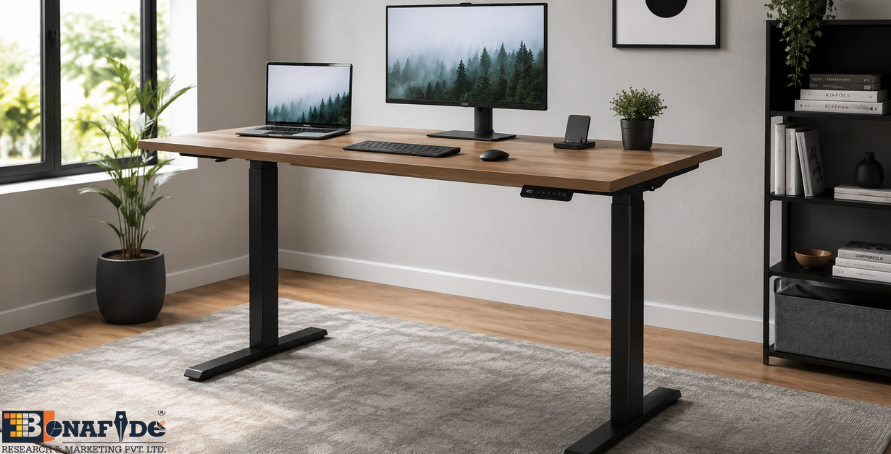
Electric standing desks include motorized height-adjustable workstations designed to provide convenient transitions between sitting and standing positions. The segment benefits from broad adoption across commercial offices, home offices, coworking spaces, professional work environments, and other applications where users require frequent workstation adjustments. Manufacturers are increasingly developing dual-
motor systems, programmable memory presets, anti-collision technology, improved lifting stability, quieter motors, integrated
cable management, USB charging,
wireless charging, and smart controls. Electric desks are also becoming more accessible across different price points, allowing manufacturers to address both residential consumers and corporate procurement programs. The combination of convenience, precise adjustment, technological integration, and growing ergonomic awareness supports electric standing desks as both the largest and fastest-growing product type segment.
Commercial users represent the largest end-user segment as businesses increasingly invest in ergonomic workstations, flexible office environments, employee wellbeing, and modern workplace infrastructure. Companies across technology, financial services, professional services,
telecommunications, education, healthcare administration, and other sectors are increasingly incorporating height-adjustable desks into office modernization programs. Standing desks can support shared workstations, activity-based working, flexible seating arrangements, hybrid workplaces, and employee-specific workstation configurations. The continued evolution of office design is also encouraging organizations to combine standing desks with ergonomic seating, monitor arms, storage systems, collaboration areas, and smart-office technologies. Commercial demand is therefore supported by both new office construction and the replacement or modernization of conventional fixed-height workstations.
Wood is the largest and fastest-growing material segment in the Global Standing Desk Market because wood and wood-based desktops provide durability, aesthetic appeal, design flexibility, and compatibility with residential and commercial interiors. Wooden surfaces can be offered in different grains, finishes, colors, thicknesses, and configurations, enabling manufacturers to target a broad range of consumers and price categories. The material is particularly attractive to users seeking standing desks that resemble conventional furniture rather than purely functional office equipment. Manufacturers are increasingly combining wooden desktops with electric lifting systems, minimalist metal frames, integrated cable management, and premium finishes. The growing interest in sustainable furniture is also encouraging the use of responsibly sourced timber and other wood-based materials, creating opportunities for manufacturers to differentiate products through material quality, durability, design, and sustainability.
Medium-priced standing desks provide a balance between affordability, ergonomic functionality, construction quality, and advanced features, making the segment the largest price range within the Global Standing Desk Market. These products generally provide reliable height adjustment, stable frames, appropriate load capacities, and features such as programmable controls, memory presets, and cable-management systems without the higher investment associated with premium workstation solutions. The segment is particularly relevant to residential users, small businesses, educational institutions, and organizations seeking to equip larger numbers of employees while maintaining manageable furniture budgets. Manufacturers are increasingly improving motor performance, desktop materials, frame stability, and ergonomic functionality within this price range, allowing medium-priced standing desks to address a broad customer base. Business opportunities exist in competitively priced electric desks, home-office models, corporate workstation packages, and bundled ergonomic solutions.
Specialty stores remain the largest distribution channel in the Global Standing Desk Market because consumers and businesses often require product demonstrations, ergonomic guidance, workstation configuration assistance, installation support, and professional consultation before purchasing adjustable furniture. Standing desks involve several considerations, including height range, lifting capacity, frame stability, desktop dimensions, motor configuration, adjustment speed, control functionality, and compatibility with accessories. Specialty retailers allow customers to physically evaluate these characteristics and compare different configurations before purchase. The channel also enables retailers to offer complementary ergonomic products such as office chairs, monitor arms, storage systems,
lighting, power accessories, and other workstation components. While e-commerce and brand websites continue to expand through detailed specifications, reviews, customization options, and convenient delivery, specialty stores remain important for consumers and commercial buyers seeking complete ergonomic workstation solutions.

















 We are friendly and approachable, give us a call.