The global
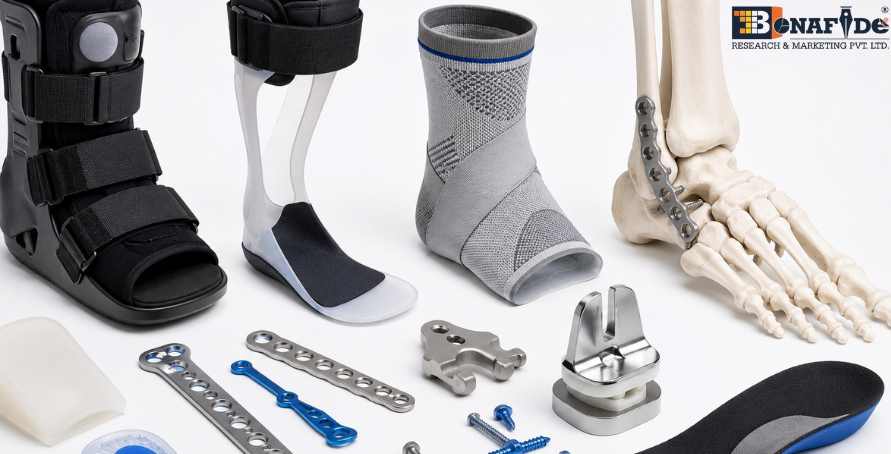
foot and ankle devices market refers to the industry focused on developing, manufacturing, and supplying medical devices used for the diagnosis, treatment, stabilization, and reconstruction of conditions affecting the foot and ankle. These devices include orthopedic implants and fixation systems,
soft tissue repair products, braces, supports, biologic materials, and advanced surgical solutions designed to restore mobility and improve patient outcomes. The market plays an important role in orthopedic healthcare because the foot and ankle are critical structures responsible for balance, weight-
bearing, and movement, and injuries or disorders in these areas can significantly affect quality of life. Growth of this market is supported by several clinical factors, including increasing cases of sports-related injuries, road traffic accidents, fractures, arthritis, deformities, and diabetic foot complications that require specialized treatment. The rising prevalence of diabetes worldwide has increased attention toward diabetic foot management, including
wound care, reconstruction, and limb preservation procedures. Technological advancements such as minimally invasive surgical techniques, patient-specific implants, three-dimensional printing, improved fixation systems, and biologic tissue repair solutions are also transforming treatment approaches. Organizations such as the American Orthopaedic Foot & Ankle Society and other regional orthopedic associations contribute to the advancement of foot and ankle care through clinical education, research initiatives, surgeon training, and development of treatment guidelines. Activities within the market include research and development of innovative implants, clinical evaluation of new surgical techniques, collaboration between orthopedic surgeons and
medical device manufacturers, and expansion of specialized orthopedic services across hospitals and ambulatory surgery centers. Healthcare providers increasingly focus on restoring function, reducing recovery time, and improving long-term mobility, which has encouraged adoption of advanced foot and ankle technologies.
According to the research report "Global Foot and Ankle Devices Market Outlook, 2031," published by Bonafide Research, the Global Foot and Ankle Devices Market was valued at more than USD 5.42 Billion in 2025, and expected to reach a market size of more than USD 8.09 Billion by 2031 with the CAGR of 7.09% from 2026-2031. The market includes products such as orthopedic implants, fixation systems, biologics, braces, and specialized
surgical devices designed to restore mobility and improve patient outcomes. Key companies operating in this space include Stryker, Zimmer Biomet, Smith+Nephew, Wright Medical Group, and Arthrex, which focus on developing advanced implants, minimally invasive instruments, and biologic solutions for foot and ankle procedures. Companies are increasingly investing in technologies such as patient-specific implants, three-dimensional printing, improved locking fixation systems, and regenerative materials to address complex orthopedic conditions. For example, manufacturers have expanded their portfolios with anatomically designed plates, specialized screws, and soft tissue repair systems that support better surgical precision and recovery. Opportunities within the market are emerging from the rising incidence of sports injuries, trauma cases, diabetes-related foot complications, and an aging population requiring treatment for degenerative joint conditions. The supply chain involves multiple stages, including raw material suppliers providing titanium,
stainless steel, polymers, and biologic materials; medical device manufacturers responsible for product development and production; regulatory authorities overseeing safety approvals; distributors supplying hospitals and ambulatory surgery centers; and healthcare professionals performing procedures. Companies are also strengthening direct distribution networks and partnerships with hospitals to improve availability of specialized orthopedic devices. Increasing collaboration between surgeons, research institutions, and manufacturers is encouraging innovation in surgical techniques and implant designs. As demand grows for functional restoration and personalized orthopedic care, the foot and ankle devices market continues evolving through technological advancements, strategic company developments, and improved supply chain efficiency.
Soft tissue and biologic products have gained importance in foot and ankle care due to the increasing need for treatments that support biological repair rather than relying only on mechanical fixation. Foot and ankle disorders frequently involve complex soft tissue structures, including tendons, ligaments, fascia, and cartilage, which play a major role in maintaining stability and movement. Traditional surgical approaches often focus on repairing structural damage with implants; however, biologic materials such as platelet-rich plasma, bone graft substitutes, collagen-based scaffolds, and tissue regeneration products are being incorporated to enhance healing and improve functional recovery. These products are particularly relevant in Achilles tendon injuries, ligament reconstruction, chronic wounds, cartilage damage, and complex trauma cases. The growing number of sports injuries has increased demand for therapies that help athletes recover mobility and return to activity more efficiently. In addition, the rising prevalence of diabetic foot ulcers has encouraged the use of
advanced wound care biologics that support tissue regeneration and reduce complications. Companies such as Arthrex, Smith+Nephew, and Zimmer Biomet have expanded their orthopedic portfolios by developing soft tissue repair systems, biologic augmentation products, and regenerative solutions designed for foot and ankle procedures. Improvements in biomaterial science, better understanding of cellular healing mechanisms, and increasing acceptance among orthopedic specialists are further strengthening the role of soft tissue and biologics in modern foot and ankle treatment approaches.
Soft tissue repair has become an essential procedure category within foot and ankle surgery due to the critical role of tendons and ligaments in maintaining balance, stability, and movement. Conditions such as Achilles tendon ruptures, ankle instability, peroneal tendon disorders, and sports-related ligament injuries frequently require surgical repair to prevent long-term disability. The growing participation in athletic activities, recreational
fitness programs, and competitive sports has contributed to higher numbers of soft tissue injuries requiring advanced repair techniques. Unlike procedures focused only on bone correction, soft tissue repair addresses functional restoration by reconstructing damaged biological structures responsible for joint movement. Modern surgical methods increasingly use suture anchors, minimally invasive repair instruments, biological augmentation materials, and arthroscopic techniques to improve precision and reduce recovery time. Healthcare providers are adopting these procedures because they can help patients regain stability while minimizing disruption to surrounding tissues. Advancements by companies such as Arthrex, which develops specialized
sports medicine and soft tissue repair technologies, have supported the wider adoption of advanced repair techniques among orthopedic surgeons. Additionally, improvements in imaging technologies have enhanced diagnosis of tendon and ligament injuries, allowing earlier intervention.
Diabetic foot complications represent one of the most challenging application areas in foot and ankle healthcare because diabetes can cause nerve damage, reduced blood circulation, delayed wound healing, and increased risk of severe infections. Patients with diabetic neuropathy may lose sensation in their feet, making it difficult to detect injuries at an early stage and increasing the likelihood of ulcers and tissue damage. Advanced foot and ankle devices are increasingly used to support wound closure, protect vulnerable areas, stabilize damaged structures, and prevent progression toward amputation. Treatment approaches involve specialized wound care products, offloading devices, fixation systems, biologic therapies, and reconstructive procedures that help maintain foot function. The growing need for multidisciplinary diabetic foot management has encouraged collaboration among orthopedic surgeons, podiatrists, vascular specialists, and wound care professionals. Healthcare systems are also placing greater emphasis on early diagnosis and preventive management because untreated diabetic foot conditions can result in serious complications requiring extensive medical intervention. Companies involved in wound care and orthopedic solutions are developing products that combine biological healing support with mechanical protection to address the complex needs of diabetic patients. Improvements in advanced dressings, regenerative materials, and limb salvage techniques are creating new possibilities for managing diabetic foot disorders.
Ambulatory surgery centres have become increasingly important in foot and ankle care as healthcare providers seek treatment environments that improve efficiency while maintaining high standards of surgical quality. Many foot and ankle procedures, including arthroscopic repairs, tendon treatments, fracture fixation, and certain reconstructive surgeries, can now be performed without prolonged hospital stays due to advancements in anesthesia techniques, surgical instruments, and postoperative care protocols. These centres offer advantages such as shorter patient waiting times, streamlined workflows, and reduced pressure on hospital operating rooms. The increasing adoption of minimally invasive surgical approaches has supported the transition of suitable procedures from traditional hospitals to specialized outpatient facilities. Ambulatory surgery centres are also investing in advanced orthopedic equipment, sterilization systems, imaging technologies, and trained surgical teams to handle complex procedures safely. Device manufacturers are adapting their products to meet the requirements of these facilities by developing efficient instruments, compact systems, and procedure-specific solutions. Companies such as Stryker, Smith+Nephew, and Arthrex provide technologies widely used across outpatient orthopedic settings. The growing preference among patients for convenient healthcare experiences, combined with healthcare providers’ focus on operational efficiency, has encouraged greater utilization of ambulatory surgery centres for foot and ankle treatments.
Three-dimensional printing has transformed the approach to designing and manufacturing orthopedic devices by allowing engineers and surgeons to create solutions based on individual patient anatomy. Foot and ankle structures vary significantly between individuals, and complex deformities or trauma cases often require highly customized treatment strategies.
3D printing enables the production of patient-specific implants, reconstruction models, and surgical guides that improve procedural planning and accuracy. Surgeons can use
digital imaging data to evaluate bone structures before surgery, simulate procedures, and select designs that better match patient requirements. This technology is particularly valuable in complex cases involving severe deformities, revision surgeries, congenital abnormalities, and extensive bone loss. Medical device companies and research institutions are increasingly exploring additive manufacturing methods using materials such as titanium alloys and advanced polymers suitable for orthopedic applications. Organizations including Stryker and Zimmer Biomet have incorporated
digital manufacturing capabilities into their broader orthopedic innovation strategies. Beyond customization, 3D printing can support faster prototyping and more flexible design processes compared with traditional manufacturing approaches. The technology also encourages collaboration between surgeons, engineers, and biomedical researchers to develop improved orthopedic solutions.





 We are friendly and approachable, give us a call.