The Global
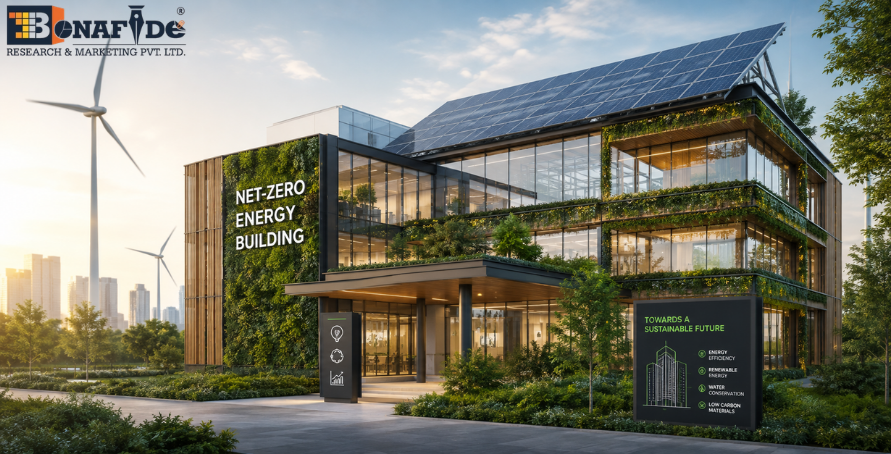
Net-Zero Energy Buildings Market is gaining momentum as governments, developers, building owners, architects, and investors increasingly focus on reducing building energy consumption and achieving measurable operational performance. Net-zero energy buildings combine demand reduction, high-performance envelopes, efficient heating and cooling, advanced
lighting,
renewable energy generation, energy storage, and intelligent building controls to balance annual energy use with renewable energy production. Demand is being supported by tightening building-performance regulations, national decarbonization strategies, green-building
certification programmes, corporate climate commitments, and growing attention to lifecycle operating costs. New construction provides a strong opportunity because building orientation,
insulation, glazing, HVAC capacity, renewable generation, and energy-management systems can be coordinated from the design stage. Existing buildings are also becoming an important opportunity as governments and property owners pursue deep renovations, electrification, energy upgrades, and performance improvements. Asia-Pacific represents the largest regional market, supported by extensive urban development, large construction pipelines, manufacturing capacity, and expanding energy-efficiency programmes across China, Japan, India, South Korea, Australia, and Southeast Asia. Europe is being shaped by ambitious building-renovation and zero-emission building policies, while North America benefits from federal, state, provincial, utility, and municipal efficiency initiatives. South America is developing through energy-labelling programmes, renewable-energy deployment, and green-building activity, while the Middle East and Africa are creating opportunities through large-scale urban developments, green-building requirements, solar integration, and climate-adapted cooling solutions. Across regions, demand is shifting from individual efficiency products toward integrated building systems capable of coordinating HVAC, renewable generation, storage, lighting, ventilation, and controls. Increasing adoption of
heat pumps,
solar PV, batteries, smart meters, building-management platforms,
digital twins, and AI-based optimisation is further expanding the technology landscape. At the same time, developers are placing greater emphasis on measurable performance, indoor environmental quality, operational resilience, and lower lifecycle costs.
According to the research report, "Global Net-Zero Energy Buildings Market Outlook, 2031," published by Bonafide Research, the Global Net-Zero Energy Buildings Market Outlook was valued at more than USD 51.40 Billion in 2025, and expected to reach a market size of more than USD 138.14 Billion by 2031 with the CAGR of 18.38% from 2026-2031. The Global Net-Zero Energy Buildings Market is being shaped by the convergence of building efficiency, electrification, distributed energy, digitalisation, and evolving construction practices. Competition is increasingly moving beyond individual HVAC, solar, or control products toward integrated solutions capable of delivering measurable building performance. Major participants include Johnson Controls, Siemens, Schneider Electric, Honeywell, Trane Technologies, Carrier, Daikin, Mitsubishi Electric, Saint-Gobain, Kingspan, ROCKWOOL, and other regional technology and building-material suppliers. Companies are expanding capabilities through digital building platforms, connected equipment, energy-management software, high-efficiency HVAC, heat pumps, building-envelope technologies, renewable integration, and energy-service models. Partnerships and technology collaborations are also becoming important as suppliers combine building automation,
artificial intelligence, renewable generation, energy storage, and engineering expertise. Notable industry developments include Trane Technologies' acquisition of BrainBox AI, which strengthened its capabilities in AI-based building optimisation, while companies across the building-technology sector continue developing platforms that connect building equipment with analytics and automated controls. Raw materials and components remain important to project economics.
Cement, steel, glass, insulation materials, aluminium,
copper, polymers, refrigerants,
electronic components, solar cells, batteries, and power-management equipment are used across different net-zero building systems. Solar modules, batteries, electronics, and selected HVAC components have highly internationalised supply chains, while bulky construction materials such as concrete, aggregates, insulation, and structural products are generally produced closer to end markets. Trade flows can therefore influence equipment availability, project schedules, and installed costs. Technology development is advancing across cold- and hot-climate heat pumps, high-performance glazing, low-carbon insulation, heat-recovery ventilation, smart inverters, building-integrated photovoltaics, energy storage, automated demand response, digital twins, and AI-enabled building-management systems. The competitive advantage is increasingly shifting toward suppliers that can combine hardware, software, engineering, commissioning, maintenance, and long-term performance optimisation.
New Construction represents the largest project type segment globally, supported by the ability to incorporate energy-efficient architecture, advanced mechanical systems, renewable generation, and digital controls from the earliest design stage. Developers can optimise building orientation, fa?ade performance, glazing, insulation, ventilation, HVAC capacity, lighting, solar generation, and storage as an integrated system without the structural limitations commonly encountered during renovation. Building-energy modelling and simulation tools allow design teams to evaluate different configurations before construction, helping reduce energy demand and determine the appropriate renewable-generation capacity. Growing urbanisation across emerging economies continues to generate substantial volumes of new residential, commercial, institutional, and mixed-use development where net-zero principles can be incorporated from the outset. Increasingly stringent energy-performance requirements are also encouraging developers to consider electrification, renewable integration, and efficient building systems during initial planning rather than as later upgrades. Prefabricated fa?ade elements, modular mechanical systems, and standardised energy packages can further improve installation consistency and reduce construction complexity. In addition, green financing and sustainability requirements from institutional investors are increasing the importance of documented energy performance in new projects. Developers can also avoid some of the disruption associated with deep retrofits by incorporating high-performance systems before occupancy. The combination of design flexibility, technological integration, construction efficiency, and regulatory alignment supports the leading position of new construction within the global net-zero energy buildings market.
Non-Residential Buildings represent the fastest-growing building type segment as commercial, institutional, hospitality, healthcare, educational, and public-sector property owners increasingly prioritise measurable energy performance and operating efficiency. These assets often contain complex mechanical systems, long operating hours, substantial lighting requirements, and significant internal heat loads, creating considerable opportunities for optimisation. Building owners are deploying advanced HVAC, heat recovery, automated lighting, occupancy-based controls, smart ventilation, energy-management systems, and on-site renewable generation to reduce energy consumption and operating costs. Large property portfolios provide an additional advantage because owners can replicate successful energy strategies across multiple facilities and centralise performance monitoring. Corporate sustainability reporting and climate commitments are also increasing demand for measurable building-level energy and emissions data. Hotels, hospitals, universities, offices, retail centres, and public facilities are particularly suited to integrated solutions because their energy consumption can be monitored continuously and optimised according to occupancy and operating schedules. Performance-based contracting and energy-as-a-service models can further reduce the initial financial burden for property owners while linking supplier revenues to measured outcomes. Digital platforms are increasingly being used to identify equipment inefficiencies, automate operating schedules, and compare actual performance against energy models. As commercial and institutional owners move beyond basic efficiency upgrades toward continuous performance management, the non-residential segment is positioned for accelerated adoption of integrated net-zero technologies and services.
Equipment remains the largest component segment because physical systems responsible for reducing energy consumption and supplying renewable power account for a substantial portion of investment in net-zero building projects.
HVAC equipment, heat pumps, chillers, ventilation systems, solar PV, batteries, lighting equipment, smart meters, inverters, sensors, and control hardware form the technological
foundation of high-performance buildings. Heating and cooling systems are particularly important because space conditioning can represent a significant portion of building energy demand depending on climate, occupancy, and building type. High-efficiency heat pumps, variable-speed equipment, energy-recovery ventilation, efficient chillers, and advanced controls can substantially reduce energy requirements before renewable generation is added. Solar PV then provides renewable electricity to offset remaining consumption, while
battery systems can improve the utilisation of locally generated power and provide greater flexibility during periods of high demand. Equipment manufacturers are also increasingly embedding connectivity and sensors into their products, allowing individual systems to communicate with building-management platforms. Developments in refrigerant technology,
inverter-driven equipment, heat recovery, thermal storage,
power electronics, and intelligent controls are broadening the available technology base. Equipment also generates recurring opportunities through maintenance, replacement, upgrades, remote diagnostics, and performance optimisation. The increasing integration of physical equipment with software and energy services is strengthening the role of equipment suppliers as long-term technology partners rather than one-time product vendors.
Asia-Pacific represents the largest regional market for net-zero energy buildings, supported by extensive urbanisation, large-scale construction activity, strong manufacturing capabilities, and expanding government programmes focused on building efficiency and decarbonisation. China provides a major centre for both deployment and manufacturing, supported by green-building policies, ultra-low-energy building programmes, renewable-energy integration, and large urban development pipelines. Japan's ZEH and ZEB initiatives encourage high-performance residential and commercial construction, while South Korea is expanding zero-energy building requirements across additional building categories. India is strengthening building-energy efficiency through its Energy Conservation Building Code framework and green-building initiatives, while Australia continues to advance building-performance requirements through its national energy-efficiency framework. Southeast Asian economies are also creating opportunities through rapid urbanisation, commercial development, industrial expansion, tourism, and increasing adoption of efficient cooling and renewable-energy systems. The region's manufacturing ecosystem provides advantages in solar PV, batteries, electrical equipment, air-conditioning systems, power electronics, and sensors, supporting the availability of technologies required for net-zero buildings. Climatic diversity is encouraging manufacturers and developers to adapt solutions for tropical humidity, extreme heat, cold winters, and mixed climates. North America continues to benefit from building-performance regulations, electrification initiatives, corporate decarbonisation programmes, and established energy-service markets. Europe is driven strongly by building renovation, zero-emission building requirements, and energy-performance policies. South America is developing through energy labelling, distributed solar, and green-building programmes, while the Middle East and Africa are seeing increased activity through major urban developments, green-building standards, solar deployment, and high-efficiency cooling. This combination of construction demand, technology manufacturing, policy development, and climate-specific innovation positions Asia-Pacific as a major global centre for both deployment and production of net-zero energy building solutions.















 We are friendly and approachable, give us a call.