The global
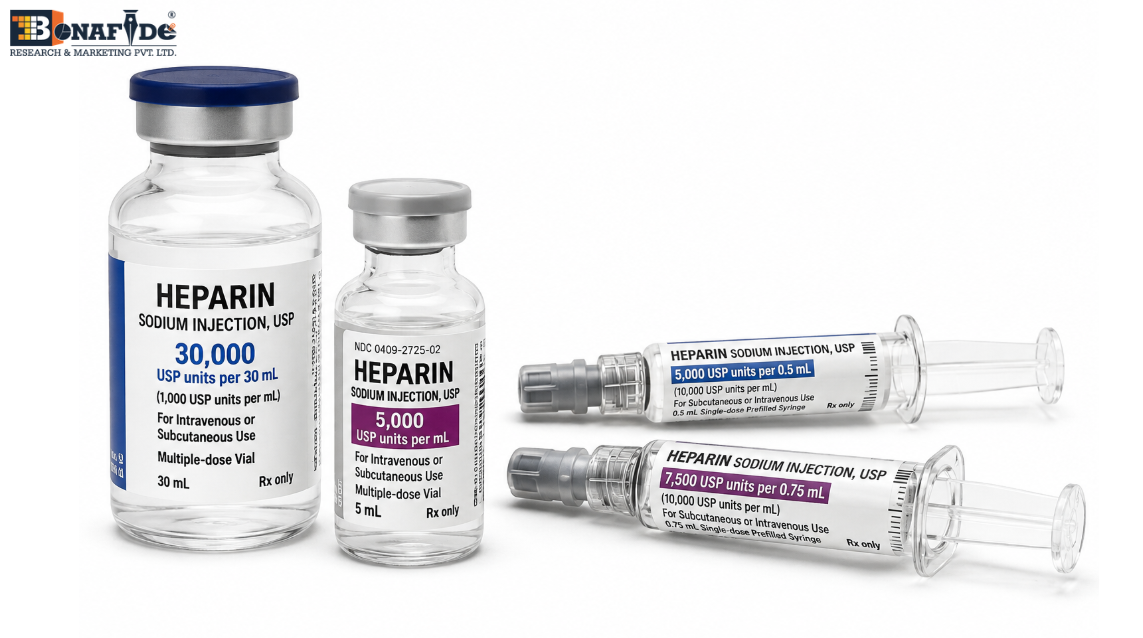
heparin market represents the pharmaceutical ecosystem surrounding unfractionated heparin (UFH), low molecular weight heparin (LMWH), and related anticoagulant products used to prevent or manage harmful blood-clot formation in cardiovascular care, surgery, venous thromboembolism, dialysis, and other hospital procedures. Heparin remains clinically important because it provides rapid anticoagulation, while UFH can be monitored and adjusted relatively quickly and its effect can be reversed with protamine when necessary. WHO identifies cardiovascular diseases as the leading global cause of death, with 19.8 million deaths attributed to CVDs in 2022, while the latest Global Burden of Disease analysis reported 19.2 million CVD deaths in 2023, reinforcing the continuing clinical environment in which anticoagulant therapy is relevant. Major growth drivers include the persistent cardiovascular disease burden, increasing recognition and management of venous thromboembolism, expanding surgical and interventional procedures, and the continued requirement for anticoagulation during haemodialysis and other extracorporeal therapies. The market is also supported by population ageing and the increasing prevalence of metabolic and cardiovascular risk factors. The International Society on Thrombosis and Haemostasis (ISTH) is an important professional association connected with this field through its work in thrombosis, haemostasis, education, scientific research, clinical guidance, and professional collaboration. Its activities help advance evidence-based approaches to prevention, diagnosis, monitoring, and treatment of thrombotic and bleeding disorders. WHO also contributes through evidence-based guidelines, cardiovascular surveillance, standards, and initiatives such as HEARTS, which supports stronger cardiovascular prevention and management within primary healthcare systems.
According to the research report, “Global Heparin Market Overview, 2031” published by Bonafide Research, the Global Heparin Market is expected to cross Global 10.19 Billion market size by 2031, with 4.29% CAGR by 2026-31..Key companies include Pfizer, Sanofi, Fresenius Kabi, B. Braun, LEO Pharma, Baxter, Aspen Pharmacare, Dr. Reddy’s Laboratories, Bioiberica, Opocrin, ROVI, and Shenzhen Hepalink, with competition spanning finished medicines as well as active pharmaceutical ingredients. A major opportunity is supply-chain diversification because pharmaceutical heparin is biologically sourced; the FDA states that heparin API is derived from pig intestines and that China supplies a large portion of the API, making animal-source traceability and geographic diversification strategically important. The FDA has also recently encouraged development of bovine-sourced heparin as an alternative source, specifically to diversify supply and strengthen resilience against potential shortages or contamination affecting the porcine chain. Manufacturing investments are another important development. ROVI completed an Esc?zar, Spain, expansion in 2024 that added a sodium-heparin production line supporting its LMWH manufacturing, reinforcing vertical integration from heparin materials into LMWH products. The supply chain therefore begins with qualified animal-derived raw material, followed by crude-heparin extraction, purification, API manufacturing, analytical testing, LMWH processing where applicable, finished-dose formulation, regulatory release, and distribution through pharmaceutical wholesalers and healthcare institutions. Quality control is particularly important because regulators require testing for contaminants and verification of animal origin; the FDA conducts testing across crude heparin, APIs, LMWHs, and finished dosage forms. This structure creates opportunities for companies investing in alternative sourcing, traceability, advanced analytical testing, API capacity, LMWH manufacturing, and reliable hospital-ready formulations.
Ultra low molecular weight heparin represents a more highly processed form of heparin in which the polysaccharide chains are reduced to very low molecular-weight fractions, giving the material pharmacological characteristics that can be useful in targeted anticoagulation. The broader LMWH class is already established because depolymerization changes the behavior of conventional unfractionated heparin, producing greater bioavailability after subcutaneous administration, longer half-life, and a more predictable dose-response relationship. These properties allow many LMWH regimens to be administered once or twice daily without routine laboratory monitoring in appropriate patients. The development of increasingly refined heparin fractions is relevant because clinicians and researchers continue to seek
anticoagulants that retain effective antithrombotic activity while offering more predictable exposure and potentially reducing treatment complexity. Recent scientific literature describes LMWHs as having selective biological activities and identifies ongoing research into derivatives with improved safety, personalized dosing, and additional applications beyond conventional anticoagulation. Ultra low molecular weight preparations are therefore associated with a broader movement toward precision in anticoagulant therapy, where molecular characteristics, renal function, body weight, clinical indication, and bleeding risk are considered together. A 2026 review emphasizes that LMWH remains particularly useful when oral anticoagulants are unsuitable or temporarily unsafe, including certain cases involving cancer-associated thrombosis, pregnancy, renal impairment, and peri-procedural care. This creates opportunities for highly characterized products that can deliver consistent pharmacodynamic effects while maintaining practical administration. However, ultra low molecular weight heparin should not be treated as automatically interchangeable with other LMWHs because individual products differ in manufacturing process, molecular-weight distribution, anti-Xa and anti-IIa activity, pharmacokinetics, and clinical characteristics.
Kidney dialysis has a distinctive relationship with heparin because the treatment itself creates an artificial circulation in which blood passes outside the body through tubing, pumps, filters, and a dialyzer. Contact between blood and these artificial surfaces activates coagulation pathways and platelets, creating a risk that the extracorporeal circuit will clot and interrupt treatment. Clinical guidance therefore recommends unfractionated or low molecular weight heparin for patients undergoing haemodialysis when they do not have an increased bleeding risk. Unfractionated heparin has traditionally been widely used because it has a proven safety record, is relatively inexpensive, has rapid anticoagulant activity, and can be administered as a loading dose followed by infusion during dialysis. The same guideline describes a common approach involving an initial dose followed by continuous administration, with heparin stopped before the end of the dialysis session to reduce anticoagulant exposure after treatment. LMWH is also used during dialysis and can provide an alternative where appropriate, giving the application a broader heparin product base. The underlying clinical need is recurring rather than occasional because patients receiving maintenance haemodialysis generally undergo repeated treatment sessions. This creates a continuing requirement for anticoagulation management, while patient-specific factors such as bleeding risk, thrombocytopenia, heparin allergy, previous heparin-induced thrombocytopenia, and surgical procedures can influence the choice of anticoagulant. Guidelines specifically recommend minimizing or omitting systemic anticoagulation in patients with elevated bleeding risk and using non-heparin anticoagulation when heparin allergy is present.
Bovine-derived heparin is gaining renewed attention because the global heparin supply chain has historically relied heavily on porcine material, creating interest in additional qualified animal sources. The U.S. Food and Drug Administration has explicitly encouraged the reintroduction of bovine-sourced heparin, explaining that the original U.S.-approved heparin products from the 1930s were bovine-derived and that bovine mucosal heparin remains available and manufactured in South America, including Brazil and Argentina. The agency's interest is connected to supply resilience rather than simply a preference for one animal source. FDA notes that concerns surrounding porcine heparin contamination in 2008 demonstrated the importance of safeguarding the heparin supply chain and states that alternative sources can help diversify supply and provide a proactive response to potential shortages or contamination affecting global porcine heparin. Bovine heparin therefore has a significant strategic opportunity because it can potentially provide another source of pharmaceutical heparin while reducing dependence on one species and concentrated supply networks. Importantly, this development does not mean bovine products can be introduced without extensive regulatory and quality controls. FDA emphasizes control of animal-material sources, manufacturing processes, current good manufacturing practices, and traceability of products and raw materials. Historical concerns regarding transmissible spongiform encephalopathy also explain why bovine-derived materials require careful sourcing and manufacturing controls. The renewed interest consequently reflects a more sophisticated approach to pharmaceutical supply security: manufacturers and regulators are considering species diversification alongside rigorous analytical
testing and traceability. The fact that bovine mucosal heparin is already manufactured in South America provides an established real-world production base rather than a purely theoretical alternative.
Intravenous infusion has an important role in situations where clinicians need anticoagulation to begin quickly and where the intensity of treatment may need to be changed during care. Unfractionated heparin is particularly suited to this approach because its pharmacological behavior permits relatively rapid adjustment compared with longer-acting anticoagulant therapies. FDA documentation describes heparin as an anticoagulant of choice when a rapid anticoagulant effect is required and notes that its effect can be monitored using widely available laboratory tests and reversed relatively rapidly with protamine. This combination of rapid action, monitoring, adjustment, and reversibility makes intravenous delivery especially useful in acute hospital environments. The route is relevant during cardiovascular interventions, selected acute coronary conditions, major surgical procedures, intensive-care treatment, and haemodialysis. Dialysis guidance, for example, describes unfractionated heparin administration using an initial loading dose followed by continuous infusion during the treatment session, with administration stopped before dialysis ends. Intravenous infusion also gives clinicians greater control when a patient's clinical condition changes rapidly. If bleeding risk increases, an invasive procedure becomes necessary, or laboratory results indicate excessive anticoagulation, infusion can be reduced or stopped rather than waiting for the effect of a long-acting dose to decline. This flexibility is particularly valuable in hospital settings where patients may undergo multiple procedures or receive several interacting medicines. At the same time, intravenous administration requires trained personnel, infusion equipment, monitoring, and careful dose management, so it is not inherently preferable for every patient.
Homecare use is becoming increasingly relevant because certain heparin-based treatment pathways can be administered without continuous hospitalization, particularly when LMWH is selected for appropriate patients. The pharmacological characteristics of LMWH are central to this shift: compared with unfractionated heparin, LMWH generally has better bioavailability after subcutaneous administration, a longer half-life, and a more predictable anticoagulant response. These characteristics permit once- or twice-daily administration in many clinical situations and can reduce the need for routine laboratory monitoring. Clinical literature has specifically identified outpatient treatment as an advantage of LMWH for uncomplicated deep-vein thrombosis, demonstrating that anticoagulation does not always require a prolonged hospital stay. More recent clinical evidence continues to recognize LMWH as important when oral anticoagulants are unsuitable, temporarily unsafe, or difficult to manage, including selected cases involving cancer-associated thrombosis, pregnancy, renal impairment, and peri-procedural care. This creates a practical role for homecare settings because patients may receive scheduled injections while returning to healthcare professionals for follow-up rather than remaining continuously hospitalized. Home-based administration can also support continuity of therapy after hospital discharge, provided that the patient's clinical condition, renal function, bleeding risk, dosing requirements, and ability to administer injections are appropriately assessed. The trend is not simply a shift of all heparin therapy into the home; unfractionated heparin still has an important role in acute situations requiring intravenous infusion and close monitoring.





 We are friendly and approachable, give us a call.