The global
antacids market comprises medicines and acid-reducing products used to relieve or manage symptoms associated with excess gastric acid, including heartburn, acid indigestion, sour stomach, and reflux-related discomfort. Antacid products generally work by neutralizing stomach acid, while related acid-control therapies such as histamine-2 receptor blockers and proton
pump inhibitors reduce acid production through different mechanisms. The category is important in gastrointestinal self-care because heartburn and gastroesophageal reflux symptoms are common worldwide; a global systematic review estimated pooled GERD prevalence at 13.98%, while North America recorded a higher regional prevalence of 19.55%. The FDA recognizes antacids as OTC treatments for heartburn, sour stomach, and acid indigestion, supporting their role in accessible symptom management. Market growth is supported by the continuing burden of reflux symptoms, increasing awareness of digestive health, aging populations, obesity, and lifestyle factors associated with reflux. Research has found that reflux symptoms are more prevalent among older adults and are associated with obesity, smoking, and NSAID or aspirin use, creating continuing demand for treatment and symptom relief. The market is also associated with gastroenterology, primary healthcare, pharmacies, consumer healthcare companies, and self-medication practices. Its activities include research and development of acid-neutralizing and acid-suppressing formulations, manufacturing of tablets, chewables, liquids, and other dosage forms, regulatory approval and safety monitoring,
packaging, distribution through pharmacies and other retail channels, and consumer education regarding appropriate use. Pharmaceutical and consumer-healthcare companies compete through formulation convenience, active-ingredient combinations, dosage options, brand recognition, and accessibility. The sector also supports pharmacist and healthcare-provider counseling because persistent or recurrent symptoms can indicate underlying GERD or another gastrointestinal condition requiring medical evaluation.
According to the research report, “Global Antacids Market Overview, 2031” published by Bonafide Research, the Global Antacids Market is expected to cross Global 10.46 Billion market size by 2031, with 4.12% CAGR by 2026-31.The market is supported by recurring consumer demand for convenient digestive-health treatment and by established pharmaceutical and consumer-healthcare companies, including Haleon, Reckitt, Bayer, Sanofi, Procter & Gamble, Sun Pharmaceutical Industries, Dr. Reddy’s Laboratories, and Perrigo. Haleon’s digestive-health portfolio includes TUMS and ENO, while its 2024 annual report states that the company launched TUMS
Gummy Bites in the U.S. and ENO Chewy Bites in India, demonstrating how manufacturers are pursuing convenient formats and new consumer-use occasions. Reckitt continues to develop Gaviscon as a heartburn and indigestion brand, with formulations designed to create a protective barrier against reflux. Bayer markets Rennie across numerous international markets for heartburn and digestive discomfort, illustrating the importance of established brands and broad geographic distribution. Supply-chain activities extend from sourcing active pharmaceutical ingredients such as
calcium carbonate, magnesium compounds, sodium bicarbonate,
alginates, and related excipients to formulation, blending, granulation, tablet compression, liquid processing, packaging, quality testing, regulatory compliance, warehousing, and distribution. Manufacturers must maintain consistent raw-material quality because variations in active ingredients can affect neutralizing capacity, stability, taste, and consumer experience. Packaging suppliers support bottles, blister packs, sachets, cartons, and other formats, while distributors move finished products to pharmacies, supermarkets, healthcare outlets, and online channels. Opportunities exist in chewable and portable formats, combination therapies, private-label manufacturing, emerging markets,
digital commerce, and products positioned around convenience and rapid relief.
Combination formulations are gaining importance because different acid-related products work through distinct mechanisms, and combining active ingredients can provide a more comprehensive approach than relying on a single mechanism alone. Traditional antacids such as calcium carbonate, magnesium hydroxide, or
aluminum hydroxide neutralize acid already present in the stomach, whereas proton pump inhibitors reduce acid secretion and H2-receptor antagonists suppress acid production through another pathway. Some combination products therefore bring together ingredients that can provide complementary effects. A well-established example is the combination of an antacid with an alginate, where the antacid helps neutralize gastric acid while alginate formulations can form a floating barrier over stomach contents, helping reduce reflux into the esophagus. Combination acid-relief products are also available with an antacid and an H2-receptor antagonist, providing both acid neutralization and longer-lasting suppression of acid production. The clinical relevance of combination approaches is particularly evident in reflux management, where symptoms can involve both immediate acid-related discomfort and repeated exposure of the esophagus to gastric contents. The American College of Gastroenterology recommends proton pump inhibitors as the preferred medical treatment for GERD when appropriate, demonstrating the importance of effective acid suppression in disease management. Combination formulations can also improve product positioning by allowing manufacturers to address different consumer needs within one dosage unit rather than requiring consumers to select separate medicines. For occasional symptoms, an antacid component can provide a familiar rapid-relief function, while an additional active ingredient can extend or complement the therapeutic effect. This versatility creates opportunities for companies to develop products around specific symptom patterns, including heartburn after meals, nighttime reflux, and recurring acid discomfort.
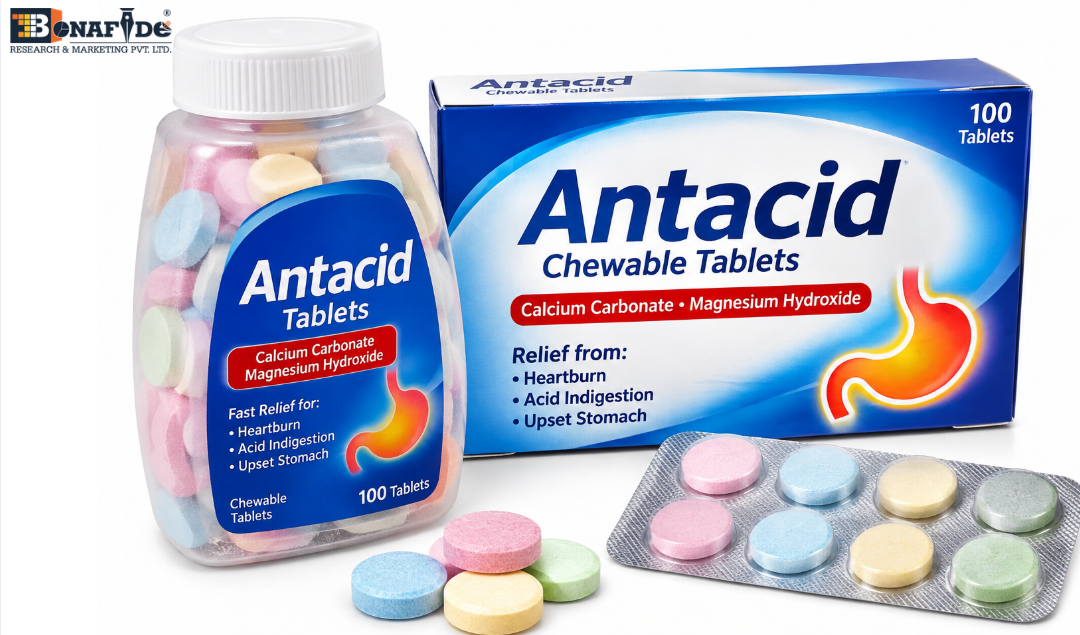
Gummies and other alternative formats are attracting attention because they respond to a fundamental consumer preference: medicines that are easier and more pleasant to take. Pharmaceutical dosage forms have expanded considerably beyond conventional tablets and capsules, and the FDA formally recognizes a wide range of oral formats, including chewable tablets, chewable gels, orally disintegrating tablets, granules, films, and other formulations. Gummies can build on this broader movement toward patient-centric oral delivery by providing a soft, chewable format that does not require swallowing a conventional tablet. This characteristic can be useful for consumers who dislike tablets or experience difficulty swallowing solid medicines. The FDA has specifically examined “candy-like” nonprescription drug products, noting that formulation development can involve palatability and that dosage-form characteristics may influence medication adherence among pediatric and geriatric populations. The same convenience characteristics are relevant to antacid products because many are purchased for self-care and taken when symptoms appear rather than as part of a complex administration routine. Gummies can also support portability, allowing consumers to carry individually packaged or compact products for use at work, while traveling, after meals, or away from home. From a product-development perspective, manufacturers can differentiate these formats through flavor, texture, serving size, active-ingredient combinations, and packaging. The emergence of gummy technology across the broader consumer-healthcare industry also provides manufacturers with established formulation knowledge regarding taste masking, texture, stability, and consumer acceptability. However, the candy-like appearance of medicinal gummies creates an important safety consideration as FDA has highlighted the potential for confusion with ordinary candy and accidental ingestion by children.
The broader others indication category can expand as consumers and manufacturers recognize that acid-relief products have applications beyond the single symptom of heartburn. U.S. FDA OTC antacid requirements specifically identify heartburn, sour stomach, and acid indigestion among the conditions for which qualifying antacid products may be labeled for relief, demonstrating that the category already encompasses several distinct digestive complaints. These symptoms can overlap clinically, but consumers may describe their discomfort differently depending on when it occurs, its relationship to meals, and whether burning, fullness, sourness, or upper-abdominal discomfort is most noticeable. This creates room for products positioned around broader digestive symptom relief rather than only the word heartburn. The expansion of indications is also supported by the variety of active ingredients available in the category. Calcium carbonate, magnesium compounds, aluminum compounds, bicarbonate-based ingredients, alginates, H2-receptor antagonists, and proton pump inhibitors have different mechanisms and treatment roles, allowing manufacturers to formulate products for particular patterns of acid-related discomfort. FDA describes nonprescription medicines as products that consumers can use without a prescription when used according to their labeling, and these products are widely available through pharmacies and other retail outlets. This accessibility supports self-care for mild and occasional digestive symptoms. At the same time, the expansion of the others indication segment does not mean every digestive complaint should automatically be treated with an antacid. Persistent or unexplained symptoms can require professional assessment, particularly when symptoms do not respond to appropriate OTC treatment. Product labeling therefore plays an important role in guiding consumers toward appropriate use and medical consultation when necessary. The broader indication group also gives manufacturers opportunities to develop specialized combinations, alternative dosage forms, and targeted consumer messaging around different digestive experiences.
Online pharmacies are becoming increasingly relevant to antacid distribution because the category is strongly connected with self-care, convenience, and products that consumers can purchase without a traditional medical appointment. The FDA explains that nonprescription medicines can be purchased through online and retail outlets, including pharmacies, grocery stores, and convenience stores. Online purchasing adds another layer of convenience by allowing consumers to search for products, compare active ingredients and dosage forms, place orders, and receive medicines without visiting a physical store. The FDA notes that consumers may turn to online pharmacies because of convenience, privacy, and potential cost savings, factors that can also influence purchasing decisions for everyday OTC medicines. Antacids are particularly compatible with this model because many products are standardized, familiar, nonprescription formulations that consumers can reorder after previous use. Online platforms can also
display multiple brands and formats simultaneously, allowing consumers to compare tablets, chewables, liquids, combination products, and alternative dosage forms more easily than may be possible on a limited pharmacy shelf. Digital purchasing additionally supports repeat orders and home delivery, which can be useful for consumers who regularly keep acid-relief medicines available at home. Manufacturers and retailers can use online channels to provide detailed product information, dosage instructions, active ingredients, warnings, and customer-support resources alongside product listings. This creates opportunities for better-informed purchasing when the information is accurate and presented responsibly.





 We are friendly and approachable, give us a call.