The global
humectants market has experienced steady growth and is expected to continue expanding during the forecast period, driven by increasing demand from personal care, food, pharmaceutical, and industrial applications. The market growth is supported by rising consumer preference for moisturizing products, sustainable ingredients, and advanced humectant solutions across various industries. The regulatory landscape for humectants is complex and varies significantly across regions. In the United States, the Food and Drug Administration enforces the Modernization of
Cosmetics Regulation Act, which mandates detailed safety documentation, ingredient transparency, and facility registration. For food applications, humectants must be Generally Recognized as Safe (GRAS) or approved as
food additives. In the European Union, the European Food Safety Authority and the European Commission regulate humectants in food, requiring thorough safety assessments. For cosmetics, the EU Cosmetics Regulation No 1223/2009 and REACH compliance impose stricter rules, including bans on over 1,400 chemicals, compared to fewer than 20 in the United States. These regulations create a competitive environment that favors suppliers with robust traceability and safety substantiation systems. The clean-label trend in cosmetics is a major driver, with brands shifting towards recognizable humectants like glycerol and sodium PCA. The expansion of drug development and the growing demand for moisture-managed products, such as nicotine pouches, present new avenues for growth.
According to the research report "Global Humectants Market Outlook, 2031," published by Bonafide Research, the Global Humectants Market was valued at more than USD 29.45 Billion in 2025, and expected to reach a market size of more than USD 41.33 Billion by 2031 with the CAGR of 5.96% from 2026-2031. The global humectants market is witnessing strategic mergers, collaborations, and partnerships aimed at enhancing product portfolios and expanding market reach. For instance, in October 2025, Brenntag, a major chemical distributor, partnered with Givaudan to supply cosmetic actives and ingredients in Thailand, aiming to improve the availability of high-quality
cosmetic ingredients in the region. In the broader beauty sector, Waldencast's acquisition of Obagi Medical expands its offerings into the growing U.S. dermal filler market. Additionally, Honasa Consumer Ltd. announced plans to acquire a 95% stake in a company for approximately ?195 crore, indicating consolidation within the personal care space. These strategic moves reflect a market seeking to leverage synergies and capitalize on growing demand. The market's growth is further fueled by the expansion of the food and
beverage industry, which uses humectants to retain moisture and extend shelf life. With the
processed food and beverage sector reaching record export values, the demand for humectants is set to rise. Key raw materials for humectants include glycerol, a byproduct of
biodiesel refining, which has led to a structural oversupply that keeps the market expanding. Suppliers are mitigating feedstock risks by certifying bio-circular
propylene glycol and securing long-term crude-glycerol offtake contracts. The trade of humectants is global, with major exporting countries including Malaysia, Thailand, Indonesia, Germany, and Belgium.
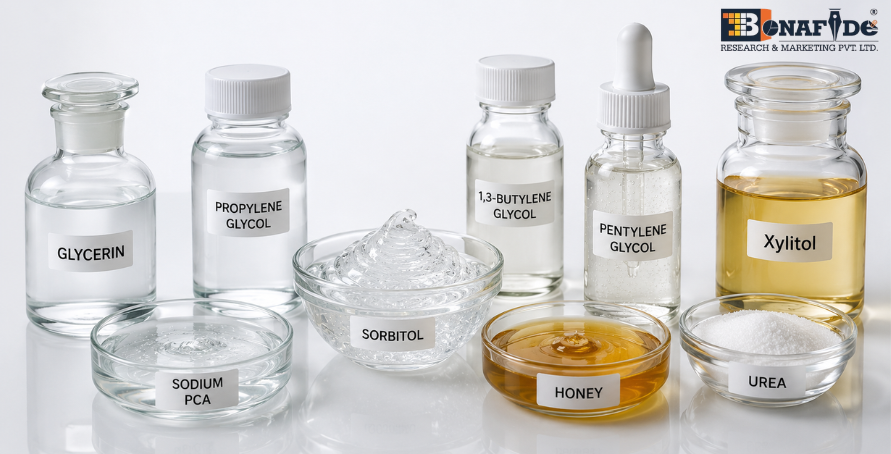
Glycerol maintains a leading position in the global humectants market because it combines strong functional performance with exceptional versatility across a wide range of industries. Its hygroscopic nature allows it to attract and retain moisture effectively, making it an essential ingredient in formulations where maintaining hydration, texture, stability, and product quality is important. The personal care and cosmetics industry represents one of the major areas where glycerol is extensively used, as it is incorporated into
moisturizers, facial creams, lotions, cleansers, shampoos, conditioners, soaps, and cosmetic products to improve skin hydration, enhance smoothness, and provide a better sensory experience. Its ability to blend easily with water, oils, emulsifiers, botanical extracts, and active ingredients allows formulators to develop stable and effective personal care products. The pharmaceutical industry also relies on glycerol in applications such as cough syrups, oral liquids, topical creams, ointments, gels, and
dental care products because it helps maintain moisture levels, improves consistency, and supports formulation stability. In the food and beverage sector, glycerol is widely used in
bakery products, confectionery, chewing gum, processed foods, and specialty formulations where it helps preserve softness, regulate moisture, and maintain desirable texture during storage. Its established acceptance as a
functional food ingredient has supported its continued use by manufacturers seeking reliable moisture-control solutions.
Synthetic humectants continue to show moderate growth in the global humectants market because they provide dependable functional performance, manufacturing consistency, and formulation flexibility across various industries. Synthetic humectants such as propylene glycol, certain petroleum-derived glycols, and other chemically produced moisture-retaining agents are widely used because they can be manufactured with controlled purity levels and predictable characteristics, allowing companies to achieve consistent results in large scale production. In the pharmaceutical industry, synthetic humectants are utilized in products such as topical creams, gels, ointments, oral solutions, and other formulations where moisture retention, solvent properties, and ingredient stability are important. Their ability to maintain formulation consistency and compatibility with active pharmaceutical ingredients makes them valuable for manufacturers developing reliable healthcare products. The personal care and cosmetics industry also uses synthetic humectants in skincare products, haircare formulations, deodorants, and hygiene products because they improve texture, enhance product spreadability, and support hydration performance. In industrial applications, synthetic humectants are incorporated into coatings, adhesives, inks, tobacco processing, and chemical formulations where controlled moisture levels are required to improve processing behavior and product characteristics. Their stable supply chains, scalable manufacturing processes, and predictable performance make them suitable for industries that require dependable raw materials.
Oral and personal care applications represent a leading and rapidly expanding area in the global humectants market because humectants provide essential functional benefits that directly influence the performance, quality, and consumer experience of everyday products. Ingredients such as glycerol,
sorbitol, propylene glycol, and other moisture retaining compounds are widely incorporated into
toothpaste, mouthwash, oral gels, moisturizers, facial creams, lotions, shampoos, conditioners, soaps, and various
personal hygiene products. In
oral care formulations, humectants play a critical role by preventing toothpaste from drying out, maintaining smooth consistency, improving spreadability, and supporting product stability throughout storage. They also help create a comfortable mouthfeel in products such as dental gels and rinses by maintaining moisture balance and improving sensory characteristics. The growing global focus on oral hygiene and increasing use of dental care products continue to support demand for ingredients that improve formulation performance and user experience. In personal care products, humectants are valued because they attract and retain moisture, making them essential for products designed to maintain skin hydration and improve skin feel. They are commonly used in moisturizers, anti-aging creams, serums, body lotions, cleansers, and haircare products because they help reduce dryness, enhance softness, and support the effectiveness of active ingredients.
Powder humectants are gaining rapid adoption in the global humectants market because their physical format provides important advantages in handling, storage, transportation, and product development across various industries. Unlike liquid forms that may require specific storage conditions and handling systems, powder humectants offer greater convenience in applications where dry ingredients are preferred or where long-distance transportation efficiency is important. These characteristics make powdered humectants valuable for manufacturers operating across different regions and supply chains. In the food and beverage industry, powder humectants are used in bakery mixes, confectionery products, nutritional powders, dry beverage blends, and processed food formulations because they can be easily combined with other dry ingredients while supporting moisture control, texture improvement, and product consistency. Their ability to maintain functionality after blending makes them suitable for manufacturers producing powdered and ready-to-use food products. In pharmaceutical applications, powder humectants are utilized in tablets, capsules, oral care powders, dry formulations, and specialized healthcare products where ingredient stability, accurate dosing, and controlled moisture management are important. Personal care manufacturers also use powdered humectants in certain cosmetic powders, facial masks, dry skincare products, and specialty formulations because they provide formulation flexibility and enable the development of innovative product formats.







 We are friendly and approachable, give us a call.