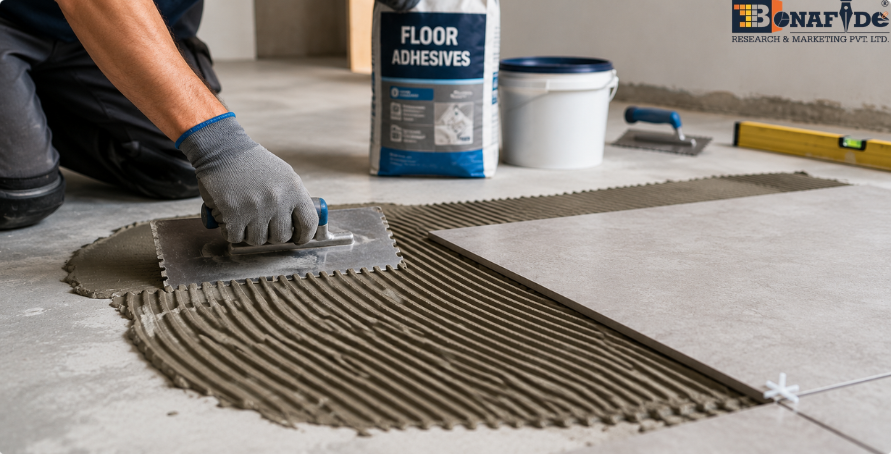
The floor adhesive market experienced notable developments during 2024 and 2025, driven by increasing demand for sustainable construction materials, technological advancements, and continuous product innovation. During 2024, manufacturers focused on expanding environmentally friendly product portfolios while strengthening production capabilities to meet evolving construction requirements. In 2025, the industry continued shifting toward high-performance adhesive technologies supported by investments in manufacturing modernization, digitalization, and sustainable raw material sourcing. Producers accelerated the commercialization of low-VOC, solvent-free, water-based, and bio-based adhesive formulations to comply with increasingly stringent environmental and indoor air quality regulations. Regulatory authorities enhanced standards governing chemical emissions, workplace safety, and sustainable construction materials, encouraging manufacturers to reformulate products using safer and more environmentally responsible ingredients. Green building certification programs and stricter construction standards further accelerated the adoption of advanced flooring adhesive solutions across residential, commercial, industrial, healthcare, education, and infrastructure projects. The industry also witnessed continued mergers, acquisitions, strategic alliances, and manufacturing investments as companies sought to strengthen product portfolios, expand production capacity, improve distribution networks, and enhance research capabilities. Localized manufacturing and supply chain diversification became strategic priorities, reducing logistical risks while improving product availability. Technological innovation remained a key competitive driver, with manufacturers introducing moisture-resistant, rapid-curing, pressure-sensitive, hybrid polymer, and high-strength adhesive formulations designed to improve installation efficiency, durability, and compatibility with luxury vinyl tile (LVT), engineered wood, laminate, ceramic, and resilient flooring materials.
According to the research report, “Global Floor Adhesive Market Overview, 2031” published by Bonafide Research, the Global Floor Adhesive market is expected to cross USD 12.29 Billion market size by 2031, with 5.62% CAGR by 2026-31. During 2024 and 2025, pricing across the floor adhesive market remained influenced by raw material costs, manufacturing expenses, product innovation, competitive positioning, and evolving customer preferences for high-performance and sustainable adhesive solutions. Manufacturers adopted a combination of premium, value-based, and cost-plus pricing strategies depending on product specifications, end-use applications, and customer segments. Premium pricing continued to characterize advanced polyurethane, epoxy, silane-modified polymer, moisture-control, and specialty flooring adhesives offering superior bonding strength, rapid curing, enhanced durability, and compliance with stringent environmental standards. Water-based acrylic and environmentally friendly adhesive formulations generally followed value-based pricing by emphasizing installation efficiency, lifecycle performance, and regulatory compliance. Standard residential flooring adhesives largely relied on cost-plus pricing supported by manufacturing scale and operational efficiencies. Promotional activities remained an important competitive tool, including contractor rebates, distributor incentives, project-based pricing agreements, bundled flooring installation systems, seasonal promotions, and volume discounts that influenced purchasing decisions across multiple customer groups. Average Selling Prices (ASP) varied considerably among sales channels, with direct supply agreements involving flooring manufacturers, contractors, and large construction firms generally achieving lower unit prices through bulk procurement, while specialty distributors, professional retailers, and flooring solution providers maintained higher ASPs because of technical consultation, logistics support, and after-sales services. Raw material costs including acrylic polymers, polyurethane intermediates, epoxy resins, petrochemical feedstocks, fillers, additives, packaging materials, energy, and transportation continued to exert significant influence on final product pricing throughout 2024–2025. Currency fluctuations affecting imported raw materials also contributed to periodic pricing adjustments for manufacturers relying on international chemical supply chains.
Water-based floor adhesives are experiencing the fastest growth in the global floor adhesive market as sustainability becomes a key priority across the construction industry. Governments and regulatory authorities worldwide are implementing stricter environmental regulations that limit volatile organic compound (VOC) emissions and encourage the adoption of environmentally responsible building materials. As a result, contractors, developers, and property owners are increasingly selecting water-based adhesives because they offer lower emissions, improved indoor air quality, and safer installation conditions compared to conventional solvent-based products. Technological advancements have significantly enhanced the bonding strength, moisture resistance, curing efficiency, and durability of water-based formulations, allowing them to perform effectively across a broad range of flooring materials, including luxury vinyl tile (LVT), engineered wood, laminate, ceramic tiles, and resilient flooring. Their low odor, easier cleanup, and reduced health risks also improve working conditions for installers while simplifying construction processes. Growing adoption of green building certifications and sustainable construction practices further accelerates market demand. Manufacturers continue investing in research and development to introduce high-performance formulations that meet evolving customer requirements without compromising environmental compliance. Water-based adhesives are increasingly used in residential, commercial, healthcare, educational, and institutional projects where indoor environmental quality is an important consideration. Expanding product availability, improved distribution networks, and increasing awareness among contractors have further strengthened market penetration. Continuous innovation in raw materials and production technologies has also improved cost competitiveness and application versatility. As the construction industry increasingly prioritizes sustainability, operational safety, and long-term environmental performance, water-based adhesives are expected to gain market share rapidly. These combined advantages position water-based technology as the fastest-growing segment within the global floor adhesive market.
Polyurethane represents the largest resin segment in the global floor adhesive market because it combines superior mechanical performance with exceptional versatility across numerous flooring applications. These adhesives provide outstanding bonding strength while maintaining flexibility, allowing flooring systems to withstand structural movement, thermal expansion, and heavy traffic without compromising adhesion. Their excellent resistance to moisture, chemicals, temperature fluctuations, and wear makes polyurethane adhesives suitable for demanding environments including residential buildings, commercial facilities, industrial plants, healthcare institutions, educational campuses, airports, and hospitality projects. Growing global demand for premium flooring materials such as luxury vinyl tile (LVT), engineered wood, laminate, natural stone, and specialty resilient flooring has significantly increased polyurethane consumption due to its broad compatibility with these materials. Manufacturers continue introducing advanced low-VOC and solvent-free polyurethane formulations that comply with evolving environmental regulations while maintaining excellent installation performance. Rapid curing characteristics improve construction efficiency by reducing project completion times and minimizing operational disruptions during renovation activities. Continuous investments in product innovation have enhanced workability, durability, and long-term reliability, encouraging broader adoption across both developed and emerging construction markets. Contractors also prefer polyurethane adhesives because they reduce maintenance requirements and extend flooring service life, improving lifecycle value for building owners. Increasing investments in commercial construction, industrial modernization, infrastructure development, and residential housing continue to create favorable market conditions for polyurethane-based products. The resin's ability to deliver premium performance across diverse environmental conditions and flooring systems enables it to maintain the largest market share. These combined advantages position polyurethane as the dominant resin technology in the global floor adhesive market.
The industrial sector represents the largest end-use segment in the global floor adhesive market because industrial facilities require highly durable flooring systems capable of supporting continuous heavy-duty operations. Manufacturing plants, warehouses, logistics hubs, food processing facilities, pharmaceutical production units, automotive factories, electronics manufacturing facilities, and chemical plants all require specialized flooring capable of withstanding machinery loads, chemical exposure, heavy traffic, and demanding operating conditions. These flooring systems depend on advanced adhesive technologies that provide exceptional bonding strength, moisture resistance, impact resistance, and long-term structural stability. Continuous industrialization across both developed and emerging economies has increased investments in new production facilities, factory expansions, and warehouse construction, generating substantial demand for industrial flooring adhesives. Modern industrial buildings increasingly utilize specialized flooring materials including epoxy flooring, anti-static flooring, heavy-duty vinyl systems, rubber flooring, and concrete flooring solutions, all of which require high-performance adhesive products. Manufacturers continue introducing technologically advanced adhesives offering faster curing, improved flexibility, and enhanced resistance to chemicals, abrasion, and temperature fluctuations. Industrial facility operators prioritize lifecycle performance, reduced maintenance costs, and operational reliability, encouraging the selection of premium adhesive technologies over lower-cost alternatives. The expansion of e-commerce, automation, semiconductor manufacturing, renewable energy production, and advanced manufacturing industries has further accelerated industrial construction worldwide.
The Others application segment accounts for the largest share of the global floor adhesive market because it covers a broad range of specialized flooring applications beyond traditional residential and commercial installations. This category includes hospitals, laboratories, pharmaceutical facilities, airports, railway stations, educational institutions, sports arenas, hotels, warehouses, manufacturing plants, logistics centers, clean rooms, and data centers, each requiring flooring systems designed to withstand demanding operational conditions. These facilities often utilize specialized flooring materials such as anti-static flooring, rubber flooring, epoxy flooring, industrial vinyl, sports flooring, and chemically resistant flooring, creating significant demand for advanced adhesive technologies. Growing investments in healthcare modernization, transportation infrastructure, industrial expansion, hospitality development, logistics facilities, and educational institutions continue to expand this application segment worldwide. Manufacturers are introducing customized adhesive formulations offering superior bonding strength, rapid curing, moisture resistance, chemical resistance, flexibility, and long-term durability to meet the unique requirements of these specialized environments. Increasing emphasis on sustainability has also encouraged the development of low-VOC, water-based, and environmentally friendly adhesive products suitable for high-performance institutional and industrial buildings. Contractors increasingly prefer technologically advanced adhesives that reduce installation time, improve flooring longevity, and minimize maintenance costs throughout the facility lifecycle. Continuous innovation in hybrid polymer formulations, moisture-control systems, and specialty adhesive chemistries further supports expanding adoption across specialized applications.






 We are friendly and approachable, give us a call.