The global
industrial wax market comprises a broad range of waxes including
paraffin wax, microcrystalline wax, synthetic waxes (such as
polyethylene and Fischer-Tropsch waxes), and bio-based waxes used across manufacturing and processing industries to provide moisture resistance, lubrication,
surface protection, sealing, dispersion, and thermal stability. Industrial waxes are essential raw materials in
candle production,
packaging materials, hot-melt adhesives, plastics and
rubber processing, coatings, polishes,
cosmetics, pharmaceuticals, textiles, and food-contact applications. The market continues to expand due to growing demand for
flexible packaging,
e-commerce shipping materials, consumer goods, personal care products, and industrial manufacturing activities worldwide. Packaging remains a major growth driver because wax coatings improve water resistance and product protection, while increasing consumption of adhesives, polymer-processing aids, and specialty coatings further supports demand. Candle manufacturing is another significant demand center, driven by decorative, religious, aromatherapy, and household applications. The industry is also witnessing rising adoption of bio-based and renewable waxes as manufacturers respond to sustainability goals and environmental regulations. Industrial wax producers are actively engaged in refining, blending, formulating, and supplying wax products tailored to specific end-use requirements, including high-purity grades for pharmaceutical and cosmetic applications. Key industry participants include integrated refining and chemical companies such as Exxon Mobil Corporation, Shell plc, BASF SE, Sasol Limited, and China Petroleum & Chemical Corporation. Industry activities encompass wax production, feedstock processing, product innovation, specialty wax development, sustainability initiatives, and global distribution. The market's importance stems from its role in enabling packaging performance, consumer product manufacturing, industrial processing efficiency, and product preservation across numerous sectors, making industrial waxes a critical component of modern manufacturing value chains.
According to the research report "Global Industrial Wax Market Outlook, 2031," published by Bonafide Research, the Global Industrial Wax Market was valued at more than USD 10.24 Billion in 2025, and expected to reach a market size of more than USD 13.35 Billion by 2031 with the CAGR of 4.63% from 2026-2031. Industrial waxes include paraffin wax, microcrystalline wax, polyethylene wax, Fischer-Tropsch wax, and emerging bio-based waxes derived from renewable feedstocks. The market is primarily driven by rising demand for flexible packaging, e-commerce shipping materials, personal care products, adhesives, and polymer-processing aids, while ongoing industrialization in Asia-Pacific continues to support volume consumption. Petroleum-based waxes remain dominant due to cost competitiveness and established refining infrastructure, but sustainability initiatives are creating significant opportunities for synthetic and bio-based alternatives. Major participants include Exxon Mobil Corporation, Shell plc, BASF SE, Sasol Limited, Dow, Evonik Industries AG, and China Petroleum & Chemical Corporation, which leverage integrated manufacturing networks and global distribution systems to serve diverse end-use industries. The industrial wax supply chain begins with crude
oil refining, natural wax extraction, or synthetic feedstock production, followed by refining, blending, formulation, packaging, and distribution to converters and manufacturers. Supply chain dynamics are heavily influenced by crude oil availability, refining economics,
logistics costs, and environmental regulations. Recent industry developments include Sasol's 2025 launch of lower-carbon-footprint SASOLWAX products and ExxonMobil's introduction of its Prowaxx brand portfolio to strengthen product differentiation and customer solutions. Opportunities are emerging in sustainable packaging, bio-based formulations, high-performance adhesives, and specialty pharmaceutical and cosmetic applications, where demand for high-purity and environmentally responsible waxes continues to increase. Asia-Pacific remains the leading production and consumption hub, supported by large-scale manufacturing activity and expanding downstream industries.
The dominance of candles within the industrial wax market is fundamentally linked to the fact that wax serves as the core ingredient of the final product rather than a secondary component. Unlike coatings, adhesives, packaging, or rubber processing applications where wax is often incorporated in relatively small proportions to impart specific properties such as lubrication, water resistance, gloss, or release characteristics, candles are composed predominantly of wax itself. Every candle requires a substantial quantity of wax to provide shape, fuel combustion, control burn behavior, and maintain structural integrity during storage and use. This creates a direct and continuous relationship between candle production and wax consumption. The widespread use of candles across religious ceremonies, cultural traditions, festivals, home d?cor, aromatherapy, hospitality settings,
emergency lighting, and wellness activities further strengthens demand. Countries across Asia, Europe, North America, Latin America, and the Middle East maintain long-standing traditions involving candle usage throughout the year, creating a broad and diversified customer base. Industrial waxes such as paraffin, microcrystalline, and blended waxes are favored because they offer controlled melting characteristics, uniform burning performance, fragrance retention, and manufacturing consistency. Modern candle producers also utilize specialized wax formulations to achieve aesthetic effects, longer burn times, and improved scent diffusion. The candle industry benefits from relatively straightforward production processes and extensive global distribution networks, allowing large-scale manufacturing operations to consume significant quantities of wax.
The leadership of fossil-based waxes stems from their deep integration into global refining and petrochemical value chains. Paraffin wax and microcrystalline wax are derived during crude oil refining, enabling manufacturers to leverage existing infrastructure, mature production technologies, and extensive distribution networks. This industrial
foundation allows fossil-based waxes to be produced efficiently and consistently at commercial scale. Their physical and chemical characteristics make them suitable for a wide range of applications including candles, packaging, hot-melt adhesives, board sizing, rubber processing, cosmetics, coatings, and pharmaceutical products. These waxes offer predictable melting points, stability during processing, excellent moisture resistance, compatibility with numerous additives, and ease of formulation. Industrial users often prioritize performance consistency because manufacturing operations require materials that behave uniformly across production batches, and fossil-based waxes have a long track record of meeting these requirements. In addition, refiners can manufacture multiple grades with varying oil content, hardness, flexibility, and melting characteristics, allowing suppliers to serve highly diverse customer needs. The availability of global crude oil refining capacity also supports dependable supply across major industrial regions. Many downstream industries have spent decades optimizing equipment and formulations around paraffin and microcrystalline waxes, creating strong technical familiarity and established procurement systems. Although renewable and synthetic alternatives are gaining attention, fossil-based waxes continue to benefit from widespread acceptance, proven performance records, large-scale manufacturing capability, and extensive application versatility.
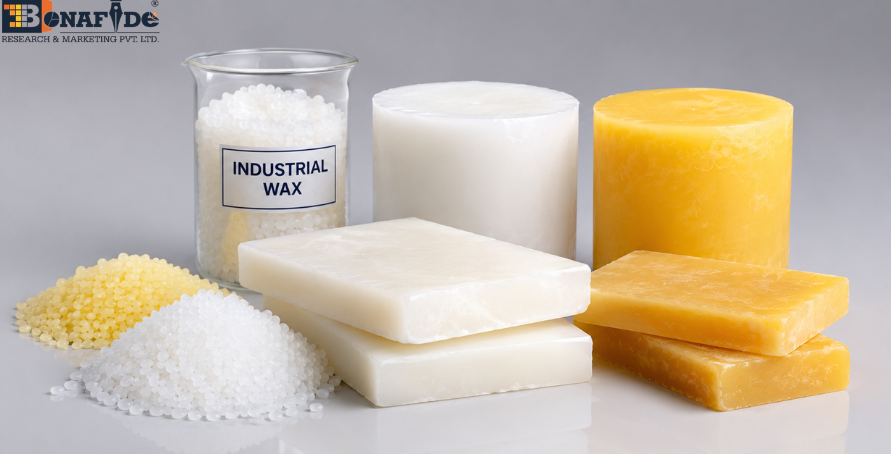
The predominance of solid wax reflects practical advantages throughout the entire industrial supply chain. Most waxes naturally exist as solids at ambient temperatures, allowing manufacturers to package, transport, store, and distribute them without requiring specialized heated equipment. Solid waxes are commonly supplied as slabs, pellets, granules, blocks, pastilles, flakes, or powders, each designed to facilitate efficient handling and controlled feeding into manufacturing processes. This physical form helps reduce leakage risks, minimizes product losses during transportation, and extends storage life under normal warehouse conditions. Industrial users value these characteristics because they simplify inventory management and lower logistical complexity. In production environments, solid waxes can be precisely measured and melted when needed, giving operators greater control over formulation and processing conditions. Industries such as candle manufacturing, adhesives, coatings, packaging, rubber processing, cosmetics, and pharmaceuticals routinely utilize solid waxes because they are easy to blend with other materials after melting while remaining stable during storage. Solid forms also support international trade by enabling bulk shipment over long distances without temperature-controlled transport in many cases. Furthermore, suppliers can tailor particle size and shape according to customer requirements, improving processing efficiency and dosing accuracy. Liquid waxes and emulsions serve important niche applications, particularly where direct application or water-based systems are required, but they generally involve additional handling considerations and specialized storage conditions.








 We are friendly and approachable, give us a call.