The
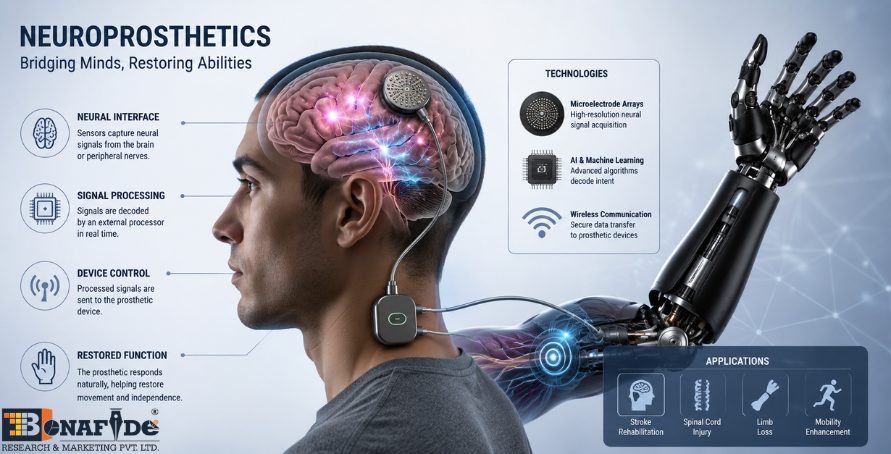
neuroprosthetics industry has steadily advanced in line with growing neurological disorder prevalence and increasing demand for effective therapeutic interventions, aiming to decrease medication side effects, reduce long-term healthcare costs, improve clinical outcomes, and enhance the quality of life for patients with neurological conditions across all regions. Neuroprosthetics encompasses various applications, including deep brain stimulation for Parkinson's disease and essential tremor, spinal cord stimulation for chronic pain, vagus nerve stimulation for epilepsy and depression, cochlear implants for hearing loss, and brain-computer interfaces for communication and
motor restoration across healthcare settings. The concept of neuroprosthetics first emerged in the mid-20th century, starting with simple cochlear implants and basic motor prosthetics. Over the years, this market has grown to feature closed-loop deep brain stimulation systems, cortical stimulation devices, implantable pulse generators, and software-driven adaptive platforms from both major manufacturers and emerging technology companies. Such technologies are extensively utilized within hospitals, rehabilitation centers, and home-care settings, particularly in regions with high neurological disease burden and advanced healthcare infrastructure. From a technical viewpoint, neuroprosthetics involves the application of implantable or non-invasive devices using neural interface technologies, electrode arrays, signal processing algorithms, and closed-loop control systems, followed by proper programming and clinical management for optimal therapeutic outcomes. These products tackle essential issues like medication side effects, inadequate symptom control, treatment resistance, and progressive functional decline associated with chronic neurological conditions.
According to the research report " Neuroprosthetics Market Outlook, 2031," published by Bonafide Research, the Neuroprosthetics market was valued at USD 14.75 Billion in 2025 and is expected to reach a market size of USD 28.37 Billion by 2031 and is anticipated to grow at 11.82% CAGR from 2026 to 2031. The neuroprosthetics market is witnessing steady expansion owing to the heightened demand for effective neurological treatments, increasing prevalence of movement disorders and
mental health conditions, expanding healthcare infrastructure across regions, and the shift toward personalized, technology-enabled neurological care. Recent innovations involve the launch of next-generation closed-loop deep brain stimulation systems with adaptive algorithms, AI-driven signal processing platforms for enhanced neural decoding, wearable stroke rehabilitation devices, and implantable brain-computer interfaces for communication restoration. Businesses are concentrating more on intelligent solutions that support remote programming, real-time adaptive stimulation, and seamless integration with
digital health platforms. Major companies are at the forefront of the market, providing a diverse array of systems including implantable pulse generators, cortical stimulation devices, spinal cord stimulators, and software platforms for neuroprosthetic management. These firms are pouring resources into innovation to mitigate neurological disability, address treatment resistance concerns, and improve the efficacy and accessibility of neuroprosthetic interventions.
By Application, Cognitive and Psychiatric Disorders represent the fastest growing segment, driven by increasing adoption of vagus nerve stimulation and deep brain stimulation for treatment-resistant depression, Alzheimer's disease, and post-traumatic stress disorder where conventional therapies have limited efficacy. The growing awareness of mental health conditions and the limitations of pharmaceutical treatments for severe psychiatric disorders has accelerated the adoption of neuroprosthetic interventions across healthcare systems. Clinical research continues to expand indications for neuroprosthetic interventions, with emerging evidence supporting their use in cognitive rehabilitation and psychiatric conditions. The success of
clinical trials demonstrating the efficacy of vagus nerve stimulation and deep brain stimulation for psychiatric conditions has accelerated adoption across healthcare systems. The growing collaboration between psychiatrists, neurologists, and neurosurgeons in managing treatment-resistant psychiatric conditions has created multidisciplinary treatment programs that incorporate neuroprosthetic interventions as standard treatment options for appropriate patients. There is a growing market opportunity for neuroprosthetics in the treatment of mental health disorders, with neurostimulation devices increasingly being explored for their effectiveness in treating conditions like depression, anxiety, and obsessive-compulsive disorder. The development of less invasive implantation techniques and improved device technology has expanded eligibility to patients who might not have been candidates for earlier, more invasive procedures. Patient advocacy groups and professional medical societies increasingly recommend neuroprosthetic evaluation for appropriate candidates, driving higher referral rates and treatment adoption. The increasing prevalence of treatment-resistant depression, affecting approximately 30% of patients with major depressive disorder, represents a significant unmet clinical need that neuroprosthetic interventions can address. The European Union's focus on mental health research funding and the growing acceptance of neuromodulation as a treatment modality for psychiatric conditions further support the growth of this segment.
By Technique, Cortical Stimulation represents the fastest growing technique segment, driven by advances in minimally invasive approaches for motor restoration, cognitive rehabilitation, and emerging visual restoration applications. Cortical stimulation offers the advantage of targeting specific cortical areas involved in motor planning and execution, potentially providing more natural control for neuroprosthetic applications compared to deep brain stimulation which targets subcortical structures. Research institutions and clinical trial networks are actively exploring cortical stimulation for stroke rehabilitation, spinal cord injury recovery, and emerging visual restoration applications, expanding the addressable patient population. The integration of machine learning algorithms with stimulation systems has enabled closed-loop approaches that automatically adjust parameters based on neural feedback, improving therapeutic precision and reducing side effects. The minimally invasive nature of cortical stimulation, which can often be performed using epidural electrode placement requiring only a burr hole rather than craniotomy, reduces surgical risks and recovery times compared to more invasive procedures. The development of implantable pulse generators specifically designed for cortical stimulation applications has improved device reliability and patient comfort, supporting broader adoption. Cortical visual neuroprostheses show particular promise for restoring vision in blind individuals, with research demonstrating that daily microstimulation sessions can elicit visual perceptions and induce significant changes in cortical connectivity patterns over time. High density
surface stimulation of the auditory cortex is being explored as a promising alternative to cochlear implants, potentially providing higher throughput and improved sound perception. The growing evidence base supporting cortical stimulation for neurorehabilitation has led to increased clinical adoption across rehabilitation centers and specialty clinics. The ability to combine cortical stimulation with conventional rehabilitation therapies has demonstrated synergistic effects, with patients achieving better functional outcomes than with either intervention alone.
By Component, Software and AI Algorithms represent the fastest growing component segment, driven by increasing integration of
artificial intelligence for adaptive stimulation, signal decoding, and remote monitoring capabilities. The integration of artificial intelligence and machine learning approaches enables more naturalistic control and personalized therapy optimization. Regulatory frameworks now permit post-market software upgrades outside costly surgical revisions, extending product life cycles. Predictive-maintenance dashboards flag
battery depletion and impedance drift, lowering unscheduled clinic appointments. Technology companies and research institutions are at the forefront of developing AI-driven neuroprosthetic software, with significant research investments supporting innovation in machine learning applications for neural signal processing and adaptive stimulation optimization. The development of cloud-based platforms for neuroprosthetic data analysis and remote programming has enabled healthcare providers to manage larger patient populations more efficiently, supporting market growth through improved access to specialized care. Deep-learning based models are being developed to compress sensory inputs into efficient biocompatible cortical stimulation patterns, requiring low power technologies or high efficiency wireless communication to externalize processing. The growing availability of large-scale neural datasets has accelerated the development of machine learning algorithms that can generalize across diverse patient populations and clinical applications. The integration of AI-driven signal processing with implantable devices has enabled real-time adaptive stimulation that responds to changes in neural activity, improving therapeutic outcomes and reducing side effects compared to fixed-parameter stimulation protocols. Incoming regulatory guidance on machine-learning-enabled medical devices should further
cement software subscriptions as recurring revenue channels within the market. The collaboration between technology companies, academic researchers, and clinical institutions has created a robust innovation ecosystem that continuously advances software and AI capabilities for neuroprosthetic applications.
By Neuroprosthetic Type, Bidirectional and Closed-Loop Neuroprosthetics represent the fastest growing type, driven by increasing demand for systems that provide neural feedback and adaptive stimulation. Bidirectional neuroprosthetics integrate advanced sensors, AI-driven signal decoding, and real-time stimulation adjustment to provide more natural control over motor functions and more precise therapeutic stimulation for movement disorders and psychiatric conditions. Researchers are developing systems that adapt to user intent through AI-driven signal processing, offering more natural control over limb movements and enabling intuitive interaction with neuroprosthetic devices. The growing evidence base supporting the clinical benefits of closed-loop systems compared to conventional open-loop stimulation, including improved symptom control and reduced side effects, has accelerated adoption. The development of fully implantable bidirectional systems with
wireless connectivity and long battery life has expanded treatment eligibility to broader patient populations, including those who might not have been candidates for earlier, less sophisticated systems. Continuous algorithm refinement reduces clinic visits and supports superior long-term outcomes, making adaptive platforms the strategic growth engine over the forecast window. The collaboration between research institutions and neuroprosthetic manufacturers has resulted in the development of proprietary closed-loop algorithms that can adapt stimulation parameters to individual patient needs in real time, improving therapeutic outcomes and patient satisfaction. The increasing availability of high-density electrode arrays and advanced signal processing capabilities has enabled more precise neural recording and stimulation, supporting the development of bidirectional systems with enhanced functionality and clinical efficacy. Six-year follow-up data on responsive neurostimulation show an 82% median seizure cut in treatment-resistant epilepsy, underscoring chronic efficacy of closed-loop systems. As hospital systems favor devices that minimize re-programming workloads, adaptive units gain formulary preference, amplifying their influence on overall market expansion.
By End User, Home-care and Ambulatory Settings represent the fastest growing end user segment, driven by increasing patient preference for remote monitoring, device programming, and home-based rehabilitation. The shift toward home-based care reflects broader healthcare trends toward reducing hospital stays and improving patient convenience, with healthcare systems increasingly adopting
telemedicine and remote monitoring solutions to reduce the burden on hospitals and improve patient outcomes through continuous monitoring and timely interventions. Patients value the convenience of remote device programming, which reduces the need for frequent travel to specialized centers for device adjustments, particularly for patients in rural areas who may face significant geographic barriers to accessing specialized care. Development of home-based functional electrical stimulators has demonstrated the feasibility of portable, user-friendly systems that allow patients to carry out muscle activation sequences for daily activities in home-care settings. The development of user-friendly mobile applications and patient portals for neuroprosthetic device management has empowered patients to take more active roles in their care, improving engagement and adherence to therapeutic protocols. The growing availability of home-based rehabilitation programs that complement neuroprosthetic interventions has enhanced treatment outcomes and patient satisfaction, supporting the expansion of home-care and ambulatory settings as preferred care delivery models. Healthcare systems are investing in infrastructure to support remote neuroprosthetic care, including broadband connectivity,
telehealth platforms, and training programs for healthcare providers delivering remote services. The cost-effectiveness of home-based care compared to hospital-based care, with reduced healthcare utilization and improved patient outcomes, has driven adoption across budget-constrained healthcare systems. Devices intended for home care require simplified maintenance, telemonitoring, and remote support, while hospital and research settings prioritize interoperability, high-fidelity data capture, and regulatory compliance.





 We are friendly and approachable, give us a call.