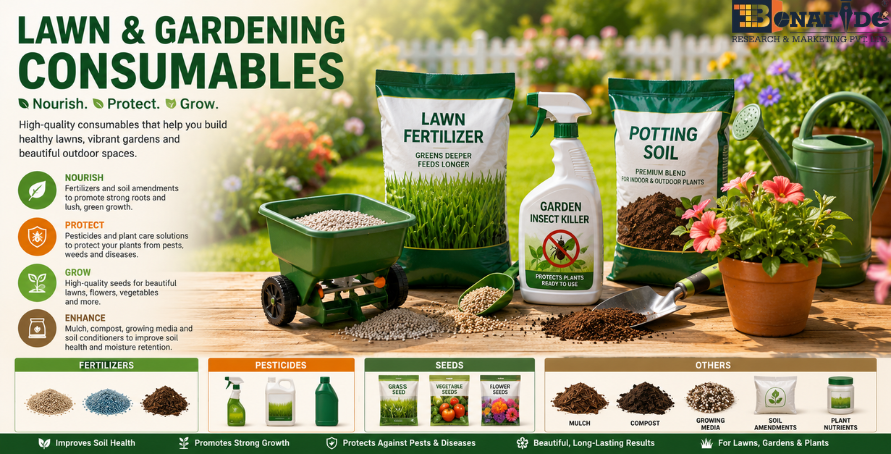
Consumers interest in landscaping is expected to dramatically raise demand for lawn and gardening goods. This increase is due to a rising industry driven by both residential and commercial construction projects, as well as the trend of converting outdoor areas into entertainment spaces such as lounges, outdoor kitchens, and party venues. With the increase in housing and commercial development, the demand for lawn and gardening consumables, particularly in the interior decoration industry, where landscaping plays an important role, is likely to rise significantly. Manufacturers are focusing on expanding their portfolios with eco-friendly formulations, biological
crop protection products, premium grass
seeds, plant nutrition solutions, and sustainable
packaging. Strategic partnerships, product innovation,
digital retail expansion, and investments in research and development are expected to intensify competition as companies respond to evolving consumer preferences for environmentally responsible gardening solutions.
A lawn is an area that is covered with soil, grass, and durable plants, which are sustained at short height using lawn movers. A garden is a well-planned area where ornamental plants, pinnacle plants, bushes, basils, or large trees are grown to maintain a healthy environment. These lawn spaces are used as a play area for kids, outdoor activities, and relaxation purposes, whereas gardens environ home that add aesthetic look to its surroundings. The growing emphasis of consumers on sustainability and eco-friendly practices is another significant factor driving the growth of the lawn and gardening consumables industry. Increasing awareness regarding environmental issues has led to a rise in the number of gardeners opting for organic products and sustainable gardening methods that minimize the use of chemicals and promote biodiversity. The demand for organic fertilizers and biopesticides has surged as consumers seek healthier options for their gardens. This shift toward sustainable practices supports environmental health and aligns with the preferences of a more eco-conscious consumer base.
According to the research report "Global Lawn & Gardening Consumables Market Outlook, 2031," published by Bonafide Research, the Global Lawn & Gardening Consumables market was valued at more than USD 22.84 Billion in 2025, and expected to reach a market size of more than USD 30.60 Billion by 2031 with the CAGR of 5.12% from 2026-2031.
Fertilizers remain the dominant product type in the global lawn and gardening consumables industry because virtually every cultivated lawn, ornamental garden, landscape, park, sports field, golf course, and urban green space depends on continuous nutrient replenishment to maintain healthy vegetation. Plants naturally remove essential nutrients from soil during growth, while rainfall, irrigation, harvesting, and repeated cultivation gradually reduce nutrient availability, making external nutrient application necessary in most managed landscapes. The Food and Agriculture Organization (FAO) defines soil fertility as the ability of soil to sustain plant growth by supplying essential nutrients and emphasizes that fertilizers become necessary whenever natural nutrient cycles cannot adequately support vegetation. FAO further explains that fertilizers include mineral, chemical, organic, and recycled nutrient sources that provide
nitrogen, phosphorus, potassium, sulfur, calcium, magnesium, and micronutrients essential for plant development. The leading position of fertilizers is further reinforced by their importance in sustainable soil management. The FAO International Code of Conduct for the Sustainable Use and Management of Fertilizers, endorsed by FAO member countries, recognizes fertilizers as one of the world's most important agricultural and horticultural inputs while promoting their responsible production, trade, regulation, recycling, and efficient use. Rather than discouraging
fertilizer use, international policy encourages balanced nutrient management, improved fertilizer quality, nutrient recycling, and integrated soil fertility management to maximize plant productivity while protecting ecosystems. These recommendations apply not only to agriculture but also to landscaping, horticulture, urban greening, and recreational green spaces where long-term soil productivity is essential.
Commercial end users are experiencing the fastest growth in the global lawn and gardening consumables market as businesses, governments, educational institutions, healthcare facilities, hospitality operators, municipalities, sports venues, and corporate campuses increasingly recognize professionally managed green spaces as essential assets rather than decorative additions. Unlike residential gardening, commercial landscaping requires scheduled maintenance throughout the year, resulting in repeated procurement of fertilizers,
soil conditioners, mulch, pesticides, seeds, compost, and growing media to preserve plant health and landscape quality. The expansion of hotels, resorts, office complexes, mixed-use developments, airports, shopping centers, golf courses, public parks, and smart-city projects has substantially increased the scale of professionally maintained landscapes worldwide. Another important factor supporting commercial growth is the increasing emphasis on urban green infrastructure. The Food and Agriculture Organization (FAO) promotes urban and peri-urban greening through its Green Cities Initiative, encouraging governments and municipalities to integrate vegetation into urban planning to improve environmental resilience, reduce heat islands, strengthen biodiversity, and enhance quality of life. These initiatives stimulate continuous demand for lawn and gardening consumables because parks, recreational areas, institutional campuses, roadside landscapes, and ecological restoration projects require ongoing plant nutrition, pest management, and soil improvement rather than one-time installation. Commercial operators are also increasingly adopting advanced landscape management practices that combine
smart irrigation, precision nutrient management, water-efficient fertilizers, drought-tolerant vegetation, and environmentally responsible maintenance programs. Hotels, educational institutions, hospitals, municipalities, and corporate campuses frequently operate under sustainability commitments that require efficient resource utilization while maintaining high-quality landscapes. These organizations therefore procure specialized consumables designed to improve nutrient-use efficiency, reduce water consumption, and support healthy vegetation under varying climatic conditions.
Retail stores remain the leading distribution channel for lawn and gardening consumables because purchasing decisions for fertilizers, pesticides, seeds, compost, mulch, soil conditioners, and growing media are often influenced by local climate, seasonal planting schedules, and the need for product-specific advice. Unlike many fast-moving consumer goods that can easily be purchased online without prior evaluation, lawn and gardening consumables frequently require customers to compare formulations, verify compatibility with local soils, understand application methods, and receive recommendations from knowledgeable retail staff before making a purchase. Garden centers, agricultural retailers, home improvement stores, nurseries, hardware chains, and specialty gardening outlets therefore continue to function as trusted destinations where consumers and professional landscapers can obtain both products and technical assistance. Another important advantage of physical retail is the ability to provide complete gardening solutions in one location. Customers purchasing fertilizers often simultaneously buy seeds, irrigation accessories, gardening tools, pots, soil amendments, decorative plants, and pest-control products, allowing retailers to serve multiple customer requirements during a single visit. Professional landscaping companies, municipalities, golf courses, hospitality operators, educational institutions, and commercial property managers further reinforce retail store leadership because maintenance activities frequently require immediate replenishment of consumables during ongoing operations.

















 We are friendly and approachable, give us a call.