The global
phosphatic fertilizer market is undergoing a fundamental strategic pivot, moving decisively away from a singular focus on phosphorus concentration toward integrated soil health solutions. After five years of supply chain disruptions, trade policy interventions, and escalating affordability crises, the industry is now witnessing the fastest growth in decades from a once?declining product: Single Superphosphate (SSP). According to sector analysis, widespread sulfur deficiency affecting over 40 percent of agricultural soils in major nations such as India has forced farmers to reassess the value of high?analysis
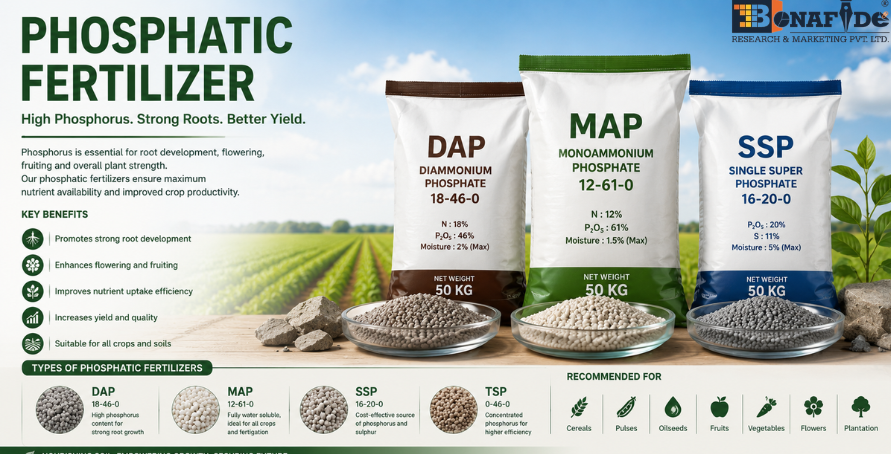
phosphates like DAP and MAP. SSP, which delivers 12?14 percent sulfur alongside 18?20 percent phosphorus, is emerging as the most cost?effective corrective measure. The International
Fertilizer Association projects that global nutrient consumption must rise, but the composition is fundamentally changing toward complete fertilizers that address multiple deficiencies in a single application. Major producers, including Coromandel International, have launched enriched SSP variants targeting this specific need, while competitors are pivoting production capacity away from traditional product lines. The market now serves a bifurcated landscape: concentrated phosphates remain dominant for
logistics?sensitive large?scale farms, but SSP and liquid formulations are capturing rapid share in precision agriculture and high?value horticulture segments where soil health and application accuracy command premium returns.
According to the research report "Global Phosphatic Fertilizer Market Outlook, 2031," published by Bonafide Research, the Global Phosphatic Fertilizer market was valued at more than USD 61.90 Billion in 2025, and expected to reach a market size of more than USD 81.18 Billion by 2031 with the CAGR of 4.65% from 2026-2031. Global transaction economics have been reconfigured by a groundswell of farmer demand for multi?nutrient solutions rather than single?analysis commodities. The sulfur fertilizer market, a direct indicator of soil health priorities, is on a strong growth trajectory driven by the recognition that sulfur deficiency has become a critical yield?limiting factor across the Americas, Europe, and Asia. In response, agricultural giants have accelerated development of fortified SSP variants. For instance, Indian experts now recommend three bags of SSP for wheat crops not only to compensate for phosphorus deficiency but also to deliver eighteen kilograms of sulfur per hectare eliminating the need for separate sulfur applications. This bundled economics is reshaping procurement behavior, with Brazilian and Southeast Asian buyers increasingly opting for lower?analysis but more complete carriers. Entry barriers for basic phosphates remain low, but the shift toward enriched and liquid formulations requires substantial research investment, favoring established producers. Consumer behavior has pivoted from pure price comparison to total nutrient value assessment, a trend reinforced by government subsidy programmes in emerging economies that now preferentially support balanced fertilizers. South America, led by Brazil's double?cropping system, remains the largest and fastest?growing regional market, with EuroChem inaugurating a billion?dollar phosphate complex to secure domestic supply.
The global resurgence of Single Superphosphate (SSP) is being fueled by its ability to correct widespread sulfur and calcium deficiencies through a single, cost-effective application, addressing a major constraint on crop productivity. While phosphate fertilizer markets were long dominated by higher-phosphorus products such as Diammonium Phosphate (DAP) and Monoammonium Phosphate (MAP), intensive farming practices have led to significant sulfur depletion in agricultural soils, with more than 40% of soils in countries such as India now considered sulfur deficient. SSP is uniquely positioned to address this challenge by supplying 18–20% phosphorus together with 12–14% sulfur, while also providing calcium that helps improve acidic soils, enhance soil structure, increase water-holding capacity, and promote stronger root development. Its economic advantage is particularly compelling, as applying three bags of SSP to a wheat crop can meet phosphorus requirements while delivering up to 18 kilograms of sulfur per hectare, eliminating the need for a separate sulfur fertilizer application. Growing interest in sustainable agriculture is further strengthening SSP demand because it has a lower carbon footprint than the more energy-intensive DAP and MAP fertilizers. Additionally, in India, SSP remains the only sulfur-containing fertilizer that provides water-soluble phosphorus, ensuring immediate nutrient availability for crops and reinforcing its value as a balanced and efficient nutrient source.
Solid granular phosphate fertilizers continue to dominate global markets because the entire fertilizer value chain from phosphate rock beneficiation and processing to international shipping, storage, distribution, and field application has been built around granular products for more than eight decades, creating a level of infrastructure lock-in that liquid alternatives struggle to overcome. Production facilities across major manufacturing regions, including Morocco, Saudi Arabia, and China, are designed to convert phosphoric acid and
ammonia into solid fertilizers such as DAP and MAP, and shifting to liquid formulations would require extensive plant redesign and billions of dollars in new capital investment. The logistical advantages of granules further reinforce their dominance, as dry bulk carriers can transport phosphate fertilizers efficiently through established global trade routes using the same infrastructure employed for grains, ores, and other bulk commodities, whereas liquid phosphates require specialized tank vessels, segregated handling systems, and higher freight costs. At the distribution level, warehouses, inland terminals, and agricultural supply networks across major farming regions are optimized for handling granular products, which can be bagged, stacked, transported, stored, and applied with minimal infrastructure. A standard bag of DAP, for example, can be easily moved, stored under basic conditions without deterioration, and accurately spread using conventional farm equipment. In contrast, liquid phosphates require dedicated storage tanks, corrosion-resistant pumps, and injection systems that are often uneconomical for smallholder farmers and local distributors. Granular fertilizers also offer superior physical stability across diverse climatic conditions, maintaining their integrity during storage from cold temperate regions to humid tropical environments. As a result, solid phosphate fertilizers dominate global markets not necessarily because they provide superior agronomic performance liquid formulations can sometimes deliver higher nutrient-use efficiency but because the global production, transportation, storage, and application ecosystem has been fundamentally designed around granular materials.
Phosphate consumption is expanding most rapidly in the fruit and vegetable sector because the economic returns generated from phosphorus application are significantly higher than those achieved in broadacre crops, directly influencing the quality characteristics that determine market value. Unlike cereal production, which primarily focuses on maximizing biomass and yield, fruit and vegetable cultivation depends on achieving premium attributes such as uniform size, vibrant color, firmness, blemish-free appearance, and extended shelf life. Phosphorus plays a central role in developing these qualities by supporting cell division, flower initiation, root development, and fruit enlargement. During critical growth stages, particularly in the weeks following flowering when fruit structure is established, adequate phosphorus availability promotes greater cell formation, resulting in larger, denser, and higher-quality produce at harvest. At the same time, global dietary trends are shifting toward increased consumption of fruits, vegetables, and nutrient-rich foods, driving demand for horticultural crops at a faster pace than staple grains. This growing demand is encouraging producers to adopt more intensive nutrient management practices, including precise phosphate fertilization. The use of highly soluble phosphate fertilizers during key developmental stages can improve fruit uniformity, reduce physiological disorders, enhance marketable yield, and increase the proportion of produce suitable for premium fresh markets rather than lower-value processing channels. Furthermore, improved fruit quality often translates into longer storage and transportation life, an increasingly important advantage in globalized food supply chains. As growers seek to maximize profitability, maintain market access, and meet rising consumer expectations, the fruit and vegetable sector is becoming the fastest-growing application area for phosphate fertilizers worldwide.








 We are friendly and approachable, give us a call.