The Global
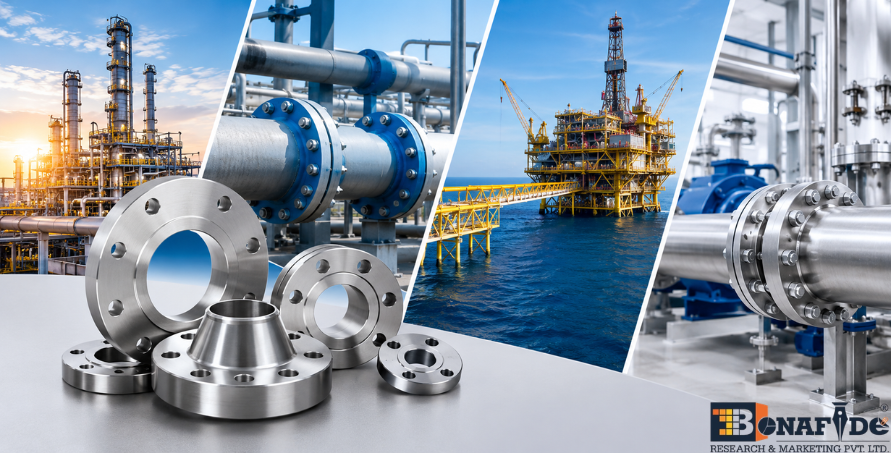
Flanges Market is gaining momentum as energy companies, industrial manufacturers, engineering contractors, infrastructure developers, and maintenance operators continue to invest in piping systems, processing facilities, power plants, water infrastructure, and large-scale industrial projects. Flanges are essential mechanical connection components used with pipes,
valves, pumps,
pressure vessels,
heat exchangers, and other equipment where secure, detachable, and serviceable connections are required. Demand spans weld neck, slip-on, blind, socket weld, threaded, lap joint, reducing, orifice, and specialty flange configurations, with
carbon steel,
stainless steel, alloy steel, duplex grades, and nickel-based alloys selected according to operating conditions. Oil and gas, refining, petrochemicals, chemicals, power generation, water treatment, mining, marine, manufacturing, and industrial construction remain important application areas. Asia-Pacific represents the leading regional market, supported by extensive manufacturing capacity, steel production, infrastructure development, refining, petrochemical investment,
shipbuilding, and industrial expansion across China, India, Japan, South Korea, and Southeast Asia. North America benefits from energy infrastructure, pipeline replacement, manufacturing investment, and industrial maintenance, while Europe is supported by process industries, energy modernization, chemical production, and infrastructure renewal. South America continues to generate opportunities through mining, energy, refining, infrastructure, and industrial development, while the Middle East and Africa benefit from oil and gas projects, petrochemical facilities, desalination, infrastructure, and large-scale industrial developments. Globally, customers are placing greater emphasis on pressure capability, corrosion resistance, dimensional accuracy, traceability, sealing performance, and long service life. Emerging investments in LNG, hydrogen, carbon-management systems, nuclear power, offshore energy, and other technically demanding applications are creating additional opportunities for specialized flange designs and advanced materials. At the same time, aging pipelines, refineries, processing facilities, and utility networks are sustaining replacement and maintenance requirements. Manufacturers are responding through improved
forging, precision machining, automated inspection, non-destructive testing,
digital documentation, customized designs, and faster delivery capabilities.
According to the research report, "Global Flanges Market Outlook, 2031," published by Bonafide Research, the Global Flanges Market Outlook was valued at more than USD 6.32 Billion in 2025, and expected to reach a market size of more than USD 8.81 Billion by 2031 with the CAGR of 5.84% from 2026-2031. The global flanges industry is also experiencing increased manufacturing investment, strategic acquisitions, portfolio expansion, and technology development across the wider piping and flow-control ecosystem. AFG Holdings announced the acquisition of Maass Flange Corporation and its affiliated businesses in Canada and Mexico in June 2021, combining carbon-steel capabilities with stainless- and nickel-alloy flange operations and strengthening its forged-products portfolio. Genesys Industries acquired Latrobe Foundry Machine & Supply Company in March 2024, adding threaded and flanged
aluminum pipe fittings and related mechanical products to its manufacturing operations. In the broader flow-control industry, Flowserve completed its acquisition of MOGAS Industries in October 2024, expanding its severe-service flow-control capabilities and strengthening its position in demanding industrial applications. Manufacturing capacity is also being expanded in North America. Victaulic announced an investment of more than $100 million to expand its Lawrenceville, Pennsylvania foundry, adding production space and advanced manufacturing equipment. Vallourec announced a $48 million investment in its Youngstown, Ohio facility in November 2025 to establish a new premium threading line serving energy applications. Product innovation is further influencing the industrial connection landscape. INTLEF Group introduced a hydraulic Quick-Connect Flange in 2025 for API 6A wellhead and blowout-preventer applications, targeting faster connection procedures and reduced installation effort. These developments demonstrate how manufacturers are pursuing greater production efficiency, improved connection performance, and application-specific solutions. Raw materials remain central to flange manufacturing, with carbon steel providing a broad base for conventional applications, while stainless steel, duplex alloys, alloy steel, and nickel-based materials address more demanding services involving corrosion, pressure, temperature, or aggressive media. The global steel industry provides the underlying material
foundation, with World Steel Association data showing approximately 1.85 billion tonnes of
crude steel production worldwide in 2025. China produced about 960.8 million tonnes, India approximately 165.6 million tonnes, the United States around 81.9 million tonnes, Japan about 80.7 million tonnes, and South Korea approximately 62.2 million tonnes. These major steel-producing economies support extensive downstream forging, machining, fabrication, and industrial-component manufacturing. Technology development is increasingly focused on CNC machining, automated dimensional inspection, ultrasonic testing, controlled heat treatment, digital quality records, forging optimization, material traceability, and customized flange production. Together, these developments are strengthening manufacturing capabilities and enabling suppliers to serve increasingly demanding energy, infrastructure, process-industry, and industrial customers worldwide.
Weld Neck Flanges remain an important product category globally, supported by their strong structural characteristics, pressure-handling capability, and suitability for demanding piping applications. The long tapered hub of a weld neck flange provides a gradual transition between the pipe and flange, helping distribute stresses and making the configuration suitable for systems exposed to high pressure, high temperature, thermal cycling, and mechanical loading. Oil and gas production, refining, petrochemical processing, power generation, chemical plants, offshore facilities, and other critical industrial operations commonly require robust connection systems capable of maintaining integrity under demanding operating conditions. Weld neck flanges are also frequently specified where fatigue resistance and long-term reliability are important considerations. Their application is supported by established engineering standards, material specifications, and procurement practices used by industrial operators and engineering contractors worldwide. Manufacturers are improving weld neck flange production through controlled forging, heat treatment, CNC machining, ultrasonic examination, dimensional inspection, and detailed material
certification. These processes help ensure consistent geometry, mechanical properties, and traceability. The segment also benefits from continued investment in high-pressure energy infrastructure, process plants, LNG facilities, petrochemical complexes, and industrial modernization. Emerging applications involving hydrogen, carbon-management infrastructure, advanced power systems, and offshore energy can create additional requirements for high-integrity connections and specialty materials. Although slip-on and other flange designs remain widely used where installation simplicity and conventional service conditions are priorities, weld neck configurations maintain an important position in technically demanding systems. Their ability to provide reliable connections in critical applications makes them particularly relevant to projects where failure could result in significant safety, environmental, or operational consequences. Continued development of high-performance alloys, precision forging, improved machining, and advanced inspection technologies is expected to strengthen the availability and performance of weld neck flanges across global industrial markets.
Others represents the fastest-growing end-use segment globally, supported by expanding flange requirements across industries beyond traditional oil and gas, refining, chemical, and power-generation applications. This category includes manufacturing, food and
beverage processing, marine activities, mining, construction, water infrastructure, shipbuilding, aerospace-related applications, industrial machinery, and other specialized sectors requiring reliable piping or mechanical connections. Industrial diversification is increasing the number of applications where flanges are needed, particularly as factories, processing facilities, water-treatment plants, ports, mines, and manufacturing sites expand or modernize. The food and beverage sector, for example, requires corrosion-resistant and hygienic components for process and utility systems, creating opportunities for stainless-steel flange products. Mining operations use flanged connections throughout slurry, water, process, and utility systems, while marine and shipbuilding applications require components capable of operating in demanding environments. Construction and building-services applications provide additional demand through mechanical piping, water systems, heating and cooling equipment, and industrial utilities. Manufacturing facilities are also increasingly using specialized piping systems for compressed air, chemicals, cooling water, steam, process fluids, and other services. The diversification of industrial investment across emerging and developed economies is therefore broadening the addressable customer base for flange manufacturers. Suppliers are responding with standardized products as well as custom-machined components designed around project-specific dimensions, materials, pressure classes, and connection requirements.
Digital manufacturing, CNC machining, automated inspection, and improved quality documentation are helping manufacturers serve smaller and more specialized orders while maintaining consistency. Growth in water infrastructure, mining, manufacturing, shipbuilding, food processing, and industrial construction is creating additional opportunities outside traditional energy applications. This broadening demand base is strengthening the role of the Others segment within the global flanges industry and reducing reliance on any single end-use sector.
Carbon steel remains the largest material segment globally, supported by its combination of strength, availability, established manufacturing infrastructure, and suitability for a wide range of conventional industrial applications. Carbon steel flanges are extensively used in oil and gas pipelines, refineries, power-generation facilities, water systems, manufacturing plants, mining operations, chemical facilities, and industrial utilities where service conditions can be managed through appropriate material selection and corrosion protection. The material benefits from a mature global supply chain extending from steel production and forging through heat treatment, machining, inspection, distribution, and fabrication. This established production network supports relatively consistent availability and makes carbon steel familiar to engineers, fabricators, contractors, and maintenance teams. Standardized specifications and established manufacturing processes also simplify procurement and replacement activities. Manufacturers are improving carbon-steel flange production through optimized forging processes, controlled heat treatment, CNC machining, ultrasonic testing, dimensional inspection, and digital material records. These technologies improve consistency while supporting increasingly demanding traceability requirements. Carbon steel is not appropriate for every service condition. Highly corrosive environments, extreme temperatures, cryogenic applications, certain hydrogen systems, and demanding offshore services can require stainless steel, duplex grades, alloy steel, or nickel-based materials. However, the broad range of conventional industrial applications suitable for carbon steel provides the material with a substantial and diversified demand base. Global steel production also provides a strong foundation for continued downstream manufacturing. Major steel-producing economies across Asia, North America, and other regions maintain extensive forging and fabrication industries capable of producing industrial components from carbon-steel grades. Continued development of pipelines, power plants, water infrastructure, manufacturing facilities, refineries, industrial plants, and mining projects supports ongoing requirements for carbon-steel flanges. Maintenance and replacement of existing equipment provide an additional recurring demand source. The combination of established availability, mechanical performance, manufacturing familiarity, and broad application suitability keeps carbon steel at the center of the global flange industry.
Asia-Pacific represents the leading regional market for flanges, supported by its extensive manufacturing base, large steelmaking industry, expanding infrastructure, energy investment, shipbuilding, refining, petrochemicals, mining, and industrial construction. China serves as the region's principal manufacturing center and provides a substantial ecosystem covering steel production, forging, machining, fabrication, industrial equipment, and export-oriented manufacturing. India is strengthening its position through refinery development, manufacturing investment, power generation, transportation infrastructure, urban development, and industrial expansion. Japan and South Korea contribute advanced engineering capabilities, particularly in shipbuilding, energy equipment, specialty materials, automotive manufacturing, and high-quality industrial components. Southeast Asian economies are also becoming increasingly important as manufacturing capacity expands and supply chains diversify across Indonesia, Vietnam, Thailand, Malaysia, and the Philippines. The region's large steelmaking base supports downstream flange manufacturing. World Steel Association data for 2025 recorded approximately 960.8 million tonnes of crude-steel production in China, 165.6 million tonnes in India, 80.7 million tonnes in Japan, and 62.2 million tonnes in South Korea. This extensive raw-material foundation supports forging, machining, and fabrication industries serving both domestic and international customers. Infrastructure development remains an important source of demand, with industrial parks, ports, power facilities, factories, refineries, chemical plants, water-treatment systems, and transportation projects requiring extensive piping networks. North America and Europe remain important mature industrial markets, supported by energy infrastructure, process industries, maintenance, modernization, and specialized manufacturing. South America offers opportunities through mining, energy, infrastructure, and industrial development, while the Middle East and Africa benefit from hydrocarbons, petrochemicals, desalination, infrastructure, and major industrial projects. Across the global market, manufacturers are increasingly investing in automation, CNC machining, non-destructive testing, digital inspection, heat-treatment control, and electronic quality documentation. Asia-Pacific's combination of raw-material availability, manufacturing scale, domestic consumption, export capability, and continuing industrial investment gives the region a strong structural position in the global flanges market.





















 We are friendly and approachable, give us a call.