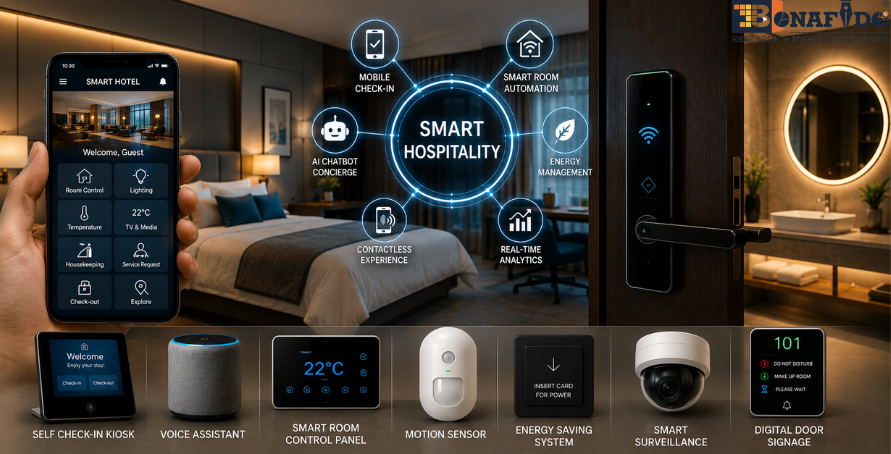
The global smart hospitality market has undergone a transformative evolution over the past five years, shifting from isolated technology pilots to a strategic imperative that now defines competitive advantage across the industry. A landmark global study conducted by h2c in partnership with Cloudbeds, released in October 2025, surveyed 189 quantitative responses and 26 executive interviews across 171 hotel chains representing more than 11,000 properties and 1.3 million rooms worldwide. The findings reveal that 78% of hotel chains are already using artificial intelligence, with 89% planning to expand AI applications over the next 12 to 24 months. Chatbots lead current AI deployment at 42%, while customer data management tops future expansion priorities at 50%. This digital acceleration is propelled by post-pandemic digitization efforts, rising global tourism, and fundamentally shifting consumer expectations toward contactless, personalized experiences. The industry has invested heavily in mobile room keys, app-based services, facial recognition check-ins, and AI-enabled multilingual chatbots that provide round-the-clock guest support. Smart energy management systems incorporating occupancy sensors and automated HVAC controls have simultaneously helped hotels cut operational costs while aligning with sustainability goals. Major hotel chains have rolled out centralized platforms to gather and analyze guest data across properties, improving loyalty programs and tailoring marketing campaigns. The United Nations Tourism Organization's 26th General Assembly, held in Riyadh in November 2025 under the theme "AI-Powered Tourism: Redefining the Future," brought together global leaders to explore how artificial intelligence and emerging technologies can transform the tourism landscape.
According to the research report "Global Smart Hospitality Market Outlook, 2031," published by Bonafide Research, the Global Smart Hospitality market was valued at more than USD 29.03 Billion in 2025, and expected to reach a market size of more than USD 97.93 Billion by 2031 with the CAGR of 23.05% from 2026-2031. The global smart hospitality ecosystem is characterized by dynamic innovation across cloud-based platforms, AI-driven solutions, and integrated IoT systems reshaping hotel operations from luxury properties to budget accommodations. Oracle Hospitality continues to dominate the property management system landscape, with PPHE Hotel Group migrating its 18 properties with 5,200 rooms across the UK, the Netherlands, and Italy to Oracle OPERA Cloud, eliminating on-premises hardware and significantly reducing IT overhead. UMusic Hotels, a pioneering hospitality group, has similarly tapped NetSuite and OPERA Cloud to gain a 360-degree view of its business and engage guests in real time. Mews, recognized as a Leader in the 2025 IDC MarketScape for Worldwide Hospitality Property Management Systems, now serves over 12,500 customers across more than 85 countries, unifying core property management, guest journeys, revenue management, payments, and business intelligence. The company's 2025 acquisitions of Clarity, Flexkeeping, and DataChat have transformed it from a cloud-native PMS into an intelligent hospitality operating system. The American Hotel & Lodging Association (AHLA), representing more than 30,000 members including 80% of all franchised hotels, recognized Agilysys Book with S.P.E.N.D. as the 2025 TechOvation Award winner for its technology breakthrough that increases ancillary revenue and guest personalization. Belmond earned recognition for developing Bella, an AI-powered email assistant leveraging HTNG AI for Hospitality best practices, while Canary Technologies was honored for automating guest communications across voice, chat, and messaging platforms. The competitive landscape features both global technology giants and specialized innovators, with cloud-based Software-as-a-Service models reducing entry barriers while data privacy regulations create additional compliance considerations.
Services represent the fastest-growing component in the global smart hospitality market because the complexity of AI integration, cloud migration, and IoT deployment creates immense demand for specialized expertise in implementation, training, and ongoing support across diverse global markets. The h2c/Cloudbeds study confirms that lack of expertise (62%) and integration challenges (45%) remain top obstacles to scaling AI adoption, creating substantial demand for professional services. Only 6% of hotel chains operate with a comprehensive AI strategy, highlighting the need for strategic consulting and implementation support. PPHE Hotel Group's migration of 18 properties to Oracle OPERA Cloud required specialized implementation services to standardize business processes and optimize operational performance. Mews' acquisitions of Clarity, Flexkeeping, and DataChat demonstrate how technology providers are expanding their service capabilities to meet growing demand. The fragmented nature of the global hospitality market, with diverse regulatory environments and technology readiness levels across regions, creates ongoing demand for localized consulting and support. Hotels transitioning from legacy to cloud-based systems require comprehensive training services across the globe. The complexity of AI integration across 78% of hotel chains generates sustained demand for specialized professional services.
Hotels and resorts represent the dominant end-use segment in the global smart hospitality market because they encompass the world's vast and diverse accommodation landscape from international chains to independent properties all facing shared pressures from tourism growth, labor optimization, and evolving guest expectations. The h2c/Cloudbeds study surveyed 171 hotel chains representing more than 11,000 properties and 1.3 million rooms worldwide, confirming hotels as the primary adopters of AI and smart technologies. Major hotel groups including PPHE Hotel Group, UMusic Hotels, and Absolute Hotel Services are implementing Oracle OPERA Cloud to centralize guest data and operations. Mews serves over 12,500 customers across more than 85 countries, demonstrating the scale of hotel technology adoption globally. The AHLA represents more than 30,000 members from all segments of the industry, including iconic global brands and 80% of all franchised hotels. Hotels globally invested in connected room infrastructure and IoT-based maintenance systems. The fragmented nature of the global hotel market, dominated by independent and small-chain properties, creates diverse technology needs that drive innovation. Hotel groups across the world are deploying AI guest messaging, mobile check-in, and smart room technologies across their portfolios.
Guest Experience Management is accelerating as the fastest-growing application in the global smart hospitality market because hotels recognize that personalized, frictionless guest journeys directly drive loyalty, revenue, and competitive differentiation in an increasingly crowded market. The h2c/Cloudbeds study identifies guest communication (77%) and personalization and upselling as the most valuable AI applications today and driving future initiatives. Hotels globally invested in contactless solutions like mobile room keys, app-based services, and facial recognition check-ins to improve convenience. AI-enabled chatbots became central to guest communication, offering multilingual, round-the-clock support. Major hotel chains rolled out centralized platforms to gather and analyze guest data across properties, improving loyalty programs and tailoring marketing campaigns. Canary Technologies' AI-powered Guest Management System automates guest communications across voice, chat, and messaging platforms while reducing staff workload. Belmond's Bella AI-powered email assistant streamlines guest communications and booking inquiries with real-time personalization. Hotels will begin deploying digital twins of rooms to simulate guest preferences in real time. Voice-activated assistants will evolve to integrate with hotel CRM systems for contextual responses based on past stays.
On-premises deployment remains significant in the global smart hospitality market because many hotels across the world operate with legacy infrastructure, face data sovereignty requirements, and have made substantial capital investments in existing systems that create migration barriers. PPHE Hotel Group, a long-standing Oracle Hospitality OPERA 5 user, is migrating to OPERA Cloud PMS to eliminate the need for on-premises hardware. However, many established hotels globally continue operating with legacy Property Management Systems designed for on-premises deployment. Data sovereignty concerns and varying national regulations across different countries create incentives for localized on-premises data storage. Many hotels lack the IT resources and expertise to manage complex cloud migrations. The capital investment already made in on-premises infrastructure represents sunk costs that many properties are reluctant to abandon. Hybrid deployment models, combining on-premises core systems with cloud-based add-on services, are emerging as a pragmatic middle ground. The h2c study confirms that integration challenges remain a top obstacle, with 45% of hotel chains citing integration as a barrier to scaling AI adoption.


















 We are friendly and approachable, give us a call.