The Global
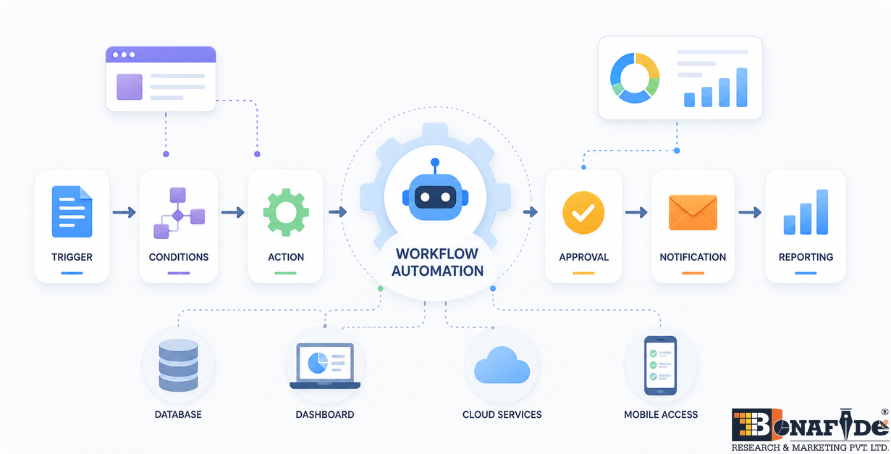
Workflow Automation Market is undergoing explosive growth, driven by the urgent need for enterprises to eliminate repetitive manual tasks, standardize processes, and meet escalating compliance demands. In the European Union, the landmark EU AI Act officially took effect in August 2024, establishing a risk-based tiered system for AI-driven workflow automation, with phased compliance deadlines extending through 2025, 2026, and 2027. Meanwhile, the United States has accelerated its federal AI push; in 2025, the Trump administration signed multiple executive orders (EO 14179, M-25-21, M-25-22) mandating federal agencies to adopt AI-enhanced workflow automations, prevent vendor lock-in, and establish technical operating standards. India enacted a massive regulatory overhaul in November 2025 by consolidating 29 old labor laws into 4 new labor codes, while the Reserve Bank of India mandated that all regulatory applications be submitted digitally via the PRAVAAH portal starting May 2025 effectively digitizing compliance workflows. In a landmark consolidation, November 2025 witnessed Process Maker and Decisions merge to form a global leader in Business Orchestration and Automation Technology ilities with Decisions' enterprise-grade rule engines collectively serving over 700 clients across financial services, insurance, and government. In August 2025, Salesforce aggressively expanded its Agent force ecosystem by acquiring AI-native startup Regrello to infuse agentic process automation directly into Slack and its CRM platform. Simultaneously, India’s Botree Software acquired Spoors to integrate mobile-first workflow automation into its distribution tech, targeting expansion into the Middle East, Africa, and Southeast Asia.
According to the research report "Global Workflow Automation Market Outlook, 2031," published by Bonafide Research, the Global Workflow Automation Market was valued at more than USD 22.69 Billion in 2025, and expected to reach a market size of more than USD 80.15 Billion by 2031 with the CAGR of 24.02% from 2026-2031.Earlier, in 2024, DocuWare acquired Natif.AI for intelligent document processing, and PairSoft absorbed APRO Software Solutions. Creatio established strategic partnerships with RITS Professional and Congero Technology Group, while Pega signed a five-year strategic collaboration with AWS to leverage agentic AI workflows for legacy modernization. Regarding raw materials, the "supply chain" for this market is not physical, but
digital comprising cloud computing infrastructure, AI
foundation models, NLP engines, and
cybersecurity protocols. These components are sourced from global hyperscalers, with intense competition for GPU compute power and data processing bandwidth. In terms of import-export trade, the market operates largely through SaaS cross border licensing. In the second half of 2025, the European business automation sector pivoted from GenAI experimentation to deploying autonomous "agentic" systems; a survey revealed that 89% of CIOs view agentic AI as a strategic priority, and US companies that have deployed it report a staggering 192% ROI. On the product front, Zoom Video Communications launched "Zoom Workflow Automation" in February 2025 a GenAI-powered platform featuring AI Companion for auto-summaries and a no-code drag-and-drop builder with pre-built templates. UiPath continues to dominate with its 2023.4 platform update, integrating advanced GenAI and automation intelligence to accelerate knowledge work. Most recently, in January 2026, Moglix introduced Cognilix, an AI-driven OS for B2B commerce that automates procurement workflows from digital catalogs and vendor compliance to competitive e-auctions and inventory forecasting.
The services component in the global workflow automation market is experiencing steady growth as businesses increasingly understand that successful automation requires professional guidance beyond simply adopting software platforms. Organizations across industries are seeking specialized service providers to evaluate existing processes, identify automation opportunities, configure workflow solutions, integrate different applications, and ensure smooth adoption across business operations. Many enterprises operate with complex technology environments that include legacy systems, cloud applications, enterprise software, and industry-specific platforms, creating a need for expert support to connect these systems effectively. Service providers help businesses design workflows that match their operational requirements while improving process efficiency, reducing manual intervention, and increasing transparency. Industries such as banking, healthcare, manufacturing, retail,
logistics, and
telecommunications are using automation services to support activities including process consulting, implementation, employee training, system integration, and workflow optimization. The increasing adoption of cloud-based automation platforms has also contributed to service demand because organizations often require assistance with migration, configuration, security management, and ongoing maintenance. Small and medium-sized enterprises particularly benefit from automation services because they can access technical knowledge and implementation capabilities without developing large internal technology teams. In addition, businesses are increasingly treating workflow automation as an ongoing improvement process rather than a one-time technology deployment.
Business Process Automation (BPA) has become the leading operation segment in the global workflow automation market because organizations worldwide are focusing on improving the efficiency of their core business activities through structured and automated processes. Companies across industries such as banking, healthcare, manufacturing, retail, telecommunications, logistics, insurance, and government services are adopting BPA to manage routine operations that previously depended heavily on manual efforts. Businesses are automating processes such as document approvals, invoice management, employee onboarding, customer service requests, procurement activities, compliance documentation, and internal communication workflows to reduce delays and improve accuracy. The increasing complexity of modern business operations has created a strong need for solutions that can connect different departments, applications, and data sources in a more organized manner. BPA enables organizations to create standardized workflows that improve collaboration and provide better visibility into ongoing activities. Many enterprises are integrating automation platforms with existing enterprise resource planning systems, customer relationship management tools, and cloud-based applications to create smoother operational environments. The growth of
digital transformation initiatives across regions has further accelerated BPA adoption as companies seek practical ways to modernize traditional processes without completely replacing existing systems. Small and medium-sized businesses are also using BPA solutions because cloud-based platforms and low-code automation tools allow them to improve efficiency without requiring extensive technical resources.
Small and Medium-sized Enterprises (SMEs) are becoming the fastest-growing organization segment in the global workflow automation market because these businesses are increasingly recognizing automation as a practical way to improve daily operations and compete in digitally evolving markets. SMEs across industries such as retail, professional services, manufacturing, healthcare, logistics, and financial services are adopting workflow automation to manage repetitive activities, improve process accuracy, and use their limited resources more effectively. Many smaller organizations handle tasks such as customer communication, invoice processing, employee management, inventory updates, scheduling, and document approvals manually, which can create operational delays and reduce productivity. Workflow automation helps SMEs simplify these activities by creating structured digital processes that require less manual intervention and provide better visibility into business operations. The availability of cloud-based automation platforms has played an important role in increasing adoption among SMEs because these solutions can be implemented without requiring large investments in physical infrastructure or dedicated technology teams. Low-code and no-code automation tools have further supported SME adoption by allowing business users to create and modify workflows with minimal programming knowledge. Unlike larger enterprises that may already have established systems, many SMEs are using automation as part of their broader digital transformation journey to modernize operations and improve customer experiences.
Retail and
E-commerce organizations are leading the adoption of workflow automation globally because their operations depend on continuous coordination between customers, suppliers, inventory systems, payment platforms, warehouses, and delivery networks. The rapid expansion of digital shopping, changing consumer expectations, and the need for faster service delivery has encouraged retailers to adopt automation technologies that improve operational efficiency and customer engagement. Businesses in this sector manage numerous repetitive activities, including order processing, product updates, customer notifications, payment verification, returns management, inventory tracking, and supplier coordination, making workflow automation highly valuable for reducing manual effort and improving accuracy. E-commerce companies especially rely on automated workflows to connect online storefronts, warehouse systems, logistics providers, and customer service platforms, ensuring smoother movement of information throughout the purchasing process. Traditional retailers are also adopting automation to integrate physical store operations with digital channels, allowing them to provide more consistent experiences across websites, mobile applications, and in-store services. Workflow automation enables companies to improve order fulfillment, manage customer requests faster, and maintain better visibility into business activities. The increasing use of cloud-based retail platforms has further supported automation adoption by allowing businesses to connect multiple applications and automate processes without major system changes.










 We are friendly and approachable, give us a call.