The global
phytonutrients market is witnessing strong expansion as consumers increasingly prioritize preventive healthcare, plant-based nutrition, healthy aging, and functional wellness. Growing awareness of the health benefits associated with naturally occurring bioactive compounds is accelerating demand for phytonutrient-rich ingredients across food and beverages,
dietary supplements,
animal nutrition,
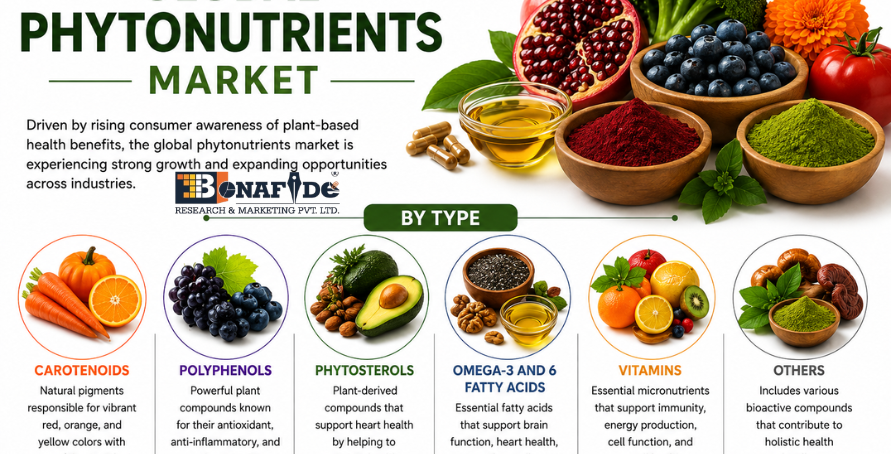
cosmetics and personal care, and pharmaceutical applications. Phytonutrients such as carotenoids, polyphenols, phytosterols,
omega-3 and 6 fatty acids, and vitamins are increasingly incorporated into functional formulations because of their potential antioxidant, anti-inflammatory, cardiovascular, immune-supporting, and overall wellness benefits. Rising interest in clean-label products, natural ingredients, botanical extracts, and scientifically supported nutritional solutions is further encouraging manufacturers to expand their phytonutrient portfolios.
According to the research report "Global Phytonutrients Market Outlook, 2031," published by Bonafide Research, the Global Phytonutrients Market was valued at more than USD 4.22 Billion in 2025 and is anticipated to reach more than USD 8.95 Billion by 2031, expanding at a CAGR of 13.69% during 2026–2031.Innovation across ingredient extraction, purification, standardization, and formulation technologies is strengthening the commercial potential of phytonutrients. Manufacturers are increasingly investing in advanced extraction techniques, improved bioavailability, standardized botanical ingredients, encapsulation technologies, and stable delivery systems to enhance the functionality and shelf life of phytonutrient-based products. Developments in plant-based processing, sustainable sourcing, precision formulation, and ingredient traceability are also supporting greater consistency and quality across the global supply chain. At the same time, growing scientific research into the role of phytonutrients in oxidative stress management, cardiovascular wellness, immune health, metabolic health, and healthy aging is contributing to broader adoption across consumer and industrial applications.
By type, carotenoids, polyphenols, phytosterols, omega-3 and 6 fatty acids, vitamins, and other bioactive compounds represent key categories within the global phytonutrients market. Polyphenols are gaining considerable attention because of their broad presence in fruits, vegetables, herbs, teas, cereals, and other plant-based sources, while carotenoids continue to benefit from their use in nutritional, food, cosmetic, and functional formulations. Phytosterols are increasingly utilized in products focused on cardiovascular and
cholesterol-management applications, whereas omega-3 and 6 fatty acids remain important ingredients across dietary supplements, functional foods, and animal nutrition. Vitamins and other bioactive phytonutrients further expand the market by supporting multifunctional formulations designed around immunity, energy, skin health, and
general wellness.
By source, fruits and vegetables represent a major category owing to their naturally high concentration of diverse phytonutrients and widespread availability across global agricultural systems. Growing demand for
berries, citrus fruits, tomatoes, leafy vegetables, cruciferous vegetables, and other nutrient-rich crops is supporting the development of concentrated extracts, powders, oils, and
functional ingredients. Cereals, pulses, and oilseeds are also becoming increasingly important sources, particularly for plant-based proteins, essential fatty acids, phytosterols, polyphenols, and other bioactive compounds. Herbs and trees provide additional opportunities through botanical extracts and traditional plant ingredients, while other sources continue to contribute specialized phytonutrients for targeted applications.
By form, powder-based phytonutrients maintain significant market adoption because of their formulation flexibility, ease of transportation, relatively long shelf life, and compatibility with dietary supplements, functional foods, beverages, and animal nutrition products. Powdered ingredients can be incorporated into capsules, tablets, sachets, functional drinks, nutrition bars, fortified foods, and premixes, allowing manufacturers to develop a wide range of finished products. Liquid phytonutrients are also gaining traction in beverages, liquid supplements, cosmetic formulations, and specialized functional products where rapid incorporation and improved formulation flexibility are important. Advances in microencapsulation, emulsification, and stabilization technologies are further supporting the development of both powder and liquid phytonutrient formats.
Food and beverages represent a major application area as manufacturers increasingly incorporate phytonutrient-rich ingredients into
functional beverages, fortified foods, nutritional products,
dairy alternatives, snacks,
bakery products, and other health-oriented formulations. Consumer demand for natural colors, antioxidant-rich ingredients, clean-label formulations, and products offering additional nutritional benefits is encouraging food manufacturers to explore a wider range of plant-derived compounds. Dietary supplements remain another important application, supported by growing interest in immunity, healthy aging, cardiovascular health, energy, and overall wellness. Meanwhile, cosmetics and personal care manufacturers are increasingly utilizing botanical
antioxidants, vitamins, polyphenols, carotenoids, and other plant-derived compounds in skin and
hair care formulations.
Regional market dynamics continue to influence the global competitive landscape. North America represents a significant market for phytonutrients due to its established nutraceutical and
functional food industries, strong consumer awareness of preventive health, advanced ingredient development capabilities, and growing demand for natural and plant-based products. Europe benefits from a mature functional nutrition sector, increasing adoption of clean-label ingredients, strong consumer interest in sustainable sourcing, and continued innovation in botanical and plant-derived formulations across major markets such as Germany, the United Kingdom, France, Italy, and Spain. Asia-Pacific is emerging as a high-growth region, supported by expanding populations, rising disposable incomes, increasing health awareness, traditional use of botanicals, and growing demand for functional foods and dietary supplements across China, Japan, India, South Korea, Australia, and Southeast Asia.
Latin America offers additional growth opportunities due to its extensive agricultural resources, biodiversity, expanding functional food sector, and increasing consumer interest in natural
health products. Brazil, Mexico, Argentina, and other countries are attracting greater attention for their availability of fruits, vegetables, herbs, oilseeds, and other plant-based raw materials. Meanwhile, the Middle East and Africa are gradually strengthening their market position through healthcare modernization, expanding wellness sectors, increasing availability of premium nutritional products, and growing consumer awareness of preventive health and functional nutrition.
The competitive landscape is characterized by continued investment in ingredient innovation, botanical sourcing, extraction technologies, product development, and strategic partnerships. Major industry participants are focusing on expanding their plant-based ingredient portfolios, improving the functional performance of phytonutrients, strengthening global distribution networks, and developing application-specific solutions for food, supplements, cosmetics, pharmaceuticals, and animal nutrition. Companies are also placing greater emphasis on sustainable agriculture, responsible sourcing, traceability, and environmentally efficient processing as customers increasingly evaluate both the health and sustainability credentials of functional ingredients.
The market outlook remains favorable as the convergence of plant-based nutrition, preventive healthcare, functional foods, personalized wellness, and sustainable ingredient development creates new opportunities across the phytonutrients value chain. Continued scientific research, improved extraction and delivery technologies, increasing consumer awareness, and expanding applications are expected to support sustained demand for phytonutrient-based ingredients. As manufacturers increasingly focus on clean-label formulations, evidence-based health benefits, and innovative plant-derived solutions, phytonutrients are positioned to become an increasingly important component of the global functional nutrition and wellness industry.


















 We are friendly and approachable, give us a call.