The global
smart pole market represents the evolution of conventional street
lighting into intelligent, multifunctional urban infrastructure that combines
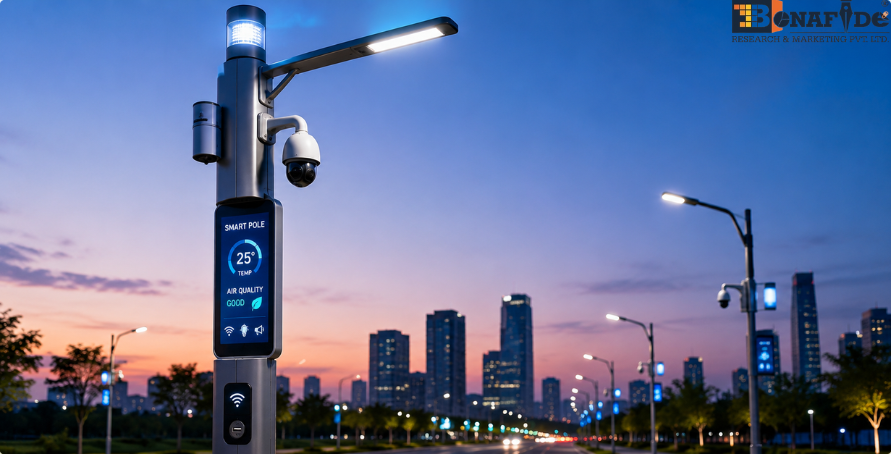
LED lighting with technologies such as Internet of Things (IoT) sensors, 4G/5G small-cell equipment,
CCTV cameras,
environmental monitoring systems, public Wi-Fi, emergency communication devices,
digital signage, and
electric vehicle charging facilities. Smart poles serve as connected urban hubs that collect, process, and transmit real-time data to improve traffic management, public safety, energy efficiency, environmental monitoring, and municipal operations. Over the past five years, the market has experienced strong momentum as governments and municipalities accelerated investments in smart city programs,
digital infrastructure, and sustainable urban development. The rapid rollout of 5G networks has significantly increased demand for smart poles because they provide ideal mounting locations for small-cell antennas while minimizing the need for new telecom structures. Growing urbanization, rising electricity costs, and stringent carbon reduction goals have further encouraged cities to replace conventional streetlights with energy-efficient, remotely managed smart poles. Public-private partnerships between municipalities, telecommunication operators, utility providers, and technology companies have also expanded deployment opportunities. Industry organizations and initiatives such as the
Smart Cities Council, the International Telecommunication Union (ITU), the IEEE Smart Cities program, and various national smart city missions have actively promoted standards, interoperability, and digital infrastructure adoption, supporting the market's development. During the last five years, market participants have increasingly focused on integrating
artificial intelligence,
edge computing, and cloud-based analytics into smart pole platforms to enable
predictive maintenance, adaptive lighting, intelligent surveillance, and real-time environmental monitoring. Manufacturers have also emphasized modular pole designs that allow cities to add new applications without replacing existing infrastructure, improving long-term investment value.
According to the research report "Global Smart Pole Market Outlook, 2031," published by Bonafide Research, the Global Smart Pole Market was valued at more than USD 15.40 Billion in 2025, and expected to reach a market size of more than USD 39.03 Billion by 2031 with the CAGR of 17.20% from 2026-2031. Leading companies such as Signify, Siemens, Huawei Technologies, Acuity Brands, Schr?der, Zumtobel Group, Eaton, Wipro Lighting, Telensa, Delta Electronics, and
General Electric are investing in product innovation, strategic partnerships, and integrated software platforms to strengthen their market positions. A notable recent development occurred in February 2024, when Unilumin Group and Huawei jointly introduced the Smart Pole Site Joint Solution at MWC Barcelona, combining intelligent lighting with advanced wireless communication infrastructure for smart city deployments. The market presents significant opportunities through expanding smart city initiatives, rapid 5G rollout, increasing electric vehicle charging infrastructure, AI-enabled traffic management, and growing adoption of edge computing and real-time analytics. Emerging economies across Asia-Pacific, the Middle East, and Latin America offer substantial deployment potential as governments prioritize digital infrastructure modernization. From a supply chain perspective, the industry begins with upstream suppliers of steel,
aluminum, LED luminaires, communication modules, semiconductor chips, cameras, sensors, controllers, batteries, and power management components. Midstream activities involve pole fabrication, electronics integration, software development, system assembly, testing, and
certification by manufacturers and technology providers. Downstream participants include telecom operators, electric utilities, engineering contractors, municipal authorities, smart city developers, and maintenance service providers responsible for installation, network integration, and lifecycle management. Public-private partnerships have become a preferred implementation model, enabling cities to share deployment costs with telecom operators and technology vendors while generating long-term value through connectivity services, digital
advertising, environmental monitoring, predictive maintenance, and data-driven urban management solutions.
Unlike hardware, which performs fixed physical functions after installation, software continuously expands the capabilities of smart poles through intelligent control, automation, and data-driven decision-making. Modern smart poles combine numerous technologies, including LED lighting, surveillance cameras, environmental sensors, public Wi-Fi, emergency communication systems, traffic monitoring devices, digital signage, and 5G small-cell infrastructure. Each of these devices generates operational data that must be processed, monitored, and managed efficiently, making software the operational backbone of the entire ecosystem. Municipal authorities increasingly rely on cloud-based management platforms to remotely adjust lighting intensity, monitor equipment health, schedule maintenance, detect equipment failures, and receive instant alerts without requiring field inspections. Artificial intelligence and machine learning have further increased software importance by enabling adaptive lighting based on pedestrian or vehicle movement, automated incident detection from surveillance cameras, predictive maintenance using equipment diagnostics, and real-time environmental analysis from air quality and
weather sensors. Open software architectures also allow cities to integrate smart poles with traffic control centers, emergency response systems, utility networks, and geographic information systems through standardized communication protocols. Frequent
cybersecurity updates, feature enhancements, regulatory compliance improvements, and compatibility with newly deployed IoT devices ensure that software remains under continuous development throughout the infrastructure lifecycle, unlike physical hardware that may remain unchanged for years.
Most urban areas worldwide already possess extensive streetlight infrastructure that has been in service for decades, making retrofit installation the most practical approach for introducing smart city technologies. Instead of removing structurally sound poles, municipalities can upgrade them with LED luminaires, communication modules,
IoT sensors, surveillance cameras,
environmental monitoring devices, public Wi-Fi equipment, emergency call systems, and 5G small-cell antennas. This approach significantly reduces construction activities, excavation work, road closures, and public disruption compared with installing entirely new poles. Existing electrical wiring, foundations, and mounting structures can often be reused after structural assessment, shortening project implementation timelines and simplifying regulatory approvals. Many local governments also face budget constraints, making infrastructure modernization through retrofitting more financially manageable than complete replacement programs. Advances in modular smart pole components have further accelerated retrofit adoption because standardized brackets,
sensor packages, controllers, and communication devices can be installed on conventional poles with minimal structural modification. Utilities and municipalities also benefit from retaining existing asset inventories while extending infrastructure service life through digital upgrades. Retrofitted poles can immediately connect to centralized management platforms, enabling remote lighting control, predictive maintenance, fault detection, and energy optimization without rebuilding the surrounding streetscape. Telecom operators increasingly utilize retrofit poles for mounting compact 4G and 5G small-cell equipment, reducing the need for additional standalone structures in dense urban environments.
Public places and plazas have become focal points for smart city investments because they accommodate large numbers of residents, commuters, and tourists who increasingly expect reliable digital services alongside safe and comfortable public environments. Unlike conventional lighting infrastructure, smart poles installed in these locations support multiple municipal functions from a single installation point. Integrated surveillance cameras strengthen public safety through continuous monitoring, while emergency communication systems improve response capabilities during incidents. Public Wi-Fi services enhance digital accessibility for visitors, and environmental sensors continuously measure air quality, temperature, humidity, and noise levels to assist municipal environmental management. Digital information displays installed on smart poles provide navigation assistance, public transport updates, event announcements, emergency notifications, and community information without requiring additional physical infrastructure.
Smart lighting systems equipped with occupancy sensors automatically adjust illumination according to pedestrian activity, reducing unnecessary energy consumption while maintaining adequate visibility during periods of high public use. These locations also serve as strategic sites for deploying 4G and 5G small-cell equipment because dense pedestrian traffic generates high mobile data demand. Urban planners increasingly integrate smart poles into redevelopment projects to create aesthetically coordinated public spaces without adding excessive street
furniture, reducing visual clutter while maximizing functionality. During public events, festivals, and civic gatherings, smart poles support crowd management, security coordination, and communication through connected monitoring systems. Municipal authorities further benefit from centralized software platforms that remotely supervise lighting, sensor performance, communication devices, and maintenance activities across multiple public spaces.










 We are friendly and approachable, give us a call.