The global scrubber systems market stands at the intersection of stringent environmental mandates and industrial operational pragmatism, having evolved rapidly over the last half-decade from a niche compliance tool to a critical infrastructure component. Initially propelled by the International Maritime Organization's (IMO) 2020 global sulfur cap, the market's growth trajectory is now being reshaped by a dual force: the relentless expansion of industrial capacity in developing economies and the escalating enforcement of emission norms in mature ones. The regulatory landscape is becoming a complex mosaic, with the European Union's Industrial Emissions Directive (IED) pushing for Best Available Techniques (BAT) and the U.S. Environmental Protection Agency (EPA) tightening National Emission Standards for Hazardous Air Pollutants (NESHAP). This is not merely about compliance; it represents a fundamental shift towards sustainable operations, forcing industries from
cement manufacturing to petrochemical refining to re-evaluate their environmental footprint. The market serves as a technological bridge, allowing heavy industries to continue operations while transitioning towards a lower-carbon future, despite the growing competitive pressure from alternative fuels like
ammonia and
methanol.
According to the research report "Global Scrubbers System Market Outlook, 2031," published by Bonafide Research, the Global Scrubbers System market was valued at more than USD 5.59 Billion in 2025, and expected to reach a market size of more than USD 9.73 Billion by 2031 with the CAGR of 9.94% from 2026-2031. The competitive landscape is characterized by a mix of established European engineering giants and agile Asian manufacturers, each offering distinct value propositions. Companies like W?rtsil? and Alfa Laval dominate the high-margin, technologically advanced marine scrubber segment with sophisticated hybrid systems. In contrast, the market dynamics shift drastically in land-based applications, where players such as Mitsubishi Power and Ducon Technologies compete on large-scale, capital-intensive
Flue Gas Desulfurization (FGD) projects for power generation. The value chain extends from specialized alloy suppliers to engineering, procurement, and construction (EPC) firms, creating significant entry barriers due to the high capital outlay and the need for extensive after-sales service networks. Transaction economics are heavily influenced by the price differential between high-sulfur and low-sulfur fuels for marine operators, and the cost of carbon credits for stationary sources. Consumer behavior is migrating towards performance-based contracts and
predictive maintenance models, leveraging the Internet of Things (IoT) to optimize chemical consumption and ensure operational reliability.
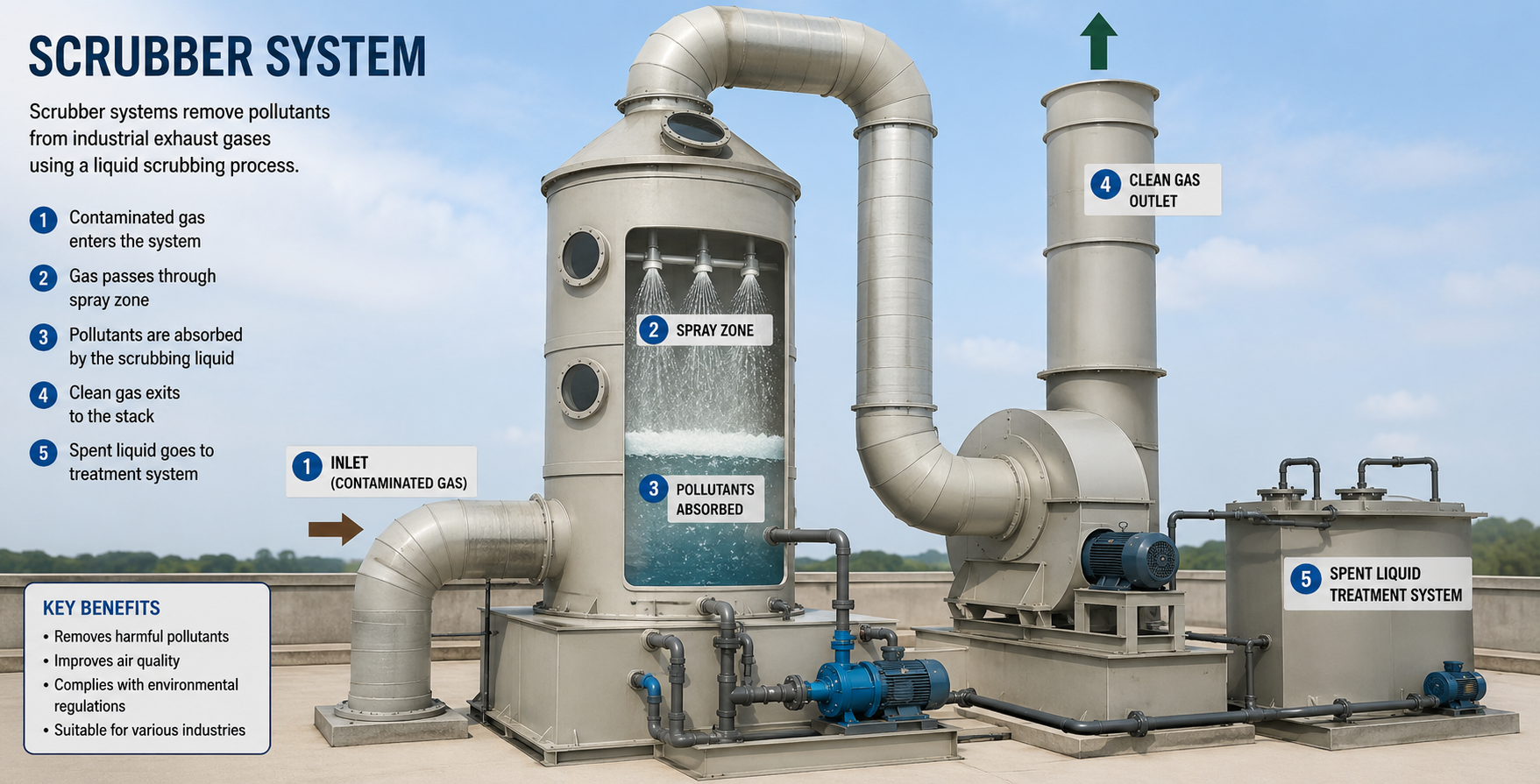
Wet scrubbers dominate the global market due to their superior SO? removal efficiency, proven reliability, and widespread deployment across power generation, chemical processing, and waste incineration sectors where high-performance flue gas treatment is mandatory. The European Union's Industrial Emissions Directive identifies wet scrubbers as the primary technique taken up in IED ELV and upper BAT-AEL scenarios, with high-efficiency wet scrubbers preferentially selected to achieve lower emission levels at higher cost. China's wet scrubbers with lime-gypsum wet FGD being the most widely adopted process for large-capacity power generation boilers across the country's extensive coal-fired fleet. Japan's Ministry of Environment confirms that wet scrubbing is the predominant method, with the majority of installed flue gas desulfurization equipment using wet methods that achieve excellent desulfurization rates and stable performance under load fluctuations. South Korea's Dangjin Power Station's wet
limestone-gypsum FGD system achieves >95% SO? removal efficiency, demonstrating the technology's effectiveness in meeting stringent national emission standards under the Clean Air Conservation Act. India's CPCB FGD guidelines identify wet limestone-gypsum FGD as the most commonly used system for large-scale flue gas treatment, with 95% of coal's sulphur converting to SO?, driving demand for high-efficiency wet scrubbers. Saudi Arabia's DynaWave scrubbers dominate the oil and gas industry with over 80% of those installed in the region, demonstrating the technology's prevalence in the world's largest petroleum-producing markets. South Africa's Kusile Power Station, the first coal-fired power station in Africa to incorporate wet limestone FGD technology, demonstrates the global reach of wet scrubber deployment across emerging markets.
Particulate cleaning is experiencing rapid growth due to tightening global PM2.5 and PM10 emission standards, the EPA's March 2025 NAAQS revisions, and extensive industrial base requirements for continuous particulate emission control. The EPA's March 2025 announcement on national air quality standards for PM2.5 has intensified demand for high-efficiency particulate scrubbers, as facilities must achieve stricter particulate emission limits to maintain operating permits across the United States. Electrostatic precipitators, fabric filters, and venturi scrubbers with wet scrubbing capabilities are deployed in cement kilns, metal processing, and waste incineration facilities globally, addressing particulate emissions from diverse industrial bases. China's new Wet Flue Gas Desulfurization Equipment Technical Specifications added PM2.5 co-treatment indicators, requiring existing equipment upgrades across the country's thermal power fleet. South Africa's Kusile Power Station, the first coal-fired power station in Africa to incorporate wet limestone FGD technology, demonstrates the scale of particulate cleaning investment in emerging markets. The Middle East Industrial Duct Dust Collection Market is valued at USD 600 million, reflecting significant investment in particulate control infrastructure across the region's industrial base. Indonesia's Morowali Industrial Park, one of the world's largest nickel processing hubs, implements extensive scrubber systems to manage particulate emissions, demonstrating the growing importance of particulate cleaning in Asia-Pacific.
The marine sector represents the largest end-user industry for scrubber systems due to the IMO 2020 sulphur cap's global enforcement, the sheer size of the commercial shipping fleet, and the economic advantage of continuing to use cost-effective high-sulphur fuel oil while meeting emission limits. Over 5,800 commercial vessels use scrubbers in 2025, up from just 3 vessels in 2008 and 4,341 in 2020, demonstrating the explosive growth trajectory driven by the IMO regulatory timeline. Scrubbers enable vessels to continue burning heavy fuel oil, which costs approximately $200-300 per tonne less than compliant low-sulphur fuels, creating significant economic incentives for shipowners facing tight profit margins. Open-loop scrubbers comprise approximately 80% of global installations, though they face increasing restrictions in ports worldwide, with over 100 ports prohibiting or restricting scrubber discharges since IMO 2020. Japan's Mitsubishi Heavy Industries developed the first domestically produced marine SOx scrubber system, while ADNOC
Logistics & Services contracted scrubber retrofits on three tanker vessels, demonstrating the global reach of marine scrubber adoption. The OSPAR ban and growing restrictions on open-loop scrubbers are accelerating adoption of closed-loop and hybrid systems, driving continued investment in the marine segment.
Horizontal scrubbers are experiencing the fastest growth due to their lower pressure drop, easier media replacement access, and preference for marine applications where space optimization and height restrictions are critical considerations for vessel operators and industrial facility managers. Horizontal scrubbers offer lower pressure drop and easier access for media replacement, making them attractive for retrofit projects where vertical clearance is limited and space optimization is essential for industrial facilities. The marine sector's preference for horizontal configurations in engine exhaust applications reflects space optimization requirements aboard vessels, where vertical clearance is often constrained and equipment must fit within limited engine room spaces. Horizontal scrubbers are gaining traction in global maritime segments as scrubber installations continue to grow, driven by IMO 2020 compliance and the need for space-efficient solutions for vessel exhaust gas cleaning systems. Cross-flow horizontal designs are increasingly specified for facilities with height restrictions, enabling scrubber installation in spaces where vertical scrubbers cannot be accommodated due to building height or operational constraints. Horizontal scrubber systems are well-suited for retrofit projects at existing industrial facilities where vertical clearance limitations preclude installation of traditional vertical scrubber configurations. The OSPAR ban and growing restrictions on open-loop scrubbers have driven adoption of closed-loop systems, with horizontal configurations offering operational flexibility for vessels calling at ports with discharge restrictions, further accelerating their adoption rate.












 We are friendly and approachable, give us a call.