The global
cheese ingredients market is a rapidly expanding segment of the dairy industry, driven by rising demand for processed foods, convenience-based diets, and premium dairy formulations.
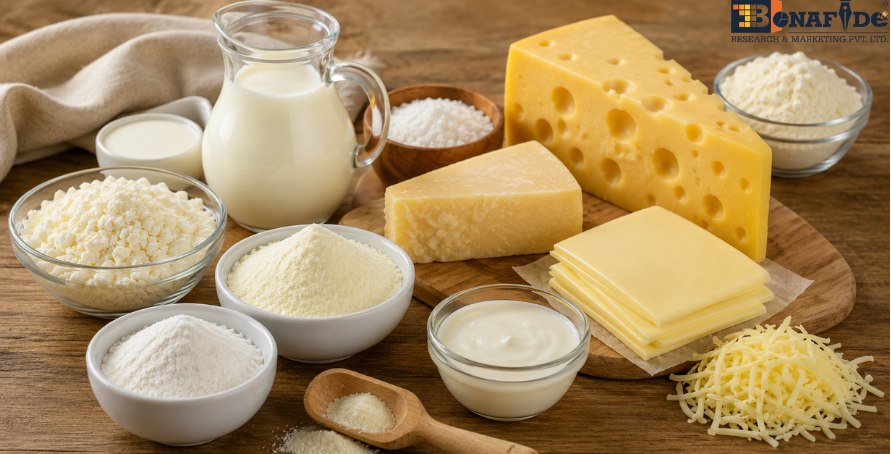
Cheese ingredients include
milk solids, whey proteins, casein, microbial cultures, and
enzymes such as rennet, emulsifying salts, and functional dairy additives that enhance texture, flavor, shelf life, and yield in cheese production. The market is strongly influenced by the growth of fast-food chains, bakery applications, ready-to-eat meals, and industrial food processing. Increasing consumption of mozzarella, cheddar,
cream cheese, and
processed cheese across households and foodservice industries is a major driver. Additionally, rising demand for high-protein diets and functional foods has increased the use of whey protein and bioactive
dairy ingredients in sports
nutrition and health products. From a regulatory perspective, the global cheese ingredients market is governed by stringent food safety and quality frameworks. Key international standards include Codex Alimentarius guidelines, which set benchmarks for dairy hygiene, labeling, and compositional requirements. In the United States, the Food and Drug Administration (FDA) regulates dairy ingredients under strict food safety modernization rules, while the European Food Safety Authority (EFSA) enforces rigorous compliance for enzyme safety, microbial cultures, and additives. Many countries also require allergen labeling and traceability systems for dairy-based ingredients.
According to the research report "Global Cheese Ingredients Market Outlook, 2031," published by Bonafide Research, the Global Cheese Ingredients market was valued at more than USD 41.74 Billion in 2025, and expected to reach a market size of more than USD 55.92 Billion by 2031 with a CAGR of 5.12% from 2026 to 2031. The global cheese ingredients market is deeply integrated into international dairy trade networks, with strong cross-border flows of raw materials, intermediate ingredients, and finished dairy formulations. Key raw materials include raw cow, goat, and sheep milk, whey derivatives, casein, microbial cultures, and enzyme systems such as rennet and lipase. Major exporting regions include Europe, the United States, New Zealand, and Australia, while high-demand importing regions include Asia-Pacific, the Middle East, and Latin America. The growth of industrial cheese manufacturing and foodservice expansion has significantly increased global trade volumes for dairy proteins and
functional ingredients. The market has witnessed increasing mergers, acquisitions, and strategic collaborations aimed at strengthening biotechnology capabilities and expanding global supply chains. A major example is the formation of Novonesis, which created a global leader in enzymes and microbial cultures for dairy applications, significantly impacting cheese ingredient innovation. Similarly, large dairy corporations such as Arla Foods, Lactalis, FrieslandCampina, and Fonterra continue to expand globally through acquisitions, joint ventures, and distribution partnerships to strengthen their ingredient portfolios and regional reach. Kerry Group and other ingredient specialists have also invested heavily in cheese flavor systems and functional dairy solutions to serve industrial food manufacturers. Technological advancements are reshaping the global cheese ingredients landscape.
The rapid expansion of
vegan cheese ingredients in the global cheese ingredients market is closely linked to major shifts in consumer dietary behavior, food technology innovation, and increasing awareness of health, environmental, and ethical considerations associated with food production systems. Across many regions, a growing number of consumers are reducing or eliminating dairy from their diets due to lactose intolerance, milk allergies, digestive discomfort, and lifestyle choices associated with vegan and flexitarian eating patterns. This has created a strong
foundation for the development and consumption of plant-based cheese products made from ingredients such as soy protein,
pea protein,
coconut oil, cashew, almond,
starch systems, fibers, and fermentation-derived compounds designed to replicate the functional properties of dairy cheese. One of the most important drivers behind this growth is technological advancement in food formulation and processing, which has significantly improved the sensory and functional performance of vegan cheese products, enabling better melting, stretching, and flavor retention compared to earlier generations of dairy-free alternatives. Food manufacturers globally are investing heavily in research and development to refine
plant protein extraction, microbial fermentation, and fat structuring techniques, allowing vegan cheese to more closely resemble traditional cheese in both cooking and consumption applications. The expansion of global foodservice networks, including fast-food chains, casual dining restaurants, caf?s, and institutional
catering services, has further accelerated demand for plant-based cheese ingredients, as these operators seek to offer dairy-free menu options to meet diverse dietary requirements.
The dominance of dairy-based ingredients in the global cheese ingredients market is fundamentally rooted in the biochemical and functional necessity of milk-derived components in cheese production, as well as the long-established global food systems built around dairy farming and processing. Cheese, in its traditional and industrial forms, is inherently a dairy product that relies on the transformation of milk proteins, particularly casein, into a structured matrix that defines texture, firmness, elasticity, and meltability. Dairy-based ingredients such as milk protein concentrates, whey proteins, cream, butterfat, skim
milk powder, and other milk derivatives are indispensable in achieving these characteristics at both artisanal and large-scale manufacturing levels. Across global food cultures, cheese is deeply embedded in dietary habits, used in a wide variety of applications including pizzas, burgers, sandwiches, bakery items, sauces, snacks, ready meals, and processed foods, all of which depend on consistent
dairy ingredient performance to ensure product quality and consumer acceptance. The global dairy industry also provides a highly developed supply chain, with established milk production systems,
cold chain logistics, and processing technologies that enable continuous and reliable availability of dairy raw materials. This infrastructure supports large-scale cheese production across North America, Europe, Latin America, Asia-Pacific, and other regions, ensuring standardized quality and functional consistency.

















 We are friendly and approachable, give us a call.