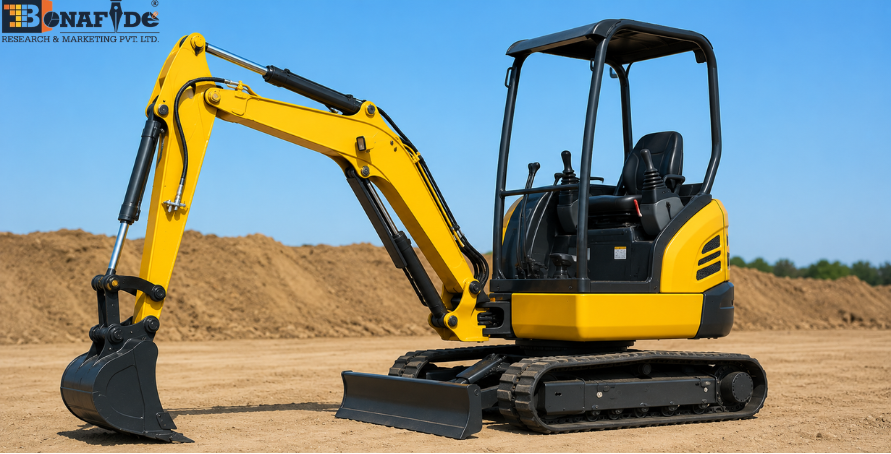
The global mini/compact
excavator market has witnessed significant technological advancements over the past five years, driven by the need for higher efficiency, lower emissions, and enhanced operator comfort. One of the most notable developments is the widespread adoption of electric and hybrid powertrains. Companies such as Volvo
Construction Equipment and Bobcat Company have evolved zero-emission compact excavators, including the Volvo ECR25 Electric and Bobcat E10e, which eliminate direct carbon emissions, reduce noise levels drastically, and lower total cost of ownership through fewer maintenance requirements. Another major technological leap is the integration of telematics and IoT-based
fleet management systems. For instance, Caterpillar’s Cat Connect technology allows real-time monitoring of machine health, fuel consumption, and location, enabling
predictive maintenance and reducing downtime. Additionally, remote control and autonomous operation have advanced rapidly. Built
Robotics and Wacker Neuson have demonstrated mini excavators capable of performing trenching and grading tasks with minimal human intervention, using GPS and LiDAR sensors. These innovations address labor shortages and enhance safety on congested urban job sites. Furthermore, intelligent attachment management systems now allow compact excavators to automatically recognize attached tools and adjust hydraulic flow and pressure accordingly, a feature pioneered by Takeuchi Mfg. Co., Ltd.The shift toward Stage V and Tier 4 Final compliant
diesel engines has also led to more efficient combustion and after-treatment systems, reducing particulate matter and
nitrogen oxides. In terms of operator environment, closed-loop hydraulic systems with load-sensing technology improve precision and fuel economy by up to 15%.
According to the research report "Global Mini/Compact Excavator Market Outlook, 2031," published by Bonafide Research, the Global Mini/Compact Excavator market was valued at more than USD 8.99 Billion in 2025, and expected to reach a market size of more than USD 13.74 Billion by 2031 with the CAGR of 7.35% from 2026-2031. Several global players have introduced breakthrough technologies in the mini/compact excavator space. Kubota Corporation, a market leader, unveiled the U10-5 electric micro excavator in 2025, featuring swappable
lithium-ion
battery packs and a brushless
AC motor that delivers equivalent digging force to diesel models while running silently for indoor demolition work. Kubota also integrated its K-Connect smart interface, allowing operators to set virtual job site boundaries and receive maintenance alerts via
mobile app. Develon (formerly Doosan Construction Equipment) launched the DX10Z-7 and DX17Z-7 mini excavators with transparent bucket and undercarriage cameras that provide a 360-degree birds-eye view, eliminating blind spots a significant safety evolution for worksites with ground workers. JCB introduced the 19C-1E electric mini excavator with a patented E-Tech battery cooling system that maintains optimal temperature even under continuous heavy digging, extending battery life by 30% compared to competitors. Hitachi Construction Machinery collaborated with Yanmar to develop a hybrid hydraulic system that recovers energy during boom descent and stores it in
supercapacitors, reducing fuel consumption by 20% on the ZX17-5B series. SANY Heavy Industry evolved its SY16C model with 5G remote operation capability, demonstrated at Bauma China 2025, where an operator located 2,000 km away successfully excavated a
foundation pit in real time.
The below 1 ton category is witnessing the fastest growth globally due to its exceptional suitability for extremely constrained working environments where traditional construction equipment cannot operate effectively. These ultra-compact machines are increasingly being used in residential backyard projects, basement excavation, indoor demolition, garden landscaping, and small-scale utility installation tasks where precision, minimal ground disturbance, and tight access capability are essential. In highly urbanized cities across North America, Europe, and parts of Asia-Pacific, construction and renovation activities are often carried out in densely packed neighborhoods, narrow passages, and interior spaces, making sub-1 ton excavators an ideal solution for contractors seeking maximum flexibility. Their lightweight design allows them to be transported easily using small trailers or even standard utility vehicles, significantly reducing
logistics complexity and operating costs. Another major factor driving growth is affordability, as below 1 ton machines require lower capital investment, reduced fuel consumption, and simpler maintenance compared to larger excavators, making them highly attractive for small contractors, landscapers, and independent operators. The increasing trend of do-it-yourself home improvement and small-scale mechanization in developed markets is also contributing to rising demand, as homeowners and small businesses seek compact equipment for renovation and outdoor improvement tasks. Equipment rental companies are further accelerating adoption by adding ultra-compact excavators to their fleets, enabling short-term access for niche applications such as municipal landscaping, indoor construction, and light utility work.
Electric mini compact excavators are experiencing rapid global growth as construction industries shift toward sustainable and environmentally compliant equipment solutions. Governments in major regions such as North America, Europe, and parts of Asia-Pacific are enforcing stricter emission standards and low-noise regulations, particularly in urban construction zones where air quality and noise pollution are major concerns. Electric machines eliminate direct exhaust emissions, making them highly suitable for indoor construction, tunnels, residential neighborhoods, hospitals, schools, and densely populated urban areas where diesel engines face operational restrictions. Another major growth driver is the increasing focus on sustainability and carbon reduction in the construction sector, where contractors and municipalities are adopting cleaner equipment to meet green building standards and environmental compliance requirements. Technological advancements in lithium-ion battery systems have significantly improved the performance of electric compact excavators, enabling longer operating hours, faster charging cycles, and improved energy efficiency compared to earlier models. These improvements are making electric machines more practical for real-world construction applications, reducing concerns about downtime and operational limitations. Additionally, electric excavators offer lower maintenance requirements due to fewer mechanical components, reduced fuel dependency, and simplified engine systems, which lowers long-term operating costs for contractors and rental companies. The expansion of equipment rental fleets is also supporting adoption, as rental providers increasingly introduce electric mini excavators to meet growing demand from urban contractors and municipal projects.
The above 60 horsepower category is gaining the fastest growth in the global mini compact excavators market due to its ability to deliver significantly higher performance while still maintaining compact operational advantages compared to larger excavators. These machines are increasingly being used in demanding construction environments such as large infrastructure development, road construction, railway expansion, mining support operations, and industrial facility construction where higher digging force, deeper excavation capability, and stronger hydraulic performance are required. Across rapidly developing economies in Asia-Pacific, South America, and the Middle East, governments are investing heavily in transportation networks, energy infrastructure, and urban expansion projects that require efficient earthmoving equipment capable of handling intensive workloads. Above 60 HP machines provide the necessary power to operate heavy-duty hydraulic attachments such as breakers, augers, and large grading tools, making them suitable for complex excavation and demolition tasks. Another important factor driving growth is the increasing preference among contractors for
high-productivity machines that can reduce project timelines and improve operational efficiency, especially in large-scale infrastructure projects where time-sensitive execution is critical. The expansion of mining-related construction and support activities in regions such as Latin America, Africa, and Australia also contributes to rising demand, as these machines are capable of operating in challenging terrain and harsh working conditions. Equipment rental companies are also expanding their fleets with higher horsepower compact excavators to serve industrial clients and infrastructure contractors who require powerful yet flexible machines for project-based usage.
The Others application segment is expanding rapidly in the global mini compact excavators market as these machines are increasingly being adopted across non-construction industries that require compact, versatile, and efficient earthmoving solutions. Landscaping is one of the fastest-expanding areas, with growing demand for garden development, park construction, golf course maintenance, and commercial outdoor design projects in urban and suburban regions. Mini compact excavators are widely used in these applications for soil preparation, trenching, grading, and drainage installation due to their precision and maneuverability. In agriculture, increasing mechanization across developing economies is driving adoption for tasks such as irrigation channel digging, farm maintenance,
fencing, and small land development projects, especially in regions transitioning from manual labor to mechanized farming practices. Municipal services also represent a major growth area, as local governments increasingly deploy compact excavators for roadside maintenance, sewer repairs, utility upgrades, and public infrastructure maintenance in cities where space constraints require smaller machines. Light demolition and renovation activities are also contributing to growth, particularly in aging urban centers where old buildings and infrastructure are being replaced or upgraded in confined environments. Another key factor supporting this segment is the rapid expansion of equipment rental services worldwide, which enables small contractors, landscapers, and municipal operators to access compact excavators for short-term, specialized tasks without ownership costs.
















 We are friendly and approachable, give us a call.