The global
grow light market is on a strong growth trajectory, underpinned by the global expansion of indoor agriculture, including vertical farms and commercial greenhouses, which increasingly rely on artificial
lighting for consistent crop production. A variety of regulations are shaping the competitive landscape, with the European Union at the forefront. The EU's revised Energy Performance of Buildings Directive (EPBD), fully implemented in May 2026, mandates automatic lighting controls in all new commercial buildings, shifting
smart lighting from an option to a necessity. Concurrently, the Ecodesign for Sustainable Products Regulation (ESPR) demands sustainability throughout a product's lifecycle, moving beyond mere energy efficiency. Elsewhere, Australia enforced its Greenhouse and Energy Minimum Standards (GEMS) for LED bulbs in March 2026, and China's Ministry of Agriculture released its first technical specifications for plant factory lighting. These regulatory shifts are major opportunities for manufacturers offering smart, efficient, and certified lighting solutions, as growers are compelled to upgrade their systems to meet these new global standards. In terms of strategic positioning, the grow light market has seen significant mergers, collaborations, and shifts in global trade. A landmark transaction is San'an
Optoelectronics' acquisition of Lumileds, a deal set to reshape the global LED supply chain. On a smaller scale, Total
Grow Lights was acquired by Posthaste Electronics to bolster its engineering capacity for the CEA sector.
According to the research report "Global Grow Light Market Outlook, 2031," published by Bonafide Research, the Global Grow Light market was valued at more than USD 2.84 Billion in 2025, and expected to reach a market size of more than USD 7.27 Billion by 2031 with the CAGR of 17.41% from 2026-2031. The global market is projected to grow substantially over the coming years. However, this growth is moderated by raw material price volatility and supply chain disruptions, particularly from geopolitical tensions and trade policies like US tariffs that are driving a reconfiguration of manufacturing footprints and sourcing strategies. Manufacturers are being forced to reassess their supply chains and consider localizing production to mitigate risks and ensure resilience for future growth. The industry's future is being defined by rapid technological advancements and key global events. Frost & Sullivan's industry analysis highlights that LEDs are now the dominant technology, accelerating the shift toward intelligent and precision-controlled lighting systems. Key innovations include full-spectrum LEDs with dynamic tuning capabilities that allow growers to create 'light recipes' for each growth stage, optimizing yields and quality. Other advances like chip-on-board architectures and quantum boards are delivering higher photon efficacy, making systems more efficient. Major industry events serve as launchpads for these innovations, including GreenTech 2026 in Amsterdam, where numerous innovators and experts converge to explore the latest horticultural trends. Other crucial gatherings include the CEA and
Indoor Farming 2026 conference, the Indoor Ag-Con 2026 in Las Vegas, and the leading trade fair Light Building 2026 in Frankfurt. These events underscore a market that is rapidly evolving beyond static lighting into an ecosystem of smart,
data-driven solutions essential for the future of agriculture.
Vertical farming has become one of the most rapidly expanding agricultural practices globally because it directly addresses the structural limitations of traditional farming systems. As cities continue to expand, available agricultural land near urban centers is shrinking, which increases the distance between
food production and consumption. Vertical farming solves this issue by producing crops inside buildings, warehouses, and repurposed industrial spaces, often located close to urban populations. This reduces transportation needs and helps maintain freshness in leafy greens, herbs, and vegetables that are commonly grown in these systems. The method also uses stacked layers of cultivation, allowing multiple crop cycles in a single footprint, which significantly improves space utilization. Controlled environment agriculture technologies such as
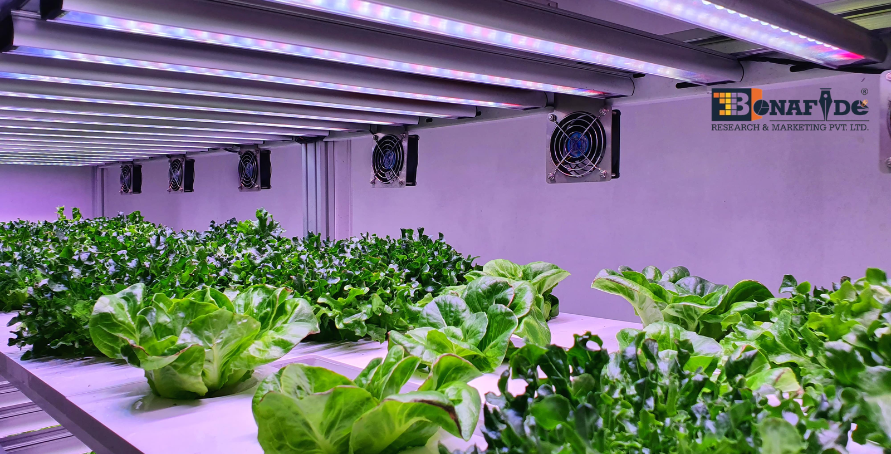
hydroponics and aeroponics are widely used in vertical farms, enabling precise control of water, nutrients, and environmental conditions. Since natural sunlight is limited or completely absent in indoor stacked systems, grow lights become the primary source of energy for photosynthesis. This dependence on artificial lighting makes vertical farming the most intensive application segment for grow lights. In addition, climate variability, soil degradation, and water scarcity in many regions are making traditional open field farming less reliable for consistent year round production. Vertical farming offers protection from
weather disruptions, pests, and seasonal changes, which improves crop reliability. Governments and private investors are also supporting
urban farming initiatives to improve food security and reduce import dependence in several countries. Technological advancements in
LED lighting, automation, and climate control systems have further improved efficiency and scalability of vertical farms. These factors combined make vertical farming a highly suitable and rapidly adopted method for modern agriculture, driving strong demand for advanced grow light systems across the global market.
LED technology has become the dominant lighting solution in the global grow light market because it aligns with the core requirements of modern indoor agriculture. Traditional lighting systems such as
high pressure sodium and metal halide
lamps consume significantly more energy and generate excess heat, which increases cooling requirements and operational costs in controlled environment agriculture facilities. LEDs, on the other hand, convert a higher proportion of electrical energy into usable light for photosynthesis, making them far more efficient for continuous agricultural use. One of the most important advantages of
LED grow lights is their ability to provide precise control over light spectrum, including red, blue, and full spectrum combinations, which can be adjusted based on plant growth stages. This flexibility allows growers to optimize photosynthesis, flowering, and yield quality for different crops within the same facility. LEDs also have a much longer operational lifespan compared to traditional lighting systems, reducing replacement frequency and maintenance costs. Another key factor driving adoption is their low heat output, which helps maintain stable temperature conditions in indoor farms and reduces the need for additional cooling systems. This is particularly important in large scale vertical farms and greenhouses where temperature control is critical for plant health. LEDs are also highly compatible with automation systems, sensors, and smart farming technologies that monitor and adjust environmental conditions in real time. Their compact design allows easy integration into layered farming structures used in vertical agriculture. Governments and agricultural organizations globally are promoting energy efficient technologies to support sustainable farming practices, further encouraging LED adoption. The combination of efficiency, flexibility, durability, and technological compatibility has made LED lighting the most widely used and fastest growing technology in the global grow light market.
Retrofit installations are gaining strong momentum in the global grow light market because many agricultural operations already exist in the form of traditional greenhouses and partially controlled farming environments. Instead of constructing new indoor farming facilities from scratch, growers are increasingly upgrading their existing infrastructure with advanced lighting systems, particularly LED based grow lights. This approach is more cost effective and allows farmers to enhance productivity without significant capital expenditure on new buildings or structural changes. Many older agricultural facilities were designed to rely on natural sunlight or older lighting technologies that are less efficient and less controllable. As agricultural practices shift toward controlled environment farming, these legacy systems are being modernized to improve performance. Retrofit solutions enable growers to integrate energy efficient lighting into existing structures while also adding modern automation systems, sensors, and climate control technologies. This improves crop monitoring and allows more precise control over growth conditions. In many regions, government programs and sustainability initiatives are encouraging energy efficient upgrades in agriculture to reduce electricity consumption and improve food production efficiency. Retrofitting also helps reduce downtime since farms do not need to stop operations for long construction periods associated with new facilities. The flexibility of retrofit systems allows gradual modernization, where growers can upgrade lighting in phases depending on budget and operational needs. This makes it accessible to both large commercial farms and smaller agricultural operators. As global demand for consistent and high quality food production increases, retrofitting existing farms has become a practical and widely adopted strategy for improving yield and efficiency while minimizing disruption and cost.
High wattage grow lights above 300 watt are widely used in global agriculture because they are essential for supporting large scale commercial cultivation systems that require strong and consistent light intensity. In controlled environment agriculture, especially in vertical farms and large greenhouses, crops are often grown in dense arrangements or stacked layers, which require powerful lighting systems to ensure that all plants receive adequate light penetration. Lower wattage systems are often insufficient for such high density farming environments. High wattage LED grow lights provide broader coverage and higher photon output, which helps maintain uniform growth across large cultivation areas. This is particularly important for commercial growers producing vegetables, herbs, and specialty crops where consistency in size, color, and quality is essential for market supply chains. In addition, high wattage systems reduce the total number of
lighting fixtures required in a facility, which simplifies installation and maintenance while improving operational efficiency. Many modern agricultural facilities are designed with advanced cooling and ventilation systems that support the use of high intensity lighting without overheating risks. This allows growers to operate powerful lighting systems continuously for optimal plant development. Governments and private investors involved in large scale indoor farming projects prefer high wattage solutions because they improve productivity and maximize output per unit area. These systems are also compatible with advanced automation and
smart agriculture technologies that regulate light intensity based on crop requirements. The combination of high output performance, operational efficiency, and suitability for commercial scale farming makes above 300 watt grow lights a widely adopted segment in global agricultural lighting systems.
Full spectrum grow lights have become the most widely used lighting type in global agriculture because they provide a balanced range of wavelengths that closely resemble natural sunlight. This is important for controlled environment agriculture systems where crops are grown indoors without access to natural light. Full spectrum lighting supports all stages of plant development including germination, vegetative growth, and flowering, which reduces the need for multiple specialized lighting systems. This makes them highly practical for commercial farming operations that grow a variety of crops within the same facility. In vertical farming and greenhouse environments, growers often cultivate leafy greens, herbs, fruits, and vegetables, all of which benefit from a broad light spectrum. Full spectrum lights help maintain healthy plant morphology, improve photosynthesis efficiency, and enhance crop quality by reducing stress caused by unnatural lighting conditions. These systems are also widely compatible with modern smart agriculture technologies, allowing integration with sensors and automated controls that adjust light intensity based on crop requirements. Another important factor is that full spectrum lighting supports research and plant breeding applications, where consistent and natural light conditions are required for experimentation and yield optimization. Governments and agricultural organizations promoting food security and sustainable farming practices encourage technologies that improve efficiency and reduce resource consumption, further supporting adoption of full spectrum systems. Their versatility across different crops and growing conditions makes them suitable for both commercial agriculture and research based cultivation. The ability to replicate natural sunlight while supporting high productivity has made full spectrum lighting a preferred choice in modern controlled environment agriculture systems worldwide.











 We are friendly and approachable, give us a call.