Defense establishments across multiple continents are channeling fresh capital into hypersonic strike development, signaling a decisive pivot from laboratory demonstrators toward operational weapon system qualification. The U.S. Navy achieved a milestone with the installation of the Conventional Prompt Strike hypersonic glide body aboard the USS Zumwalt destroyer at Huntington Ingalls Industries’ Pascagoula shipyard, while the Army’s Long Range Hypersonic Weapon
battery completed cold-
weather training at Joint Base Lewis-McChord ahead of its first full-salvo test. Australia’s SCIFiRE collaborative program, jointly executed by Boeing, the Defence Science and Technology Group, and the U.S. Air Force, recently concluded a full-scale scramjet combustor trial at the Woomera Test Range that sustained Mach 7 conditions for a record duration. Simultaneously, France’s Direction G?n?rale de l’Armement awarded ArianeGroup a follow-on contract to fabricate a second V-MaX hypersonic glide vehicle demonstrator, incorporating thermal protection data from the 2023 Biscarrosse flight. Japan’s Acquisition, Technology &
Logistics Agency awarded Mitsubishi Heavy Industries a prototype fabrication agreement for the Hyper Velocity Gliding Projectile, accelerating the island-defense hypersonic effort with a target initial operational capability advanced by two years. India’s BrahMos Aerospace and Russia’s NPO Mashinostroyeniya completed the preliminary design review of the BrahMos-II scramjet
cruise missile, moving a Mach 7 anti-ship weapon closer to a planned 2027 flight demonstration. These parallel investments illustrate a global race to field maneuvering hypersonic payloads that outpace the kinematic limits of terminal-phase interceptors.
According to the research report "Global Precision Guided Munition Market Outlook, 2031," published by Bonafide Research, the Global Precision Guided Munition market was valued at more than USD 57.20 Billion in 2025, and expected to reach a market size of more than USD 39.86 Billion by 2031 with the CAGR of 6.37% from 2026-2031. A parallel surge is reshaping the attritable precision effectors segment, as loitering munition portfolios expand from tactical niche to mainstream procurement across allied forces. The U.S. Army selected AeroVironment’s Switchblade 600 and Anduril Industries’ Fury under the Low Altitude Stalking and Strike Ordnance program, committing to an initial multi-hundred-unit buy for infantry and armored brigade combat teams. UVision Air, an Israeli manufacturer, secured a multi-year supply agreement with a European NATO member for the Hero-400EC extended-range loitering system, featuring an encrypted, anti-jam datalink and a tandem anti-armor warhead. Roketsan of Turkey finalized a contract to deliver the MAM-T dual-seeker micro-munition to a Southeast Asian air force, upgrading Bayraktar TB2
drone squadrons with a 30-kilometer stand-off precision strike capability. Elbit Systems disclosed the delivery of SkyStriker loitering munitions to an undisclosed African partner, with onboard deep-learning target classification enabling autonomous terminal engagement in GPS-denied environments. Rheinmetall and UVision further broke ground on a dedicated loitering munition integration and test center in Berlin, designed to support European Hero production without reliance on offshore final assembly. Concurrently, Poland’s WB Group expanded its Warmate loitering munition production line to fulfill a large-scale order for Ukraine’s territorial defense forces, integrating a tandem shaped-charge warhead. This wave of commitments demonstrates a market-wide recognition that networked, lower-cost autonomous platforms can complement exquisite stand-off missiles, delivering massed precision effects at a sustainable per-engagement cost.
Hypersonic missiles represent the fastest-growing product category as global military powers pour unprecedented funding into penetrating weapons that outpace modern air defense reaction times. The U.S. Air Force’s AGM-183A Air-launched Rapid Response Weapon achieved a successful hypersonic boost test in 2022, validating a glide vehicle that reaches Mach 8 before terminal impact. Russia’s Kinzhal air-launched ballistic missile, fired from MiG-31K interceptors, has been used operationally in Ukraine, demonstrating hypersonic strike from a combat-proven platform. China’s DF-17 medium-range ballistic missile, equipped with a hypersonic glide vehicle, entered service with the PLA Rocket Force in 2019 as the world’s first operational hypersonic weapon system. France’s Direction G?n?rale de l’Armement successfully tested the V-MaX scramjet-powered glide vehicle in 2023, advancing the country’s national hypersonic roadmap. The United Kingdom’s Hypersonic Technologies programme, funded through the Ministry of Defence and Dstl, is developing a sovereign hypersonic strike capability separate from the FC/ASW timeline. Australia’s SCIFiRE joint project with the United States has progressed to full-scale scramjet engine testing at Woomera, targeting a Mach 7 operational demonstrator. India’s Defence Research and Development Organisation conducted a successful Hypersonic Technology Demonstrator Vehicle scramjet flight in 2020, laying the propulsion groundwork for a long-range strike variant. Japan’s Acquisition, Technology & Logistics Agency simultaneously pursues the Hyper Velocity Gliding Projectile for island defense, with a planned initial operational capability by the early 2030s.
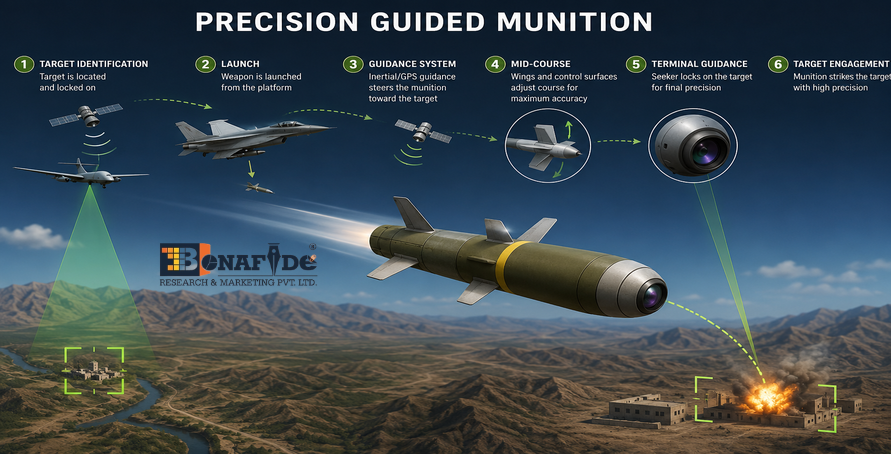
Guidance modules and seeker packages command the largest subsystem value because every precision munition requires a jam-resistant navigation unit and at least one terminal homing
sensor to function. BAE Systems’ long-wave infrared seeker for the AGM-158C LRASM autonomously discriminates ship targets in contested maritime environments without emitting radar, reducing susceptibility to electronic warfare. Raytheon’s tri-mode seeker on the GBU-53/B StormBreaker fuses millimeter-wave radar, uncooled imaging infrared, and semi-active laser guidance, enabling moving target engagement in adverse weather. China’s Luoyang Optoelectro Technology Development Center produces a cooled mid-wave infrared seeker for the PL-15 beyond-visual-range air-to-air missile, equipping the J-20 stealth fighter. Russia’s Kometa design bureau supplies the active radar homing head for the Kh-59MK2 cruise missile, enabling 290-kilometer stand-off land attack with terminal scene matching. Israel Aerospace Industries integrates a passive anti-radiation seeker into the Harop loitering munition, homing onto emitting air defense radars without human intervention. South Korea’s LIG Nex1 manufactures the imaging infrared seeker for the 70-millimeter K-LOGIR guided rocket, enabling low-cost naval swarm defense. India’s Defence Research and Development Organisation has indigenized the radio-frequency seeker for the BrahMos supersonic cruise missile, transitioning from Russian-supplied components to a locally built variant at the Hyderabad facility, underscoring how seekers and navigation consistently outstrip propulsion in procurement billings.
Unmanned platforms constitute the fastest-expanding launch segment as attritable drone swarms and loyal wingman aircraft redefine persistent precision engagement without aircrew risk. The U.S. Department of Defense’s Replicator initiative aims to field thousands of autonomous systems within two years, each carrying a precision loitering munition or sensor-fuzed glide weapon. The United Kingdom’s Project Vixen loyal wingman, under development by the Royal Air Force Rapid Capabilities Office, will carry Brimstone and SPEAR missiles as an unmanned force multiplier. Australia’s MQ-28 Ghost Bat, built by Boeing Defence Australia, has progressed through weaponization trials with a loitering effector bay designed for collaborative combat. China’s GJ-11 Sharp Sword stealth unmanned combat aerial vehicle conducts armed reconnaissance with internal precision bomb carriage, demonstrated during Zhuhai Airshow displays. Turkey’s Bayraktar TB2, armed with Roketsan MAM-L and MAM-C micro-munitions, has been exported to over 30 nations and logged thousands of combat hours. Russia’s Orion medium-altitude long-endurance drone has fired guided missiles in Syrian operations, validating its weaponized variant. India’s CATS Warrior loyal wingman, powered by a small turbofan, is designed to carry the SAAW anti-airfield glide bomb alongside manned fighters, signaling an Indo-Pacific shift toward unmanned launch as the fastest-growing platform category for precision effects.
The 50-to-300-kilometer range band remains the largest by installed base because it balances operational reach with export permissibility under the Missile Technology Control Regime. India’s BrahMos supersonic cruise missile, capped at 290 kilometers for export customers, has been sold to the Philippines under a $375 million contract, demonstrating the commercial viability of a regime-compliant variant. Taiwan’s Hsiung Feng III supersonic anti-ship missile, with a 300-kilometer range, equips coastal batteries and destroyers to deny amphibious approaches across the Taiwan Strait. Russia’s Tactical Missiles Corporation fields the Kh-59MK2 subsonic cruise missile at 290 kilometers, arming Su-57 fighters for stand-off precision without triggering higher-tier arms control scrutiny. Turkey’s SOM-J air-launched cruise missile, integrated on F-16 and Bayraktar Ak?nc?, delivers a 275-kilometer stand-off attack with an imaging infrared seeker, exported to Azerbaijan. Japan’s original Type 12
surface-to-ship missile, prior to its extended-range upgrade, provides a 200-kilometer coastal defense envelope for the Japan Ground Self-Defense Force. South Korea’s Haeseong I anti-ship cruise missile, deployed on destroyers with a 180-kilometer reach, delivers sea-skimming precision against surface threats. Israel’s Delilah-G loitering missile sustains 250 kilometers of man-in-the-loop flight, providing real-time video feedback before terminal engagement. These diverse systems spanning Asia, the Middle East, and Europe collectively demonstrate how the medium-range segment dominates inventory depth precisely at the intersection of tactical necessity and regulatory accessibility.
Hypersonic speed profiles are growing faster than any other velocity segment because intercepting a Mach 5+ maneuvering vehicle exceeds the kinematic envelope of current air defense systems. Russia’s Zircon hypersonic cruise missile, launched from frigates and submarines, achieved a Mach 8 sustained flight in final state trials and entered service with the Russian Navy in 2023. The U.S. Navy’s Conventional Prompt Strike program, integrating a hypersonic glide body onto Zumwalt-class destroyers and Virginia-class submarines, targets a Mach 8+ glide phase for time-critical deep strike. China’s DF-17 boost-glide vehicle executes evasive maneuvers during its hypersonic terminal phase, complicating ballistic missile defense intercept solutions. India’s BrahMos-II, a scramjet-powered hypersonic cruise missile under joint development with Russia, targets a Mach 7 operational speed for anti-ship and land-attack roles. Japan’s Hyper Velocity Gliding Projectile program, funded through the 2024 Defense Buildup Program, pursues a Mach 5+ maneuvering reentry vehicle for island defense. France’s ASN4G air-launched nuclear-tipped hypersonic cruise missile concept, led by ArianeGroup and MBDA, aims for scramjet-powered sustained Mach 5+ flight to replace the ASMPA. Australia’s SCIFiRE full-scale flight test campaign with Boeing and the U.S. Air Force will demonstrate a Mach 7 scramjet integrated with a hypersonic cruise missile airframe. The global sprint toward operational hypersonic speed reflects a fundamental recognition that subsonic and supersonic penetration aids are losing effectiveness, pushing hypersonic development budgets up across every major defense establishment simultaneously.



 We are friendly and approachable, give us a call.