The global
automated feeding system market is expanding rapidly as livestock production worldwide shifts toward precision agriculture,
digital farming, and AI-driven automation to meet rising demand for
meat, dairy,
poultry, and aquaculture products. The market is characterized by strong adoption across North America, Europe, and Asia-Pacific, with increasing penetration in South America and the Middle East and Africa. Growth is primarily driven by labor shortages in agriculture, rising feed costs, and the need to improve feed conversion efficiency in large-scale commercial livestock operations. Governments across multiple regions are indirectly and directly supporting automation through agricultural modernization programs, sustainability targets, and digital farming initiatives. In North America, regulatory bodies such as the USDA and FDA promote feed safety, traceability, and efficiency, encouraging adoption of automated systems. In Europe, the Common Agricultural Policy (CAP) and the European Green Deal strongly support sustainable livestock farming, which aligns with precision feeding technologies that reduce waste and environmental impact. In Asia-Pacific, national programs such as China’s
smart agriculture initiatives and India’s digital agriculture missions promote modernization of livestock farming and encourage adoption of automation technologies. Global trade plays a significant role in market expansion, with Europe and North America exporting advanced automated feeding technologies to Asia-Pacific, South America, and the Middle East and Africa, where adoption is accelerating. At the same time, emerging economies are increasingly localizing assembly and manufacturing to reduce costs and improve supply chain resilience.
According to the research report "Global Automated Feeding System Market Outlook, 2031," published by Bonafide Research, the Global Automated Feeding System market was valued at more than USD 5.18 Billion in 2025, and expected to reach a market size of more than USD 8.33 Billion by 2031 with the CAGR of 8.46% from 2026-2031. Major global players such as DeLaval, GEA Group, Big Dutchman, and Lely are actively expanding their global footprint through acquisitions, joint ventures, and technology partnerships with AI startups,
sensor manufacturers, and farm management software developers. These collaborations are focused on building fully integrated smart feeding ecosystems that combine
robotics, cloud computing, and
predictive analytics. Market growth is strongly driven by increasing global consumption of animal protein, expansion of large-scale commercial farms, and rising demand for efficient feed utilization to reduce production costs. The supply chain for automated feeding systems is globally distributed and depends on
high-precision
electronic components such as sensors, microcontrollers,
actuators, and control systems, along with
stainless steel for durable machinery and advanced polymer materials used in feed transport and storage systems. Semiconductor components are largely sourced from Asia, mechanical manufacturing expertise is concentrated in Europe, and system integration and software development are often led by companies in North America. The global automated feeding system market is undergoing rapid technological transformation driven by advances in
artificial intelligence, robotics, IoT-enabled devices, machine learning, and cloud-based
data analytics. Leading companies such as DeLaval, GEA Group, Lely, BouMatic, and Big Dutchman are continuously introducing advanced automated feeding solutions that enhance precision, efficiency, and sustainability in livestock production.
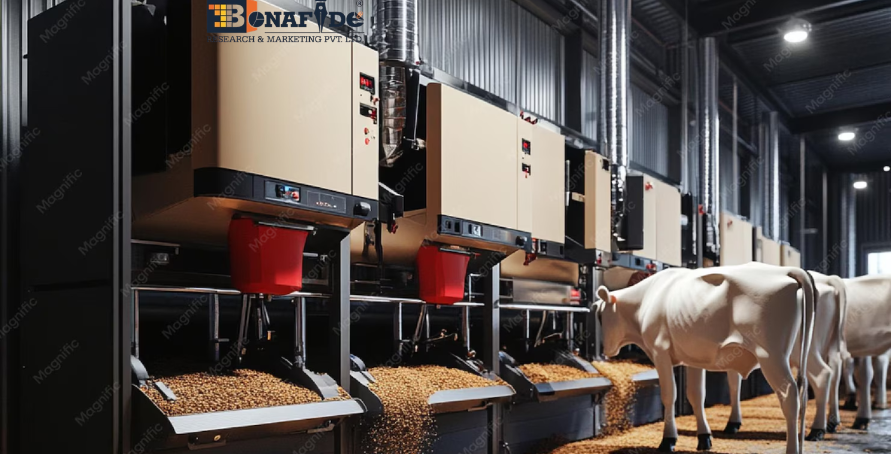
Self-propelled feeding systems are increasingly adopted in modern livestock operations because they provide mobility, automation, and operational flexibility that stationary or rail-based systems cannot match in large-scale farm environments. These systems are designed to move independently across barns, feeding alleys, and multi-building farm layouts, which is particularly important in dairy and
beef operations where herd distribution is not static. Their ability to transport, mix, and distribute feed without requiring permanent
conveyor infrastructure reduces installation complexity and allows farmers to retrofit existing facilities without major structural changes. In many commercial farms, especially in Europe and North America, labor shortages and rising wage costs have made manual feeding increasingly inefficient, encouraging adoption of
mobile automated systems that can perform repetitive tasks with consistency. Self-propelled units also integrate sensors, weighing systems, and programmable feeding schedules, which improves ration accuracy and reduces feed waste, a critical factor given the high cost of feed inputs in livestock production. These systems are also compatible with precision livestock farming practices, where feeding is adjusted based on animal group needs, production stage, or health status. In addition, they offer scalability advantages, as farms can deploy multiple units to manage larger herds without redesigning infrastructure. The integration of
battery-powered electric drivetrains has further improved sustainability by reducing fuel dependency and enabling quieter operation inside enclosed barns.
Aquaculture has emerged as the most rapidly adopting segment for automated feeding systems due to the unique biological and environmental sensitivity of aquatic farming environments. Unlike terrestrial livestock, fish and
shrimp rely entirely on external feed input, and even minor inefficiencies in feeding can directly impact water quality,
oxygen levels, and survival rates. This makes precision feeding not just a productivity enhancement but a critical operational necessity. In modern aquaculture farms, automated feeding systems are used to regulate feed timing, quantity, and distribution based on water temperature, fish size, and behavioral patterns. These systems often incorporate underwater sensors and
surface cameras that monitor feeding response, ensuring feed is supplied only when fish are actively consuming it, which significantly reduces feed wastage and prevents water pollution caused by uneaten feed decomposition. In regions such as Southeast Asia, Norway, and China, aquaculture is increasingly shifting toward intensive farming models where high-density production requires consistent and controlled feeding schedules that are difficult to maintain manually. Automated feeders also help reduce dependence on labor in offshore and remote aquaculture farms, where human access is limited and costly. Additionally, disease management in aquaculture is closely linked to feeding control, as overfeeding can increase
ammonia levels and stress aquatic species, making automation essential for maintaining stable farm environments.
Machine vision and AI analytics are becoming the fastest-growing technology segment in automated feeding systems because they transform livestock feeding from a fixed schedule-based process into an adaptive, data-driven system. Machine vision systems use cameras and imaging sensors to continuously monitor animal behavior, body condition, feeding patterns, and movement within barns or farms. This visual data is then processed using artificial intelligence algorithms that identify changes in feeding behavior, early signs of disease, or variations in feed consumption across individual animals or groups. Such capabilities are particularly valuable in large commercial farms where manual monitoring is not feasible due to herd size. AI analytics platforms integrate data from multiple sources including feeding equipment, environmental sensors, and animal tracking systems to optimize feed composition and distribution in real time. This reduces feed waste, improves feed conversion efficiency, and enhances overall animal health outcomes. In dairy farming, for example, AI systems can detect reduced feeding activity that may indicate illness or stress, allowing early intervention. In poultry and swine operations, machine vision helps in adjusting feed distribution density and timing to avoid competition and ensure uniform growth. The growing adoption of precision livestock farming practices globally has further accelerated the need for intelligent analytics systems that can process large volumes of farm data.
Large-scale livestock farms are the fastest adopters of automated feeding systems because operational complexity increases significantly as herd size expands beyond 500 animals, making manual feeding inefficient, inconsistent, and costly. These farms typically operate as commercial dairy, beef, or poultry production units where productivity, feed conversion efficiency, and labor optimization directly influence profitability. Automated feeding systems help standardize feed distribution across large herds, ensuring each animal receives the correct nutritional balance based on its production stage or health condition. This level of precision is difficult to achieve manually in large operations where multiple feeding cycles and large volumes of feed must be managed daily. In addition, large farms often operate across multiple barns or geographically distributed facilities, making centralized automated systems essential for coordinated feed management. Labor shortages in agriculture further accelerate adoption, as large farms face higher staffing requirements and increasing wage costs. Automated systems reduce dependence on manual labor while improving operational consistency and reducing human error. Large farms also have stronger financial capacity to invest in advanced automation technologies, making the return on investment more acceptable compared to smaller farms. Furthermore, these operations are often integrated into supply chains that require high-quality, standardized livestock products, which necessitate precise feed control and traceability.















 We are friendly and approachable, give us a call.