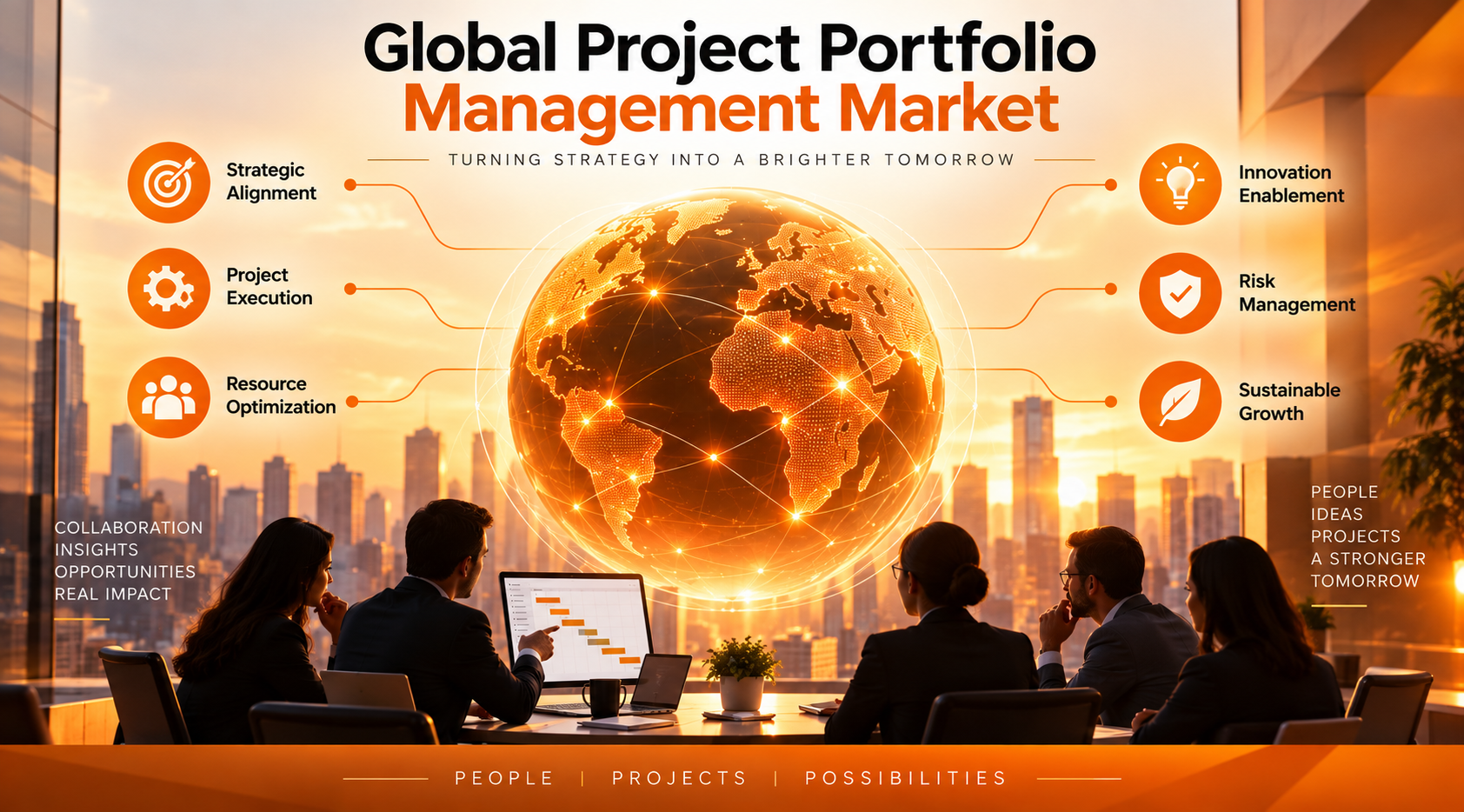
The global Project Portfolio Management Market is entering a period of continued transformation as organizations face larger investment portfolios, tighter resource constraints, increasing governance requirements, and greater pressure to demonstrate measurable outcomes from strategic initiatives. PPM is moving beyond traditional project scheduling and status reporting toward a broader enterprise discipline that connects strategy, investment decisions, project delivery, workforce capacity, financial management, risk, and business outcomes. Organizations across technology, healthcare, manufacturing, construction, retail, financial services, and the public sector are increasingly seeking a consolidated view of what work is being proposed, what work is funded, where resources are committed, and whether initiatives remain aligned with changing priorities.
According to the research report, "Global Project Portfolio Management Market Outlook, 2031," published by Bonafide Research, the Global Project Portfolio Management Market Outlook was valued at more than USD 8.32 Billion in 2025, and expected to reach a market size of more than USD 15.80 Billion by 2031 with the CAGR of 11.57% from 2026-2031. The competitive environment is increasingly influenced by the ability to connect Strategic Portfolio Management Software with Project, Program and Resource Management, Financial Portfolio Management, Governance, Risk & Compliance Management, Agile and Collaborative Work Management, and Portfolio Analytics & AI Intelligence. Vendors are therefore positioning PPM platforms as connected enterprise management environments rather than isolated project-office applications. The market's technological direction is being strongly influenced by
artificial intelligence and advanced analytics. Portfolio leaders are dealing with large volumes of project status, schedule, budget, resource, risk, dependency, and benefit information that can be difficult to interpret manually. Portfolio Analytics & AI Intelligence capabilities can support forecasting, anomaly identification, risk signaling, summarization, scenario evaluation, and prioritization. The growing use of these technologies is expected to improve the speed with which leadership teams can identify emerging portfolio problems and evaluate alternative investment decisions, while human governance remains essential for final approvals and strategic trade-offs.
The convergence of agile and traditional delivery is creating another important opportunity. Enterprises increasingly combine agile product teams with stage-gated programs, infrastructure initiatives, construction projects, regulatory work, and operational transformation. PPM platforms are responding by providing common portfolio structures while allowing different delivery methodologies to operate beneath the same governance framework. Agile and Collaborative Work Management therefore complements rather than replaces conventional portfolio controls, enabling organizations to maintain executive visibility without imposing identical execution methods on every team. Resource and financial visibility are becoming increasingly important to portfolio decisions. An initiative may appear strategically attractive but remain infeasible because the required skills are unavailable, funding is constrained, or other projects already consume critical capacity. Integrating resource planning, time and expense information, project budgets, financial controls, and portfolio priorities allows organizations to evaluate the practical feasibility of investment choices. This is strengthening demand for PPM platforms that can connect strategic intent with the financial and workforce realities of execution. Services are also becoming a major component of the market as organizations recognize that successful PPM adoption depends on operating-model design as well as software functionality. Professional Services providers are helping enterprises define portfolio taxonomies, governance structures, approval workflows, data models, integrations, reporting standards, and user-adoption programs. Managed Services is gaining momentum as organizations seek ongoing administration, platform optimization, reporting support, and configuration management after implementation. This service ecosystem is supporting broader adoption while reducing the need for every organization to maintain deep internal PPM-specialist capabilities. Deployment preferences are also changing. Cloud-based PPM platforms are increasingly attractive because they can support distributed teams, multi-business-unit portfolios, rapid deployment, centralized updates, and integration with other cloud enterprise applications. On-premises platforms remain relevant where organizations have strict data-residency, customization, security, or internal-control requirements. Across both deployment models, buyers are increasingly evaluating integration architecture, identity management, data quality, reporting flexibility, workflow configuration, and scalability alongside core portfolio functionality.
Regional dynamics are influencing adoption patterns, with North America positioned as the leading regional environment and Asia Pacific emerging as the fastest-growing. North America benefits from a mature enterprise software ecosystem, a high concentration of large organizations, established project-management practices, and strong demand for
digital transformation and analytics. Asia Pacific is expanding rapidly as enterprises undertake technology modernization, manufacturing transformation,
telecommunications investment, infrastructure development, and cloud adoption across multiple countries and business units. These conditions are creating increasing demand for scalable portfolio governance and resource coordination. Looking ahead, the Project Portfolio Management Market is expected to increasingly center on continuous planning, intelligent portfolio analysis, integrated financial and resource management, and outcome-oriented governance. Organizations are likely to evaluate PPM platforms not simply by their ability to report project status, but by how effectively they help leadership decide which initiatives to pursue, which to delay, how to allocate scarce resources, and how to respond when assumptions change. The competitive environment will therefore increasingly reward vendors that combine strategic portfolio management, execution visibility, enterprise integration, AI-supported intelligence, and implementation expertise within a coherent platform ecosystem.









 We are friendly and approachable, give us a call.