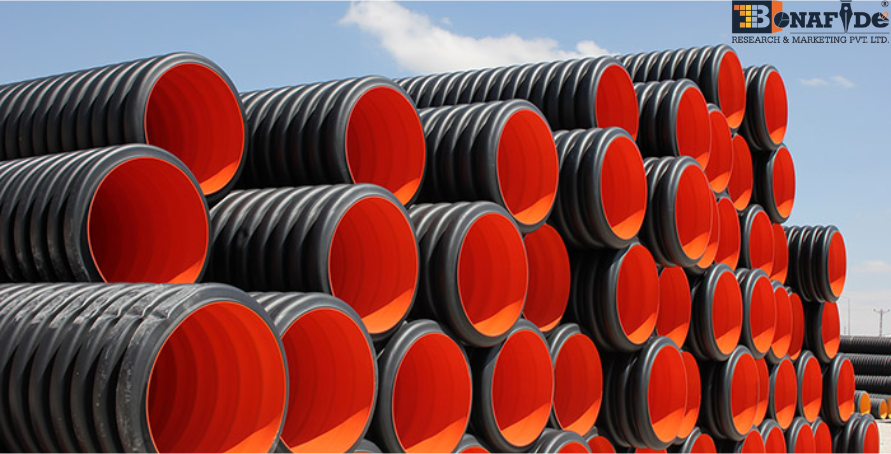
Corrugated pipes are designed with a distinctive ribbed structure, providing flexibility, high strength, and superior resistance to pressure and deformation, making them ideal for applications such as drainage systems, stormwater management, sewage networks, cable protection, and irrigation. These pipes are primarily made from high-density
polyethylene (HDPE), polyvinyl chloride (PVC), and
polypropylene (PP), with each material offering unique benefits in terms of chemical resistance, longevity, and adaptability to diverse environmental conditions. HDPE pipes, for example, are highly resistant to corrosion and chemicals, making them suitable for industrial and chemical-laden water applications, while PVC pipes are lightweight, easy to install, and cost-effective, often used in municipal and residential drainage systems. Over the years, the market has witnessed significant technological advancements in production processes, such as improved extrusion and corrugation techniques, which enhance pipe performance while reducing manufacturing costs. Urbanization and industrialization across both developed and emerging economies have further contributed to the demand for corrugated pipes. Rapid population growth and increasing urban settlements necessitate the development of sophisticated drainage and sewage systems to manage water efficiently and prevent flooding. Similarly, the expansion of road networks, bridges, airports, and railway systems requires durable piping solutions capable of withstanding heavy loads and extreme environmental conditions. Beyond traditional civil engineering applications, corrugated pipes are also gaining traction in agriculture for irrigation and drainage projects, ensuring proper water management and soil conservation. Furthermore, the
telecommunications and energy sectors increasingly rely on these pipes to safeguard underground
cables and pipelines, enhancing safety and operational efficiency. With global emphasis on sustainable construction practices, corrugated pipes are preferred due to their recyclable materials, long service life, and reduced maintenance requirements.
According to the research report “Global Corrugated Pipe Market Outlook, 2030” published by Bonafide Research, the Global Corrugated Pipe market is projected to reach market size of USD 25.01 Billion by 2030 increasing from USD 18.48 Billion in 2024, growing with 5.28% CAGR by 2025-30.The primary driver of this growth is large-scale infrastructure development across residential, commercial, and industrial sectors. Governments worldwide are investing heavily in transportation, water management, and urban development projects, fueling the adoption of corrugated pipes due to their durability, lightweight structure, and adaptability to varying environmental conditions. In addition to traditional construction applications, the increasing focus on water and wastewater management projects is stimulating demand for corrugated pipes. These pipes provide effective solutions for stormwater drainage, sewage disposal, and flood prevention, supporting urban planning and environmental sustainability. Regionally, the Asia-Pacific market dominates due to rapid urbanization, industrial expansion, and government initiatives in countries such as China, India, and Southeast Asian nations. The presence of extensive infrastructure projects, including highways, airports, and metro rail systems, requires robust piping solutions capable of handling large volumes of water and heavy loads. North America and Europe also hold substantial market shares, driven by stringent environmental regulations, sustainable construction practices, and the replacement of aging pipe networks. HDPE corrugated pipes are leading the market globally due to their chemical resistance, flexibility, and long lifespan, while PVC pipes remain prominent in cost-sensitive municipal and agricultural applications. Technological developments, such as enhanced corrugation techniques, multi-layered pipe structures, and improved joint systems, are further improving pipe efficiency, installation speed, and overall performance.
High-Density Polyethylene (HDPE) has emerged as the largest material type in the global
corrugated pipe market due to its superior performance characteristics, durability, and versatility across a wide range of applications. HDPE pipes are manufactured from a high-strength polymer that offers exceptional resistance to corrosion, chemicals, and abrasion, making them ideal for both industrial and municipal use. Unlike traditional materials such as concrete or metal, HDPE pipes are lightweight, flexible, and easy to transport and install, reducing labor and installation costs while maintaining high structural integrity. The ribbed or corrugated design of HDPE pipes enhances their strength-to-weight ratio, allowing them to withstand heavy loads, high-pressure conditions, and ground movement without cracking or deforming. These properties have made HDPE the preferred choice in applications requiring long-term durability, particularly in water and wastewater management, drainage systems, and stormwater projects. The widespread adoption of HDPE corrugated pipes is also driven by environmental and regulatory factors. HDPE is fully recyclable, has a low carbon footprint during production, and can be reused in various infrastructure projects, aligning with the global emphasis on sustainable construction practices. Governments and regulatory authorities in developed and emerging economies increasingly promote eco-friendly materials for public utilities and urban development projects, further boosting HDPE adoption. Moreover, HDPE pipes offer excellent chemical resistance, making them suitable for industrial wastewater discharge, chemical transport, and agricultural drainage applications where pipes may be exposed to aggressive substances. Technological innovations, such as improved joint systems, multilayer structures, and enhanced corrugation techniques, have further increased the performance and reliability of HDPE pipes, reinforcing their dominance in the market.
Drainage applications account for the largest segment in the global corrugated pipe market due to the critical role these pipes play in managing stormwater, wastewater, and
surface water in urban, industrial, and agricultural environments. Rapid urbanization and population growth worldwide have led to increased impervious surfaces, such as roads, pavements, and buildings, which limit natural water absorption and increase the risk of flooding. Corrugated pipes, particularly those made from durable materials like HDPE, PVC, and PP, provide an efficient, cost-effective, and long-lasting solution for channeling excess water from streets, highways, residential areas, and industrial sites to designated drainage systems or treatment facilities. Their flexibility and high load-
bearing capacity make them ideal for underground installations where soil movement or heavy traffic loads are concerns, ensuring structural stability and operational efficiency over time. The dominance of drainage applications is further supported by the growing emphasis on environmental protection, water conservation, and sustainable urban planning. Governments and municipal authorities are investing in modern stormwater management systems to prevent flooding, control soil erosion, and improve water quality in urban centers. Corrugated pipes facilitate the creation of efficient subsurface drainage networks, which are essential for proper stormwater conveyance and sewage management. In agriculture, drainage pipes help remove excess water from fields, improve soil aeration, and enhance crop yields, highlighting their importance beyond urban infrastructure. Additionally, drainage systems must handle large volumes of water during peak rainfall events, and corrugated pipes’ superior hydraulic performance, combined with corrosion and chemical resistance, ensures reliable and long-term operation. The versatility of corrugated pipes in drainage systems also contributes to their market dominance. They can be easily configured into different diameters, lengths, and layouts to meet the specific requirements of roadways, commercial complexes, industrial facilities, and agricultural lands.
Double-wall corrugated pipes have emerged as the largest structural type in the global corrugated pipe market due to their superior mechanical strength, durability, and versatility across a wide range of applications. Unlike single-wall pipes, double-wall pipes feature a smooth inner wall and a corrugated outer wall, combining optimal hydraulic performance with enhanced structural integrity. The smooth inner surface reduces friction and ensures efficient flow of water, sewage, or other fluids, while the corrugated exterior provides superior resistance to external pressure, soil loads, and mechanical impacts. This unique combination makes double-wall corrugated pipes particularly suitable for underground installations, high-traffic areas, stormwater management, and sewage conveyance, where both flow efficiency and structural durability are critical. The global preference for double-wall pipes is largely driven by their ability to support large loads and withstand soil movement without deformation, which is essential in urban infrastructure projects, highways, and industrial facilities. Their enhanced strength-to-weight ratio allows them to be installed at varying depths without requiring additional concrete encasement, reducing construction costs and installation time. Additionally, double-wall pipes are available in a wide range of diameters and materials, including HDPE, PVC, and polypropylene, offering flexibility in design and adaptability to different environmental conditions. This versatility makes them suitable for applications ranging from municipal drainage and sewage networks to irrigation and cable protection. Technological advancements in extrusion and corrugation processes have further improved the performance of double-wall pipes, making them more resistant to chemical corrosion, UV exposure, and extreme temperatures.
The <300 mm size category represents the largest segment in the global corrugated pipe market due to its versatility, ease of installation, and suitability for a wide range of applications, particularly in residential, commercial, and municipal drainage systems. Pipes of this diameter are lightweight, cost-effective, and manageable, which allows for faster installation and reduced labor costs compared to larger diameter alternatives. The smaller size also facilitates easier transportation and storage, particularly in urban areas with limited space or challenging construction conditions. The demand for <300 mm pipes is further driven by their adaptability to perforated and non-perforated designs, making them highly suitable for subsurface drainage, stormwater management, and agricultural water control. In residential and commercial areas, these pipes are frequently used for roadside drainage, gardens, parking lots, and small-scale municipal projects where high flow capacity is not critical, but reliability and ease of maintenance are essential. In agricultural applications, <300 mm pipes efficiently drain small fields and orchards, preventing waterlogging and soil erosion, which is increasingly important in regions with heavy rainfall or intensive farming practices. Urbanization and infrastructure growth across emerging economies such as India, China, and Southeast Asian nations have also driven the demand for <300 mm pipes. Rapid expansion of roads, residential complexes, and public utilities requires large quantities of smaller diameter pipes for efficient stormwater and sewage management.
The municipal and infrastructure segment is the largest end-user category in the global corrugated pipe market due to the essential role these pipes play in urban planning, water management, and large-scale civil engineering projects. As cities expand and populations grow, there is a continuous need for efficient stormwater drainage, sewage systems, road networks, and utility pipelines to support urban life. Corrugated pipes, particularly those made from durable materials like HDPE and PVC, are highly suitable for municipal and infrastructure projects because of their strength, flexibility, corrosion resistance, and cost-effectiveness. These properties make them ideal for underground installations in urban environments, where high load-bearing capacity, resistance to soil movement, and long-term durability are critical. Rapid urbanization in emerging economies, especially in Asia-Pacific, Africa, and Latin America, has significantly increased the demand for municipal infrastructure. Governments and city authorities are investing heavily in projects such as highways, airports, metro systems, bridges, and public utilities, all of which require extensive piping networks. Corrugated pipes are favored in these projects due to their ability to handle heavy traffic loads, their long service life, and their low maintenance requirements. Additionally, in municipal water management systems, these pipes facilitate efficient stormwater drainage, flood control, and wastewater disposal, which are vital for reducing urban flooding and protecting public health. Infrastructure projects in developed economies, such as North America and Europe, also contribute to this segment’s dominance. Replacement of aging pipe networks, modernization of urban drainage systems, and adherence to stringent environmental and safety regulations have led municipal authorities to adopt corrugated pipes extensively. HDPE double-wall corrugated pipes are particularly preferred because they combine structural strength with smooth internal walls for efficient fluid flow, making them ideal for large-scale drainage and sewage projects.







 We are friendly and approachable, give us a call.