

Top Companies Global Remote Working Software Market
Global Remote Working Software Market Outlook, 2030 is projected to reach market size of USD 94.80 Billion by 2030

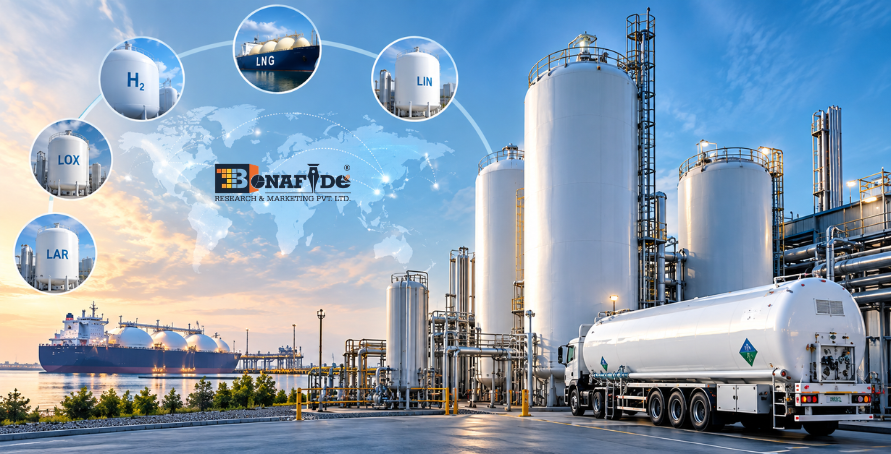
The Global Industrial landscape is increasingly dependent on technologies capable of safely storing and handling gases at extremely low temperatures. From liquefied natural gas (LNG) terminals and industrial gas facilities to hospitals, semiconductor fabs, aerospace programs, and emerging hydrogen infrastructure, cryogenic tanks have become an essential part of the modern industrial ecosystem.
Cryogenic tanks are specialized storage and transportation systems designed to contain liquefied gases such as LNG, liquid nitrogen, liquid oxygen, liquid argon, and other cryogenic fluids under extremely low-temperature conditions. Their ability to maintain temperature stability, minimize product losses, and provide safe containment makes them critical across energy, manufacturing, healthcare, food processing, electronics, and advanced technology applications.
According to the research report, "Global Cryogenic Tanks Market Outlook, 2031," published by Bonafide Research, the global cryogenic tanks market was valued at more than USD 11.28 billion in 2025 and is projected to reach more than USD 16.11 billion by 2031, expanding at a CAGR of 6.27% during 2026–2031. Asia-Pacific represents both the largest and fastest-growing regional market.
Understanding the Cryogenic Tanks Landscape
Cryogenic tanks are engineered storage and transport systems used for liquefied gases maintained at cryogenic temperatures. Depending on application, capacity, mobility, and gas type, these systems range from large stationary tanks used at LNG terminals and industrial gas plants to smaller microbulk tanks, transport tanks, and ISO tank containers.
The global market includes five major product categories: large stationary cryogenic tanks, medium stationary cryogenic tanks, microbulk/small cryogenic tanks, cryogenic transport tanks, and cryogenic ISO tank containers. Demand is influenced by the scale of gas consumption, infrastructure investment, transportation requirements, safety regulations, and the specific characteristics of the cryogenic gas being handled.
Cryogenic tanks are also increasingly being integrated with automated controls, sensors, remote monitoring, advanced instrumentation, predictive maintenance systems, and digital control platforms. These technologies are helping operators improve safety, reduce cryogen losses, increase energy efficiency, and obtain better visibility into tank performance.
Market Size and Growth Dynamics
The global cryogenic tanks market is entering a period of sustained expansion as LNG infrastructure, industrial gas consumption, healthcare infrastructure, advanced manufacturing, and hydrogen-related investments increase worldwide.
The market was valued at over USD 11.28 billion in 2025 and is expected to reach USD 16.11 billion by 2031, representing a CAGR of 6.27% during 2026–2031. The market covers applications across energy and LNG, manufacturing and industrial operations, chemical and petrochemical facilities, healthcare, electronics and semiconductors, food and beverage, aerospace and space, and water treatment/other applications.
The expansion of LNG storage and transportation infrastructure remains a major contributor to market demand. At the same time, increasing consumption of liquid nitrogen, liquid oxygen, and liquid argon across industrial and healthcare applications is creating a broad and diversified demand base.
Emerging applications are also becoming increasingly important. Investment in liquid hydrogen infrastructure, semiconductor manufacturing, aerospace technologies, and advanced research is creating new requirements for highly specialized cryogenic storage systems.
Large Stationary Tanks Anchor the Product Landscape
Large stationary cryogenic tanks represent a major product category because of their use in LNG terminals, air separation plants, industrial gas facilities, and large-scale energy infrastructure.
These tanks are particularly important at LNG liquefaction plants, export terminals, import terminals, peak-shaving facilities, and regasification infrastructure. Their large capacity allows operators to store significant volumes of cryogenic liquids while maintaining the temperature and pressure conditions required for safe and efficient operation.
Medium stationary tanks serve industrial and commercial applications where substantial but more moderate storage capacity is required. Meanwhile, microbulk and small cryogenic tanks support decentralized gas distribution and smaller-volume requirements.
Transport tanks and ISO tank containers perform a different but complementary function by connecting production facilities, storage locations, distribution networks, and end users. The growth of small-scale LNG distribution and international movement of cryogenic products is creating additional demand for these mobile storage solutions.
Energy & LNG Remains a Major Demand Center
Energy and LNG represent a central demand segment for cryogenic tanks because LNG requires specialized storage throughout its supply chain.
From natural gas liquefaction and storage to transportation, import terminals, and regasification, cryogenic tanks are required at multiple stages of the LNG value chain. Increasing investment in LNG infrastructure, energy security, import terminals, export facilities, and peak-shaving systems is therefore supporting demand for large stationary tanks and transport equipment.
Small-scale LNG is also creating opportunities for transport tanks and ISO containers, particularly for marine bunkering, industrial applications, and locations without extensive pipeline infrastructure.
Beyond LNG, manufacturing and industrial users require cryogenic tanks for gases used in metal processing, chemicals, electronics, and other industrial operations. Healthcare and life sciences are generating demand for medical gases, biobanking, pharmaceutical applications, and cell and gene therapy.
Liquid Nitrogen, Oxygen and Argon Expand Industrial Applications
While LNG represents a major cryogenic gas application, industrial gases provide another important source of market demand.
Liquid nitrogen is widely used across industrial, healthcare, food, pharmaceutical, electronics, and research applications. Liquid oxygen supports healthcare and industrial processes, while liquid argon is important in metallurgy, manufacturing, and specialized industrial applications.
The expansion of air separation plants and bulk industrial-gas distribution networks is consequently increasing the requirement for reliable cryogenic storage systems. Semiconductor and electronics manufacturing adds another layer of demand because advanced fabrication processes require controlled handling of high-purity gases.
Asia-Pacific Leads the Global Market
Asia-Pacific represents the largest and fastest-growing regional market for cryogenic tanks. The region's position is supported by industrial expansion, LNG infrastructure development, manufacturing growth, semiconductor investments, and increasing demand for industrial and medical gases.
China, Japan, India, Australia, and South Korea represent important markets within the region. Rapid industrialization and infrastructure investment are increasing demand for cryogenic storage across energy, manufacturing, electronics, healthcare, and chemical industries.
North America and Europe also remain significant markets due to established industrial gas infrastructure, LNG investments, healthcare applications, advanced manufacturing, and technology-intensive cryogenic applications. South America and the Middle East & Africa provide additional opportunities as energy infrastructure, industrial capacity, and gas distribution networks expand.
Market Drivers
Expansion of LNG Infrastructure and Cryogenic Energy Projects
Increasing investment in LNG liquefaction, storage, transportation, and regasification infrastructure is creating demand for large stationary and transport cryogenic tanks. LNG's role in power generation, marine fuel, industrial applications, and energy diversification is supporting continued infrastructure development.
Rising Industrial Gas and Healthcare Applications
Growing consumption of liquid nitrogen, liquid oxygen, liquid argon, and other cryogens across industrial gases, healthcare, chemicals, metals, electronics, and life sciences is broadening the addressable market for cryogenic tanks.
Market Challenges
High Capital Costs and Complex Installation
Cryogenic tanks require specialized materials, insulation, engineering, safety systems, testing, and certification. Large-scale systems can involve significant capital expenditure and long project-development cycles, potentially delaying investment among smaller users and price-sensitive markets.
Stringent Safety and Regulatory Requirements
Cryogenic fluids present unique operational risks because of extremely low temperatures, pressure conditions, flammability in certain applications, oxygen enrichment, and potential material embrittlement. Manufacturers and operators must therefore comply with demanding design, testing, pressure-vessel, transportation, environmental, and workplace-safety requirements.
Hydrogen and Digitalization Create the Next Growth Opportunities
The emergence of the hydrogen economy is opening a new application area for cryogenic tanks. Liquid hydrogen requires highly specialized storage and transfer technologies capable of maintaining extremely low temperatures while controlling boil-off and maintaining operational safety.
Investment in hydrogen production, liquefaction, storage, transportation, mobility, aerospace, and energy applications could therefore create an expanding demand base for advanced cryogenic tanks through 2031. Aerospace and advanced research applications are also supporting demand for specialized cryogenic systems involving liquid hydrogen, helium, and other high-performance cryogens.
At the same time, cryogenic tank manufacturers are increasingly incorporating automated controls, remote monitoring, sensors, predictive maintenance, digital systems, and advanced instrumentation. Improved insulation and vacuum technologies are also helping reduce cryogen losses and improve operating efficiency.
See how you can up your career status

Global Remote Working Software Market Outlook, 2030 is projected to reach market size of USD 94.80 Billion by 2030

The global flanges market is becoming increasingly important to industrial piping and mechanical connection systems, supporting oil and gas, chemical and petrochemical, power generation, water treatment, mining, marine, and manufacturing applications. The market was valued at USD 6.32 billion in 2025 and is projected to exceed USD 8.81 billion by 2031, growing at a 5.84% CAGR during 2026–2031.

The market was valued at USD 109.49 Billion in 2025 and is projected to reach USD 138.71 Billion by 2031, expanding at a 4.12% CAGR from 2026 to 2031.

According to the research report Global Automotive Manufacturing Equipment Market Outlook, 2031, published by Bonafide Research, the global automotive manufacturing equipment market was valued at more than USD 32.59 billion in 2025 and is projected to exceed USD 44.04 billion by 2031, registering a compound annual growth rate (CAGR) of 5.28% during 2026–2031.
 We are friendly and approachable, give us a call.