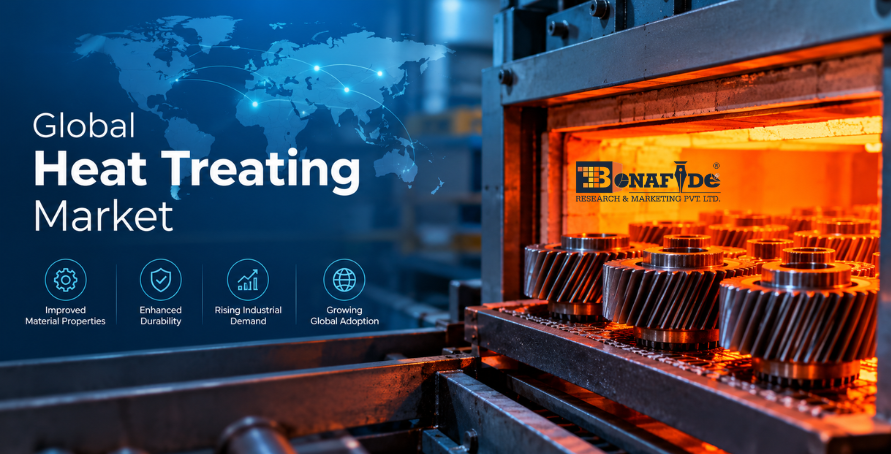
The Global Heat Treating Market is expanding as manufacturers across automotive, machinery, metalworking, construction equipment, aerospace, defense, energy, and general engineering increasingly require controlled material properties, improved component durability, and consistent production performance. Heat treatment remains an essential manufacturing process for modifying hardness, toughness, wear resistance, fatigue strength, machinability, and dimensional stability across a wide range of metallic components.
The market was valued at USD 109.49 Billion in 2025 and is projected to reach USD 138.71 Billion by 2031, expanding at a 4.12% CAGR from 2026 to 2031. Asia Pacific represents both the largest and fastest-growing regional market, supported by its concentration of steel production, automotive manufacturing, machinery, industrial equipment, and component manufacturing.
Steel remains the largest material segment because of its extensive use in gears, shafts, bearings, axles, fasteners, tooling, rollers, structural components, mining equipment, and industrial machinery. Global crude steel production reached approximately 1.85 billion tonnes in 2025, with China accounting for approximately 960.8 million tonnes, followed by India at 164.9 million tonnes, Japan at 80.7 million tonnes, the United States at 82.0 million tonnes, and South Korea at 61.9 million tonnes.
Automotive represents the largest end-user segment within heat treating. Global vehicle production increased from 92.7 million units in 2024 to 96.4 million units in 2025, while Asia Pacific accounted for approximately 59.2 million vehicles, or more than 61% of global production. Heat treatment remains relevant across gears, shafts, bearings, transmission components, steering systems, suspension components, braking systems, fasteners, and other precision metallic parts, including components used in electric vehicles.
Electrification and Precision Manufacturing Reshape Heat Treatment Demand
The transition toward electrified vehicles is changing the composition of heat-treated components rather than eliminating the need for thermal processing. Electric vehicles continue to require reduction gears, bearings, shafts, differentials, steering systems, braking components, fasteners, and other precision metallic components. China produced approximately 16.63 million new-energy vehicles in 2025, creating additional demand for high-precision components and controlled thermal processing.
Beyond automotive manufacturing, aerospace, defense, energy, mining, construction equipment, renewable-energy equipment, and industrial machinery are increasing requirements for controlled treatment of alloy steels, stainless steels, titanium alloys, nickel-based alloys, aluminum alloys, and other engineered materials. Component miniaturization and higher performance requirements are also increasing the importance of thermal cycles that improve fatigue strength, wear resistance, surface hardness, and dimensional stability.
Manufacturing modernization is simultaneously supporting investment in electrically heated furnaces, controlled-atmosphere systems, vacuum equipment, induction systems, automated quenching, continuous treatment lines, and digitally monitored thermal cycles. Electrically heated furnaces represent the largest equipment segment because they provide precise temperature control, programmable heating profiles, repeatable processing conditions, and compatibility with automated production environments.
Hardening and Tempering Remains Central to Industrial Heat Treatment
Hardening and tempering represents the largest process segment because it provides a versatile method for establishing the required balance of hardness, strength, toughness, and dimensional stability across industrial steel components. The process is widely used for gears, shafts, axles, pins, rollers, fasteners, dies, machine components, construction equipment, agricultural machinery, mining equipment, and wear parts.
Its broad applicability also supports continued demand across batch, continuous, atmosphere-controlled, vacuum, and induction-based systems. Manufacturers can combine hardening and tempering with carburizing, nitriding, induction treatment, or surface finishing to establish differentiated surface and core properties. Existing furnace installations also provide a substantial installed base for upgrades involving automation, quenching systems, controls, and data capture.
Electrically Heated Furnaces Support Efficiency and Process Control
Electrically heated furnaces lead equipment demand through their ability to deliver controlled heating conditions across hardening, tempering, annealing, normalizing, stress relieving, aging, and solution-treatment applications. Their integration with digital controllers, thermocouples, sensors, programmable logic controllers, data acquisition systems, and automated material handling makes them increasingly compatible with connected manufacturing environments.
The equipment transition is also connected to energy-management priorities. Manufacturers are evaluating furnace efficiency, thermal insulation, heat recovery, optimized cycle times, electrically powered heating, and automated controls to reduce energy consumption per processed component. Modern furnace systems can also support continuous production lines, automated loading and unloading, controlled atmospheres, and plant-level energy monitoring.
Asia Pacific Maintains Its Position as the Largest Heat Treating Market
Asia Pacific is the largest regional market, supported by the world's highest concentration of steel, automotive, machinery, industrial equipment, shipbuilding, and component manufacturing. China, India, Japan, South Korea, Vietnam, and Indonesia collectively provide a large steel-intensive manufacturing ecosystem that creates heat-treatment requirements throughout forging, casting, machining, assembly, and industrial production.
The region produced approximately 59.2 million vehicles in 2025, representing more than 61% of global vehicle production. China produced approximately 34.53 million vehicles, India 6.49 million, and Japan 8.41 million. Southeast Asia is also becoming increasingly important as automotive and electronics manufacturers expand production and diversify supply chains across Thailand, Vietnam, Indonesia, Malaysia, and neighboring economies.
Technology Development and Capacity Expansion Continue Across the Industry
Heat-treatment suppliers are increasingly investing in vacuum processing, advanced furnace designs, automation, hydrogen-ready systems, and expanded processing capacity. In July 2026, SECO/WARWICK signed a contract to supply a CaseMaster Evolution dual-chamber vacuum furnace with oil quenching to a Polish aerospace plant manufacturing critical landing-gear components.
Other developments include FPM Heat Treating's 2024 capacity expansion with a large Solar Manufacturing vacuum furnace, Aalberts Surface Technologies' expansion of austempering capabilities in Ohio, and SECO/WARWICK's supply of a Vector vacuum furnace to Turkish manufacturer YALMAN KNIVES in 2023. These developments reflect continued investment in specialized processing capacity and higher-precision thermal treatment.
Technology development is also addressing energy efficiency and lower-emission processing. Tenova introduced its TRKSX HydrogenReady SmartBurner in 2021 for heat-treatment furnaces, designed for natural gas and hydrogen-containing fuel mixtures while incorporating Industry 4.0 technologies. ECM Technologies also launched its ECO Furnace, an electrically heated vacuum furnace focused on energy efficiency and reducing the environmental impact of heat-treatment operations.






 We are friendly and approachable, give us a call.