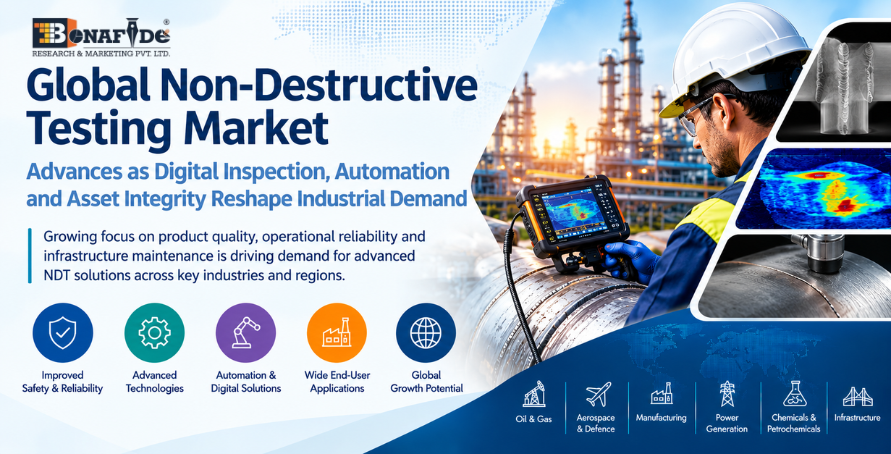
What if industries could detect hidden defects, assess structural integrity and evaluate component quality without damaging the products they inspect? That is the value of Non-Destructive Testing (NDT), a technology-driven industry becoming increasingly important to modern manufacturing and industrial maintenance.
According to Bonafide Research’s Global Non-Destructive Testing Market Outlook, 2031, the market was valued at USD 20.81 billion in 2025 and is projected to reach USD 32.94 billion by 2031, growing at a CAGR of 8.03% during 2026–2031.
What Is Driving NDT Market Growth?
NDT helps industries identify material discontinuities, measure thickness and evaluate component condition without intentionally damaging the item being inspected. Its applications span oil and gas, aerospace and defence, manufacturing, transportation, power generation and infrastructure.
As industrial assets become more complex, manufacturers and operators increasingly need reliable inspection methods to verify product quality, assess degradation and support maintenance decisions. This creates demand for inspection services, specialised equipment and software capable of managing inspection data.
Technology Is Changing the Inspection Process
Digital radiography, advanced ultrasonic systems, eddy-current arrays, industrial computed tomography and robotic inspection are expanding inspection capabilities. Software and automated workflows are also helping organisations collect, analyse and manage inspection information more effectively.
Recent developments highlight this shift. In October 2026, Eddyfi Technologies introduced Ignite, a digital eddy-current array platform designed to integrate data acquisition, analysis and automation. Waygate Technologies and Varex Imaging also announced a partnership to expand digital field-radiography solutions. Meanwhile, NDT Global commercially launched QUADRA in September 2026, an inline pipeline-inspection solution designed to combine multiple inspection datasets in a single run.
These developments demonstrate how the industry is moving toward connected, data-driven inspection workflows rather than relying solely on individual instruments.
Which Segments Offer the Biggest Opportunities?
NDT Services is the largest offering segment in Bonafide Research’s assessment, supported by inspection, testing, asset-integrity evaluation and specialist technical expertise.
Eddy-Current Testing (ET) is identified as the fastest-growing testing method. Its applications include inspection of suitable conductive materials, tubing and selected manufacturing components.
Weld and Joint Inspection represents the largest application segment because weld integrity is important across pipelines, fabricated structures, pressure systems and industrial equipment.
General Manufacturing and Heavy Industry is identified as the fastest-growing end-user segment in the current assessment, reflecting the range of inspection requirements throughout manufacturing and industrial operations.
Why Regional Markets Matter
North America leads the global market in Bonafide Research’s assessment, supported by its industrial inspection base, energy infrastructure, aerospace activities and maintenance requirements. Europe benefits from advanced manufacturing and industrial maintenance, while Asia-Pacific is supported by manufacturing expansion, infrastructure investment and energy development.
South America and the Middle East and Africa offer inspection opportunities across energy, mining, petrochemicals, power generation and industrial infrastructure. Regional demand varies according to industrial activity, technical requirements, investment and access to qualified inspection personnel.
What Lies Ahead?
The NDT industry's future will be shaped by the growing need for reliable inspection, asset integrity and manufacturing quality. Digital imaging, automation, robotics, advanced testing methods and inspection software are creating opportunities for equipment manufacturers and service providers.
However, technology alone is not enough. Accurate results still depend on suitable inspection methods, qualified personnel, validated procedures and proper interpretation.






 We are friendly and approachable, give us a call.