The Global Container Homes Market was valued at over USD 68.21 Billion in 2025 and is projected to reach USD 100.03 Billion by 2031, growing at a 6.76% CAGR 2026-2031.
Growing urbanization, rising housing shortages, increasing construction costs, and the global shift toward sustainable building practices are driving strong demand for container homes worldwide. Governments, developers, and private homeowners are increasingly embracing modular construction to reduce project timelines, minimize material waste, and improve affordability. As demand for flexible, durable, and environmentally responsible housing continues to rise, container homes are emerging as a practical alternative to conventional residential and commercial construction.
Container homes are reshaping the future of modular construction
Container homes are constructed using new or repurposed shipping containers that are transformed into permanent or movable residential and commercial structures. These buildings offer shorter construction cycles, lower labor requirements, enhanced structural durability, and greater design flexibility compared to traditional construction methods. Container homes are being adopted across residential housing, vacation homes, emergency shelters, workforce accommodation, healthcare facilities, educational infrastructure, and hospitality projects. Their ability to withstand harsh environmental conditions while supporting modern architectural designs has positioned them as one of the fastest-growing segments within the modular construction industry.
Sustainability initiatives and affordable housing programs are accelerating adoption
Governments across developed and emerging economies are increasingly promoting sustainable construction practices through green building regulations, affordable housing initiatives, and incentives for modular construction. The reuse of shipping containers significantly reduces construction waste and lowers embodied carbon compared to conventional building materials. In parallel, rapid urbanization, rising land prices, and housing affordability challenges are encouraging developers to adopt faster and more cost-effective construction methods. Disaster-prone regions are also utilizing container-based structures for temporary and permanent rehabilitation projects due to their rapid deployment capabilities and structural resilience.
Design innovation and smart technologies are transforming container housing
Modern container homes have evolved far beyond simple steel structures. Manufacturers are integrating advanced insulation materials, energy-efficient glazing, solar photovoltaic systems, battery storage, rainwater harvesting, smart lighting, HVAC automation, and IoT-enabled building management solutions to improve comfort and operational efficiency. Modular design software, Building Information Modeling (BIM), prefabrication technologies, and precision manufacturing further enable highly customized layouts while reducing construction errors and project delays. These technological advancements are making container homes increasingly attractive for permanent residential developments and premium architectural applications.
Strategic partnerships and product innovation continue to strengthen market competition
The competitive landscape of the Global Container Homes Market is evolving through technological innovation, strategic collaborations, geographic expansion, and customized modular solutions. Manufacturers are investing in high-performance insulation systems, multi-story modular designs, luxury container residences, and turnkey construction services to meet diverse customer requirements. Companies are expanding their global footprints through partnerships with real estate developers, hospitality operators, government agencies, and infrastructure contractors. Increasing investments in digital design platforms, factory automation, and sustainable construction materials are further strengthening the industry's competitive environment.
Residential construction and tourism projects continue to drive investment
Residential housing remains the primary application for container homes as consumers seek affordable, energy-efficient, and rapidly deployable housing solutions. Rising demand for vacation rentals, eco-resorts, glamping facilities, and remote accommodation has also accelerated the adoption of container-based hospitality infrastructure. Government-funded emergency housing, disaster relief shelters, military accommodation, student housing, and workforce camps continue creating additional demand across public infrastructure projects. The ability to relocate or expand modular units with minimal disruption further enhances their long-term investment appeal.
North America leads while Asia Pacific records the fastest expansion
North America remains the largest regional market owing to the widespread acceptance of modular housing, favorable construction regulations, high consumer awareness, and growing investment in sustainable residential developments. The United States and Canada continue witnessing increasing demand for affordable housing, recreational cabins, and container-based commercial projects. Meanwhile, Asia Pacific is expected to register the fastest growth, supported by rapid urbanization, expanding middle-class populations, infrastructure development, and rising government investments in affordable housing across China, India, Southeast Asia, and Australia. Europe continues emphasizing circular economy principles and green building standards, while Latin America, the Middle East, and Africa present significant long-term opportunities through affordable housing initiatives and infrastructure modernization.
New and idle containers remain the preferred construction solution
New and idle shipping containers continue to dominate the market because they offer superior structural integrity, longer operational life, improved corrosion resistance, and greater design flexibility. These containers require fewer structural modifications and provide enhanced safety, making them particularly suitable for permanent residential developments, commercial buildings, healthcare facilities, and premium modular housing projects. Increasing customer preference for durable and code-compliant buildings continues supporting demand for newly manufactured container structures.
Factory-built container homes emerge as the fastest-growing construction model
Factory-built container homes are expected to witness the fastest growth due to their superior quality control, faster project completion, lower labor dependency, and improved cost efficiency. Controlled manufacturing environments enable manufacturers to integrate plumbing, electrical systems, insulation, flooring, and interior finishes before on-site installation, significantly reducing construction timelines. Growing labor shortages in the construction industry and increasing demand for standardized modular housing solutions continue accelerating factory-built production worldwide.
Residential homes remain the largest end-user while emergency housing expands rapidly
Residential homes continue representing the largest end-user segment as urban populations grow and affordable housing demand increases globally. Homeowners increasingly prefer container homes for primary residences, vacation homes, rental properties, and off-grid living due to their affordability, sustainability, and architectural flexibility. Meanwhile, emergency housing is emerging as one of the fastest-growing applications as governments, humanitarian organizations, and disaster management agencies invest in rapidly deployable housing solutions for disaster relief, refugee accommodation, and temporary rehabilitation projects. Their portability, durability, and quick installation make container homes highly suitable for emergency response scenarios.
Smart modular communities and circular construction will define the future
The future of the Global Container Homes Market will be shaped by smart modular communities, net-zero energy buildings, circular construction practices, and digitally enabled manufacturing. Increasing integration of renewable energy systems, energy storage, smart home technologies, AI-based building management, and sustainable construction materials will further enhance the performance and attractiveness of container homes. As governments continue promoting green infrastructure and affordable housing while consumers prioritize sustainable lifestyles, container homes are expected to play an increasingly important role in the future of residential and commercial construction worldwide.



 By Sunny Keshri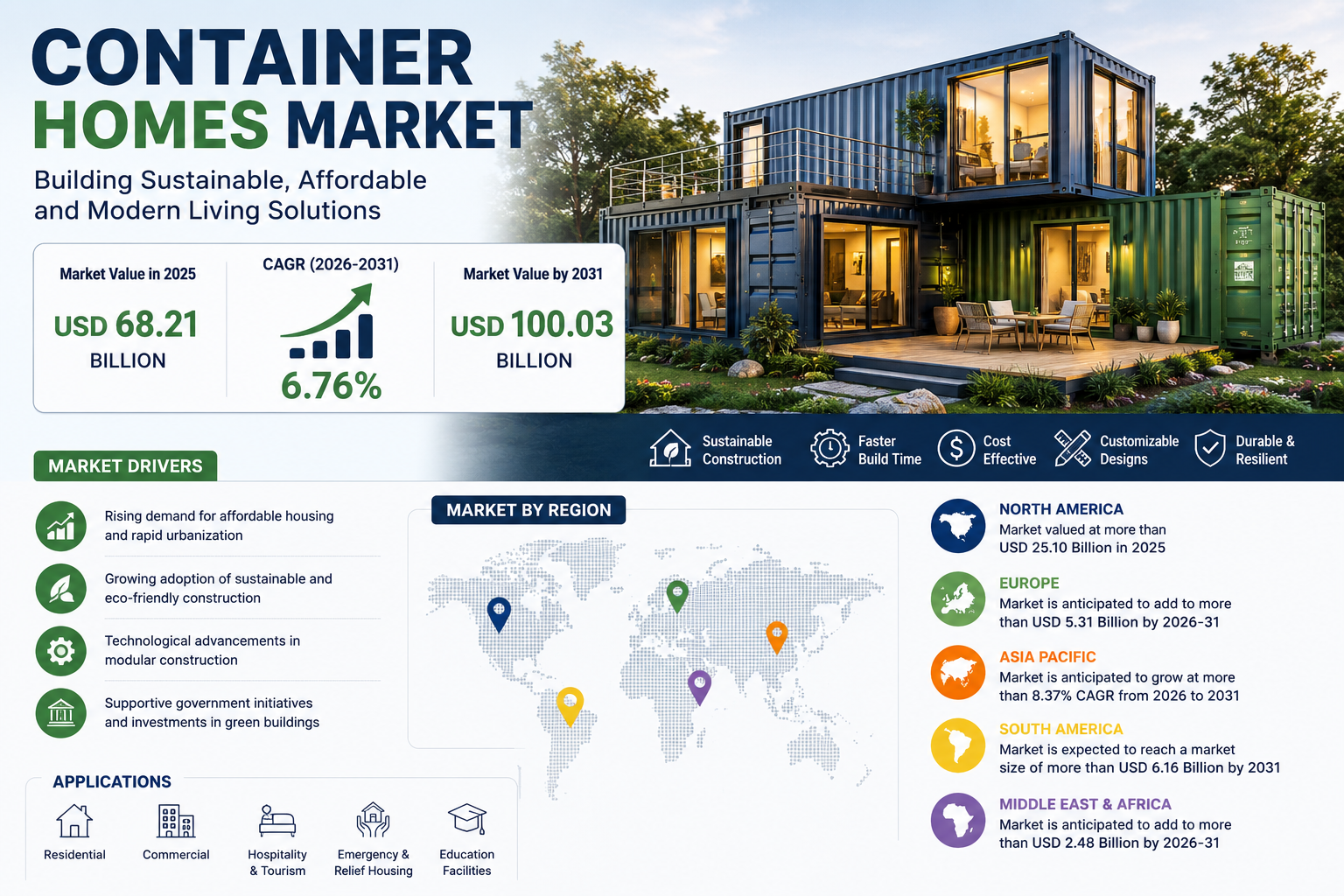
.png)

 We are friendly and approachable, give us a call.