The global
Student Information System (SIS) market comprises software platforms designed to centralize, manage, and automate student-related data and academic administration processes across K-12 schools, colleges, universities, and other educational institutions. These systems serve as a
digital backbone for educational operations by maintaining student records, enrollment information, attendance, grades, schedules, assessments, disciplinary records, financial data, and communication workflows within a unified platform. The market has gained substantial relevance as educational institutions worldwide continue to modernize administrative functions and adopt digital-first operating models. Growing student populations, increasing demand for data-driven decision-making, and the need for streamlined administrative processes are among the primary factors driving SIS adoption globally. Educational institutions are increasingly integrating SIS platforms with learning management systems, enterprise resource planning solutions, analytics tools, and communication applications to create comprehensive digital ecosystems that enhance operational efficiency and improve student outcomes. The rise of cloud computing has further accelerated market growth by enabling scalable, cost-effective, and remotely accessible SIS deployments. Additionally, the expansion of online learning, hybrid education models, and mobile-based academic services has increased the need for real-time access to student information among administrators, faculty, students, and parents. Regulatory requirements related to student data management, reporting, compliance, privacy, and institutional accountability have also strengthened the importance of robust SIS solutions. Organizations and associations involved in
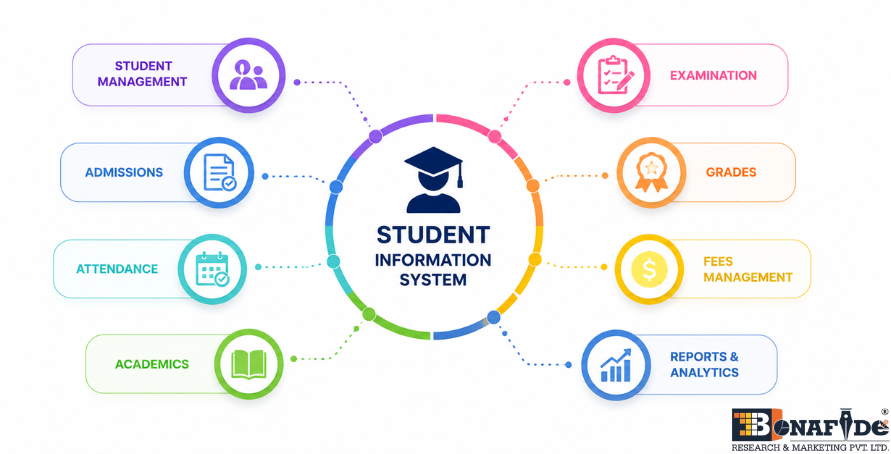
educational technology, digital learning, and institutional accreditation increasingly emphasize the role of integrated student data management systems in supporting educational quality and governance. Key activities performed by SIS platforms include admissions processing, enrollment management, attendance tracking, grade reporting, course scheduling, transcript generation, student performance analytics, parent-teacher communication, financial administration, and regulatory reporting.
According to the research report "Global Student Information System Market Outlook, 2031," published by Bonafide Research, the Global Student Information System Market was valued at more than USD 17.65 Billion in 2025, and expected to reach a market size of more than USD 46.43 Billion by 2031 with the CAGR of 17.95% from 2026-2031. SIS solutions have become essential for schools, colleges, and universities seeking to digitize operations and improve decision-making through real-time student data. The market is driven by growing cloud adoption, increasing demand for integrated education management platforms, expansion of online and hybrid learning models, stricter regulatory reporting requirements, and the need for data-driven student success initiatives. Major vendors include PowerSchool, Ellucian, Oracle, Workday, Blackbaud, SAP, Anthology, and Skyward, all of which continue to enhance cloud-native and analytics-driven capabilities. Recent developments include Workday's expansion of its Student platform into Australia and New Zealand, Blackbaud reporting strong recurring-revenue performance from its education portfolio, and Jenzabar expanding its collaboration with Google Cloud to strengthen SIS functionality. Opportunities remain significant in emerging markets, AI-powered student retention analytics, mobile-first learning environments, predictive enrollment management, and integration with learning management systems and financial platforms. The SIS value chain typically begins with software development and cloud infrastructure providers, followed by system integrators, implementation partners, managed service providers, educational institutions, and end users such as administrators, faculty, students, and parents. Increasing demand for unified data ecosystems, automated workflows,
cybersecurity controls, and personalized student experiences continues to encourage investment and innovation across the global SIS landscape.
Educational institutions are no longer purchasing Student Information Systems as standalone software products that can be deployed without extensive technical assistance. Modern SIS platforms are integrated environments connected with learning management systems, financial management platforms, human resource systems, communication tools, analytics applications, and government reporting frameworks. As a result, schools and universities increasingly depend on specialized service providers to configure these systems according to institutional requirements. The migration of decades of student records from legacy databases to cloud-based platforms has become one of the most service-intensive activities in the education technology ecosystem. Institutions must ensure that enrollment records, attendance histories, academic transcripts, financial information, and compliance documents are transferred accurately while maintaining data integrity and regulatory compliance. Furthermore, many educational organizations lack large internal IT teams capable of handling implementation, cybersecurity management, user training, workflow customization, and software upgrades independently. Service providers therefore play a critical role throughout the lifecycle of an SIS deployment. The growing emphasis on
digital transformation has also increased demand for consulting services that help institutions redesign administrative processes and optimize student data management practices. Additionally, the expansion of remote and hybrid learning environments has created new requirements for platform integration, user onboarding, and technical support. Continuous software updates, security monitoring, performance optimization, and compliance management further strengthen the need for managed services. Educational institutions increasingly view professional services as essential for achieving operational efficiency, reducing implementation risks, minimizing downtime, and ensuring successful user adoption.
The role of parents in educational decision-making has expanded significantly over the last decade, prompting schools and universities to strengthen digital communication channels between institutions and families. Student Information Systems have evolved from administrative record-keeping tools into interactive engagement platforms that provide parents with immediate access to academic and non-academic information. Through dedicated portals and mobile applications, parents can monitor attendance records, assignment completion, examination results, behavioral updates, fee payments, transportation schedules, and school announcements without waiting for periodic reports or parent-teacher meetings. The widespread adoption of smartphones and digital communication technologies has made continuous engagement between schools and families both practical and expected. Educational institutions increasingly recognize that parental involvement is associated with improved student attendance, stronger academic performance, and enhanced student accountability. As a result, schools are actively investing in SIS features that facilitate direct communication with parents through notifications, alerts, messaging systems, and progress-tracking dashboards. Regulatory expectations surrounding student welfare and transparency have also encouraged institutions to maintain more comprehensive communication with families. During periods of remote and hybrid learning, many institutions experienced firsthand the value of digital parent engagement tools, accelerating long-term adoption of parent-focused SIS functionalities. Furthermore, growing concerns related to student safety, mental well-being, academic progression, and attendance monitoring have increased parental demand for immediate access to institutional information.
Educational institutions increasingly face budget constraints, fluctuating enrollment levels, and evolving technology requirements, making flexible procurement models more attractive than traditional long-term software contracts. The pay-per-use approach enables schools, colleges, and universities to adopt sophisticated Student Information System capabilities without making substantial upfront investments in software licenses, infrastructure, or maintenance resources. This model has gained momentum alongside the broader adoption of cloud computing and software-as-a-service architectures, which make consumption-based pricing technically feasible and operationally efficient. Educational institutions often experience varying demand levels across academic cycles, enrollment periods, examination seasons, and administrative processes. Pay-per-use structures allow organizations to scale system usage according to these changing needs while avoiding the financial inefficiencies associated with overprovisioned systems. The model is particularly attractive for smaller institutions, emerging educational providers, vocational training centers, and organizations undergoing digital transformation initiatives. Furthermore, many institutions prefer to evaluate platform performance before committing to broader implementation, making usage-based pricing an effective risk-reduction strategy. Vendors also benefit because the model encourages wider adoption among organizations that may have been unable to justify large capital expenditures. The increasing integration of analytics, communication tools,
mobile services, and cloud infrastructure within SIS environments further supports usage-based billing mechanisms. Educational leaders are placing greater emphasis on measurable return on investment and operational efficiency, making flexible payment structures increasingly appealing.
The purpose of Student Information Systems has expanded far beyond administrative record management, reflecting a broader shift toward student-centered education strategies. Institutions worldwide are under increasing pressure to improve retention rates, academic achievement, graduation outcomes, and overall student satisfaction. As a result, Student Information Systems are being leveraged to identify students who may require academic, behavioral, financial, or emotional support before challenges become severe. Modern SIS platforms generate valuable insights from attendance records, assessment performance, participation trends, and engagement indicators, allowing educators and administrators to intervene proactively. The growth of hybrid learning environments has further highlighted the importance of monitoring student engagement beyond traditional classroom settings. Educational institutions now seek comprehensive visibility into student interactions, communication patterns, course participation, and support service utilization. Student support applications integrated within SIS platforms facilitate academic advising, counseling coordination, mentoring programs, early warning systems, and personalized learning pathways. Increasing awareness of
mental health concerns and student well-being has also expanded institutional investment in engagement-focused technologies. Many schools and universities recognize that successful educational outcomes depend not only on academic instruction but also on continuous support throughout the student journey. Government agencies, accreditation bodies, and educational policymakers increasingly emphasize student success metrics, further encouraging investment in engagement-focused solutions. Additionally, students themselves expect digital experiences that provide personalized communication, self-service capabilities, and immediate access to support resources.
The K–12 sector represents the
foundation of formal education systems worldwide and serves substantially larger student populations than most higher education segments. Managing millions of students across public and private school networks requires extensive administrative coordination, making Student Information Systems essential operational tools. K–12 institutions rely heavily on SIS platforms to manage enrollment records, attendance tracking, grade reporting, behavioral monitoring, health information, transportation management, scheduling, and parent communication activities. Unlike many higher education institutions where students operate more independently, K–12 schools maintain frequent interactions among administrators, teachers, students, and parents, creating a greater need for centralized information management and communication systems. Government education authorities also impose extensive reporting requirements related to attendance, funding allocation, academic performance, student demographics, and regulatory compliance, further increasing SIS adoption within this segment. The growing integration of digital learning technologies into primary and secondary education has expanded the role of SIS platforms beyond administration to include student engagement, performance analytics, and personalized support initiatives. Additionally, the widespread availability of parent portals and mobile applications has strengthened the importance of SIS platforms in maintaining transparency and family involvement. Many countries continue to invest heavily in educational digitalization programs, school modernization projects, and data-driven education policies, with K–12 institutions frequently serving as primary beneficiaries. The need to support large student populations, facilitate communication among multiple stakeholders, improve operational efficiency, and enhance educational outcomes makes Student Information Systems indispensable within K–12 environments.










 We are friendly and approachable, give us a call.