The global
Secure Web Gateway (SWG) market has become a critical segment of the
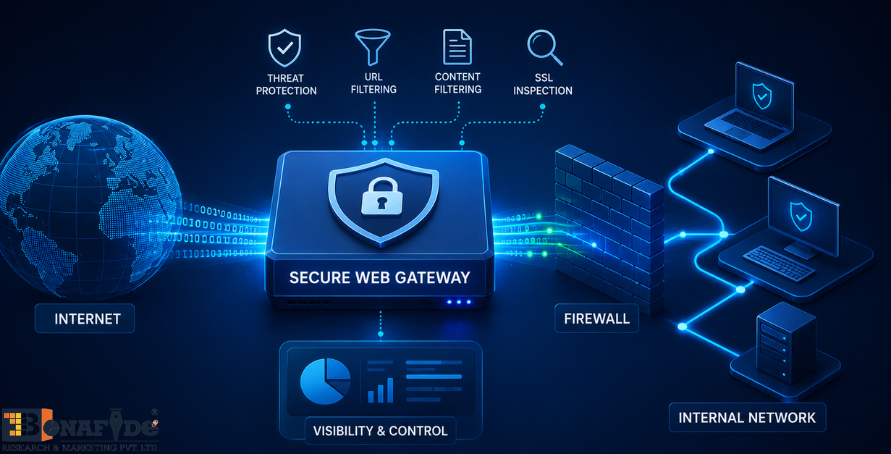
cybersecurity industry as organizations increasingly rely on internet-based applications, cloud platforms, and hybrid work environments. A Secure Web Gateway is a security solution that monitors, filters, and controls web traffic between users and the internet to protect against malware, ransomware, phishing attacks, malicious URLs, unauthorized applications, and data leakage while enforcing organizational security policies. Modern SWG solutions are delivered as both on-premises appliances and cloud-native services, enabling consistent protection for employees regardless of their location or device. The market is experiencing steady expansion due to the rapid adoption of cloud computing, Software-as-a-Service (SaaS) applications, remote and hybrid work models, increasing internet usage across enterprises, and the growing sophistication of cyber threats. Organizations are also adopting
Secure Web Gateways to comply with data privacy regulations and cybersecurity frameworks while improving visibility into web activity and reducing security risks. The market plays an essential role in enabling Zero Trust security strategies by continuously inspecting encrypted traffic, authenticating users, enforcing access policies, and preventing unauthorized data transfers. Secure Web Gateways are increasingly integrated into broader Security Service Edge (SSE) and Secure Access Service Edge (SASE) architectures alongside Cloud Access Security Brokers (CASB), Zero Trust Network Access (ZTNA), Firewall-as-a-Service (FWaaS), and
Data Loss Prevention (DLP) solutions to provide unified cloud-delivered security. Industry organizations such as the Cybersecurity and Infrastructure Security Agency (CISA), the National Institute of Standards and Technology (NIST), the European Union Agency for Cybersecurity (ENISA), the Cloud Security Alliance (CSA), and the Internet Engineering Task Force (IETF) contribute to the development of cybersecurity guidance, standards, and best practices that influence Secure Web Gateway deployments. Continuous innovations in
artificial intelligence, machine learning, threat intelligence, encrypted traffic inspection, browser isolation, and behavioral analytics are further enhancing SWG capabilities
According to the research report "Global Secure Web Gateway Market Outlook, 2031," published by Bonafide Research, the Global Secure Web Gateway Market was valued at more than USD 12.79 Billion in 2025, and expected to reach a market size of more than USD 36.76 Billion by 2031 with the CAGR of 19.73% from 2026-2031. Leading vendors including Cisco Systems, Zscaler, Palo Alto Networks, Netskope, Broadcom (Symantec), Fortinet, Check Point Software Technologies, Forcepoint, Sophos, Cloudflare, and iboss continue to expand their SWG capabilities through artificial intelligence, threat intelligence, sandboxing, browser isolation, and integrated data protection features. One of the most significant market opportunities lies in the growing adoption of Security Service Edge (SSE) and Secure Access Service Edge (SASE), where Secure Web Gateway functions are combined with Cloud Access Security Broker (CASB), Zero Trust Network Access (ZTNA), Firewall-as-a-Service (FWaaS), and Data Loss Prevention (DLP) into unified cloud-delivered platforms. Companies are also investing in
generative AI security, enabling SWGs to monitor AI application usage, prevent sensitive data exposure, and detect AI-assisted cyberattacks. Recent developments include continuous platform enhancements by Zscaler and Netskope to strengthen cloud-delivered
security services, Cisco's expansion of its Security Cloud platform with integrated Secure Service Edge capabilities, and Cloudflare's addition of advanced browser isolation and secure web filtering features within its Zero Trust platform. The market value chain begins with technology providers developing threat detection engines, encryption technologies, and AI models, followed by cybersecurity software vendors integrating these capabilities into SWG platforms. Cloud infrastructure providers support scalable service delivery, while system integrators, managed security service providers (MSSPs), value-added resellers, and distributors deploy and manage solutions for enterprises. End users across banking, financial services, healthcare, government, manufacturing, retail, education, and information technology sectors utilize Secure Web Gateways to enforce internet access policies, protect remote employees, secure SaaS applications, and ensure regulatory compliance. Increasing encrypted web traffic, expanding cloud adoption, stricter data privacy regulations, and rising ransomware and phishing incidents continue to create substantial opportunities for innovation, partnerships,
managed security services, and cloud-based Secure Web Gateway deployments worldwide.
Educational institutions have undergone a significant
digital transformation over the past decade, shifting from traditional classroom infrastructure to cloud-enabled learning ecosystems that depend on continuous internet connectivity. Universities, colleges, schools, and research institutes now rely extensively on learning management systems, virtual classrooms,
cloud storage platforms,
digital libraries, online examinations, and collaboration applications that are accessed by students, faculty members, researchers, and administrative staff from multiple locations and devices. Unlike conventional enterprise environments, educational networks support thousands of unmanaged personal laptops, smartphones, and tablets, creating an extensive attack
surface that increases exposure to phishing attacks, malware downloads, malicious websites, credential theft, and unauthorized data transfers. Secure Web Gateways help educational institutions enforce acceptable internet usage policies, inspect encrypted web traffic, block malicious domains,
filter inappropriate content, and protect users regardless of whether they access resources from campus or remotely. Many universities also conduct collaborative international research involving confidential intellectual property, making protection against data leakage increasingly important. Government-backed digital education initiatives across several countries have further expanded internet-based learning, increasing dependence on cloud-delivered cybersecurity solutions. Budget limitations have encouraged educational organizations to adopt cloud-managed security platforms that reduce infrastructure complexity while providing centralized policy enforcement. Additionally, educational institutions are frequent targets of ransomware operators because of the large volume of personally identifiable information, financial records, and research data they maintain.
Modern cyber threats have evolved beyond conventional malicious websites, leading organizations to demand security capabilities that extend well beyond traditional web filtering. The "Others" category typically encompasses advanced technologies such as Remote Browser Isolation (RBI), cloud application visibility, encrypted traffic inspection, threat intelligence integration, secure DNS protection, user behavior analytics, sandboxing, and AI-powered threat detection. As enterprises increasingly migrate workloads to cloud environments and employees access numerous SaaS applications daily, conventional Secure Web Gateway capabilities alone are often insufficient to address emerging risks associated with shadow IT, credential theft, malicious browser sessions, zero-day exploits, and unauthorized cloud application usage. Browser isolation has become particularly valuable because it executes potentially risky web sessions in remote cloud environments instead of endpoint devices, significantly reducing exposure to browser-based attacks. Simultaneously, AI-enabled detection engines improve the identification of phishing attempts, suspicious URLs, malicious scripts, and abnormal browsing behavior in real time. Organizations are also integrating Secure Web Gateway platforms with broader cybersecurity ecosystems, including Zero Trust frameworks, identity management platforms, endpoint detection solutions, and cloud security services, creating demand for complementary security capabilities that fall within this broader solution category. Increasing adoption of generative AI applications has introduced new concerns regarding sensitive data exposure and unauthorized AI usage, encouraging organizations to implement additional web monitoring and policy enforcement tools. Regulatory compliance requirements also encourage deployment of technologies capable of providing detailed activity logging, content inspection, and granular
access control.
Deploying a Secure Web Gateway has become significantly more complex than simply installing web filtering software, as modern cybersecurity environments require integration with identity management platforms, cloud infrastructure, endpoint security solutions, Zero Trust architectures, Security Information and
Event Management (SIEM) systems, and compliance monitoring frameworks. Consequently, enterprises increasingly depend on professional services and managed security providers to ensure successful implementation, policy configuration, migration, optimization, and continuous operational support. Organizations often operate hybrid infrastructures consisting of on-premises applications, multiple cloud platforms, remote workforces, and numerous Software-as-a-Service environments, each requiring carefully designed security policies to avoid disrupting legitimate business operations while maintaining strong protection. Professional consulting services assist enterprises in designing suitable architectures, assessing security risks, defining internet access policies, and ensuring compliance with evolving regulatory requirements. After deployment, managed security services provide continuous monitoring, threat analysis,
incident response, policy tuning, software updates, and security reporting, reducing the operational burden on internal IT teams. The global shortage of experienced cybersecurity professionals further increases dependence on specialized service providers capable of maintaining advanced security platforms around the clock. Service providers also help organizations respond quickly to evolving threats by updating security policies, integrating new threat intelligence feeds, and optimizing protection against emerging attack techniques. As businesses increasingly adopt cloud-native Secure Web Gateway platforms, migration planning, employee training, configuration validation, and post-deployment support become equally important. Many small and medium-sized organizations lack dedicated cybersecurity personnel, making outsourced expertise an attractive option for maintaining effective web security.
Enterprise computing has shifted dramatically toward cloud infrastructure, Software-as-a-Service applications, and distributed workforces, fundamentally changing how organizations secure internet access. Traditional appliance-based Secure Web Gateways were designed primarily to protect users operating within corporate office networks, but modern employees increasingly access business applications from homes, branch offices, customer locations, and mobile devices using direct internet connections. Cloud-delivered Secure Web Gateway platforms address this challenge by enforcing identical security policies regardless of user location, eliminating dependence on backhauling internet traffic through centralized corporate data centers. This approach improves application performance while reducing network complexity and operational overhead. Cloud deployments also simplify software maintenance because updates, threat intelligence feeds, policy enhancements, and security patches are managed centrally by solution providers without requiring extensive customer intervention. Organizations benefit from rapid deployment, flexible scalability, and simplified expansion when onboarding new users, branch offices, or business acquisitions. Cloud-native architectures also integrate more effectively with Security Service Edge (SSE), Secure Access Service Edge (SASE), Zero Trust Network Access (ZTNA), Cloud Access Security Broker (CASB), identity providers, and cloud application ecosystems, enabling unified security management across distributed digital environments. The widespread adoption of remote work, increasing reliance on SaaS productivity platforms, and migration of enterprise workloads to public and private cloud environments have reinforced demand for cloud-based web protection. Cloud deployments also support centralized visibility, policy consistency, and real-time analytics across geographically dispersed users.
Small and medium-sized enterprises have become increasingly dependent on cloud applications, digital collaboration platforms, online banking,
e-commerce systems, and remote work technologies, exposing them to many of the same cyber threats faced by large multinational corporations. Despite this growing digital dependence, many SMEs operate with limited cybersecurity budgets, small IT teams, and minimal dedicated security personnel, making it difficult to manage increasingly sophisticated cyber risks independently. Cloud-based Secure Web Gateway solutions provide these organizations with enterprise-grade protection without requiring substantial investment in hardware infrastructure or specialized security expertise. The subscription-based delivery model allows SMEs to deploy advanced web filtering, malware detection, phishing protection, encrypted traffic inspection, application control, and data loss prevention capabilities quickly while minimizing operational complexity. Cybercriminals increasingly target smaller businesses because they often maintain weaker security controls yet possess valuable financial information, customer records, intellectual property, and supplier relationships. Secure Web Gateways help reduce these risks by preventing access to malicious websites, identifying suspicious downloads, enforcing internet usage policies, and protecting employees regardless of whether they work from offices or remote locations. As SMEs continue adopting Software-as-a-Service applications and digital business processes, secure internet access becomes essential for maintaining operational continuity and regulatory compliance. Managed security services offered alongside cloud-delivered Secure Web Gateway platforms further reduce administrative burdens by providing ongoing monitoring, updates, and expert support.










 We are friendly and approachable, give us a call.