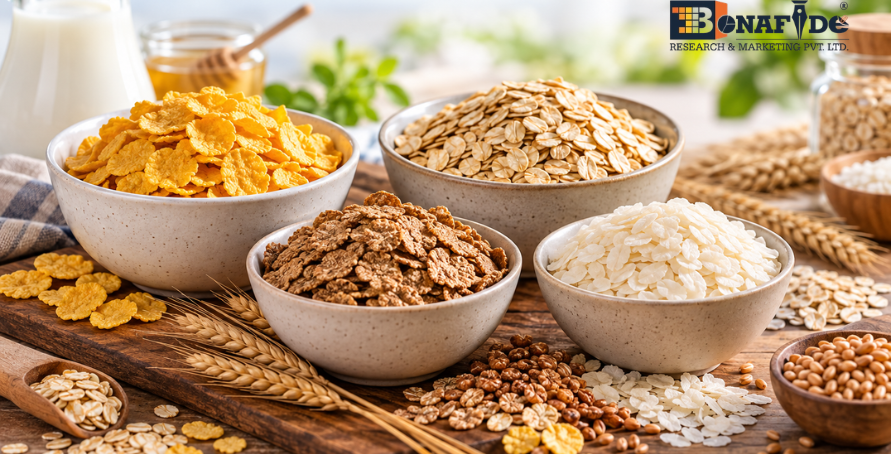
Convenience Breakfast Consumption, Grain-Based Nutrition, Product Innovation, Modern Retail, and E-Commerce Drive Global Edible Flakes Market.
Food & Beverages


India is the third-largest producer and second-largest consumer of fertilizers. The country ranks second in terms of population, only after China. The growing populace and shrinking arable land call for the optimum use of crop nutrients and crop protection through fertilizers. The pressure has been rising to improve the end yields to meet the demand of the ever-rising population. Given such a scenario, the agriculture sector will rely heavily on the extensive usage of fertilizers and other chemicals to improve productivity.
Fertilizers are any solid, liquid, or gaseous substances containing one or more plant nutrients. They are applied to the soil, directly on the plant (foliage), or added to aqueous solutions to maintain soil fertility, improve crop development, yield, and crop quality. The purpose of fertilizers is to supplement the natural supply of soil nutrients, build up soil fertility to satisfy the demand of crops with high yield potential, and compensate for nutrients taken by harvested products or lost through unavoidable leakages to the environment. Manufactured fertilizers are classified based on different criteria, including the number of nutrients (single-nutrient or straight fertilizers and multi-nutrient/compound fertilizers with two, three, or more nutrients), type of combination (mixed fertilizers or bulk blends), physical condition (solid, liquid, or gaseous), and nutrient release mechanism (quick-acting, slow-acting, controlled-release by coating, or stabilized by inhibitors).
The Government of India has been consistently pursuing policies conducive to increased availability and consumption of chemical fertilizers in the country, thereby maximizing agricultural production. The government promotes and assists industries in the fertilizer sector and also plans and arranges import and distribution of fertilizers nationwide. The department disburses subsidies to manufacturers and importers of decontrolled fertilizers under the nutrient-based subsidy (NBS), which is administered by the Department of Fertilizers to make these fertilizers available to farmers at indicative MRP. Initiatives like the Soil Health Card Scheme and PM-Kisan Samman Nidhi Yojana have further encouraged the balanced use of fertilizers while promoting sustainable farming practices.
According to a recently published report by Bonafide Research, India Chemical Fertilizers Market Outlook, 2027-28, the chemical fertilizers market in the country is moving forward with a healthy CAGR and is expected to flourish in the coming years. The current low consumption of chemical fertilizers in India, compared to the world average, offers immense opportunities for future growth. Availability of cheap labor and low processing costs presents an opportunity for MNCs to set up their manufacturing hubs in India for their export markets. The sector is also driven by significant opportunities for contract manufacturing and research for Indian players due to the large availability of technically skilled labor. Despite low per-hectare consumption compared to developed nations, there is a significant unserved market in the country. By educating farmers and conducting special training programs regarding the proper use of chemical fertilizers, the end yields can be improved, which will help satisfy the rising demand for food grains in the country.
The demand for organic and bio-based fertilizers is also gaining traction due to increasing awareness of soil health and environmental sustainability. The Indian government has been promoting the use of organic fertilizers through schemes such as the National Mission for Sustainable Agriculture (NMSA) and Paramparagat Krishi Vikas Yojana (PKVY), which support farmers in transitioning to eco-friendly alternatives. Companies are investing in R&D to develop microbial and plant-based fertilizers, which not only enhance soil fertility but also reduce dependence on synthetic chemicals.
Furthermore, advancements in precision agriculture and digital farming techniques are influencing fertilizer application. Technologies such as drone-based spraying, AI-driven nutrient management, and satellite monitoring of soil health are optimizing fertilizer usage. These innovations are expected to revolutionize India's fertilizer market by ensuring efficient utilization, reducing wastage, and enhancing overall productivity.
Major participants in the chemical fertilizers market include private sector undertakings such as Coromandel, Mangalore, and Zuari; public sector units including GSFC and GNFC; and cooperative societies such as IFFCO and KRIBHCO. As demand continues to grow, these players are expanding their production capacities and investing in sustainable solutions to cater to the evolving needs of the Indian agricultural sector.














 We are friendly and approachable, give us a call.