The Global Self-Storage Market is experiencing sustained expansion as households, individuals, and businesses increasingly seek flexible, secure, and accessible space for storing personal belongings, household goods, business inventory, documents, equipment, vehicles, and other possessions. Self-storage facilities provide customers with private rental units that they can access and manage directly, allowing them to retain control of their belongings without committing to larger residential or commercial premises. The market includes climate-controlled storage, non-climate-controlled storage, portable container storage, and vehicle storage, with facilities offering different unit sizes and rental arrangements to accommodate varying customer requirements. Unlike traditional warehousing and third-party logistics services, self-storage is based on customer-controlled storage space where the operator provides the premises, security, access infrastructure, and related facility services. The flexibility of rental periods, availability of different unit sizes, convenient locations, digital booking options, and increasing adoption of security and facility-management technologies are strengthening the role of self-storage within the broader flexible-space ecosystem.
According to the research report, "Global Self-Storage Market Outlook, 2031," published by Bonafide Research, the Global Self-Storage Market was valued at more than USD 62.75 Billion in 2025 and is expected to reach more than USD 87.73 Billion by 2031, growing at a CAGR of 5.89% from 2026 to 2031. The market is projected to expand throughout the forecast period as urbanization, residential mobility, limited household space, business expansion, changing lifestyles, and growing awareness of organized storage solutions increase demand for dedicated storage facilities. Operators are also expanding their portfolios through new development, acquisitions, facility modernization, digital rental systems, remote management, and technology-enabled security. These developments are supporting the transformation of self-storage from a basic space-rental service into an increasingly professionalized and technology-enabled real estate service.
Flexible Storage Demand: The Primary Driver of Market Expansion
The increasing need for flexible storage space represents one of the fundamental factors supporting Self-Storage Market demand. Households increasingly require additional space during residential relocation, renovation, downsizing, travel, life-stage transitions, temporary accommodation, and other situations where available living space becomes insufficient. Self-storage allows customers to temporarily or permanently move belongings outside the home while retaining convenient access to their possessions. The ability to select different unit sizes also enables customers to rent only the amount of space they require rather than occupying larger residential or commercial premises. Urbanization is particularly important to the development of self-storage because densely populated cities often experience limited residential space and higher property costs. Apartments and smaller homes can reduce the amount of space available for seasonal belongings, furniture, sports equipment, household items, documents, and other possessions. Self-storage facilities located close to residential communities can therefore function as an extension of household space. The development of compact urban facilities and the conversion of existing commercial or industrial properties are providing operators with additional ways to serve customers in locations where land availability is constrained. Business demand is another important component of market expansion. Small businesses, retailers, contractors, e-commerce sellers, professionals, and independent operators can use self-storage for inventory, equipment, documents, tools, seasonal products, promotional materials, and other operational goods. For smaller businesses, self-storage can provide additional capacity without requiring a conventional warehouse lease or long-term commercial property commitment. As business models become more flexible and e-commerce activity expands, storage facilities can also support businesses that require localized inventory capacity close to their customer base. The growing professionalization of the sector is further supporting demand. Modern operators increasingly provide online reservations, electronic contracts, automated payments, digital access control, surveillance, customer portals, insurance options, packing supplies, and other ancillary services. These features improve convenience while enabling operators to manage larger customer bases across multiple properties. The combination of flexible space, recurring rental revenue, customer-controlled access, and technology-enabled management is strengthening the position of self-storage within the wider real estate and flexible-space market.
Urbanization and Residential Space Constraints Supporting Adoption
Changes in housing patterns represent another important factor influencing the Global Self-Storage Market. Urban populations are increasingly concentrated in metropolitan areas where residential space can be expensive or limited. Smaller apartments, higher housing costs, relocation between cities, and changing household structures can increase the need for external storage. Customers may use self-storage during home moves, property renovations, family transitions, downsizing, or periods when furniture and other belongings cannot be accommodated within the available residential space. Self-storage can also provide a practical solution for households that want to retain possessions without moving to a larger property. Seasonal items such as winter clothing, bicycles, recreational equipment, decorations, luggage, and outdoor furniture can be stored outside the home and accessed when required. This makes storage particularly relevant for customers living in apartments and other compact residential environments. Residential mobility can create additional short-term demand. Customers moving between rental properties, relocating for employment, studying in another city, or temporarily living overseas may require storage for several weeks or months. Similarly, homeowners undertaking renovations may need to move furniture and household goods into temporary storage. Such circumstances support demand for flexible rental agreements and convenient facilities located near residential areas. The role of self-storage as an extension of living space is becoming increasingly visible in Asia-Pacific. The Self Storage Association Asia's 2025 survey reported that individual customers accounted for approximately 72% of occupied storage space across the region. The survey also noted that average individual tenancy was approaching 20 months, indicating that self-storage is increasingly being used beyond purely short-term transitional requirements in several markets.
Technology Integration Transforming Self-Storage Operations
Technology is increasingly changing how self-storage facilities are developed, operated, and accessed. Traditional facilities relied heavily on physical locks, staffed reception areas, manual contracts, and on-site customer service. Modern facilities increasingly incorporate electronic gates, smart locks, digital access credentials, surveillance cameras, automated payment systems, online reservations, customer portals, property-management software, and remote monitoring. Digital access control allows customers to enter facilities using mobile applications, access codes, keypads, or other electronic credentials. These systems can improve convenience while providing operators with information about facility access and customer activity. Smart locks can also reduce dependence on traditional keys and allow operators to manage access remotely. Remote facility management is becoming particularly important as operators expand across multiple locations. Centralized technology platforms can allow operators to monitor security systems, access controls, alarms, payments, occupancy, customer communication, and other facility functions from centralized locations. This can reduce dependence on full-time staffing at individual properties while allowing operators to maintain service availability across larger portfolios. Artificial intelligence is also becoming more relevant to facility management. The 2025 FEDESSA European Self Storage Industry Report reported that 90% of surveyed self-storage businesses were actively using AI, while growth in remotely managed stores was also identified as an industry development. The report covered 138 operators representing 1,447 stores across 16 continental European countries. AI applications can include customer-service automation, marketing analysis, revenue management, security monitoring, lead management, demand forecasting, and operational analytics. As technology becomes more integrated into facility operations, operators can increasingly use data to identify occupancy patterns, optimize pricing, manage customer interactions, and improve asset-level performance.
Security and Accessibility Supporting Customer Confidence
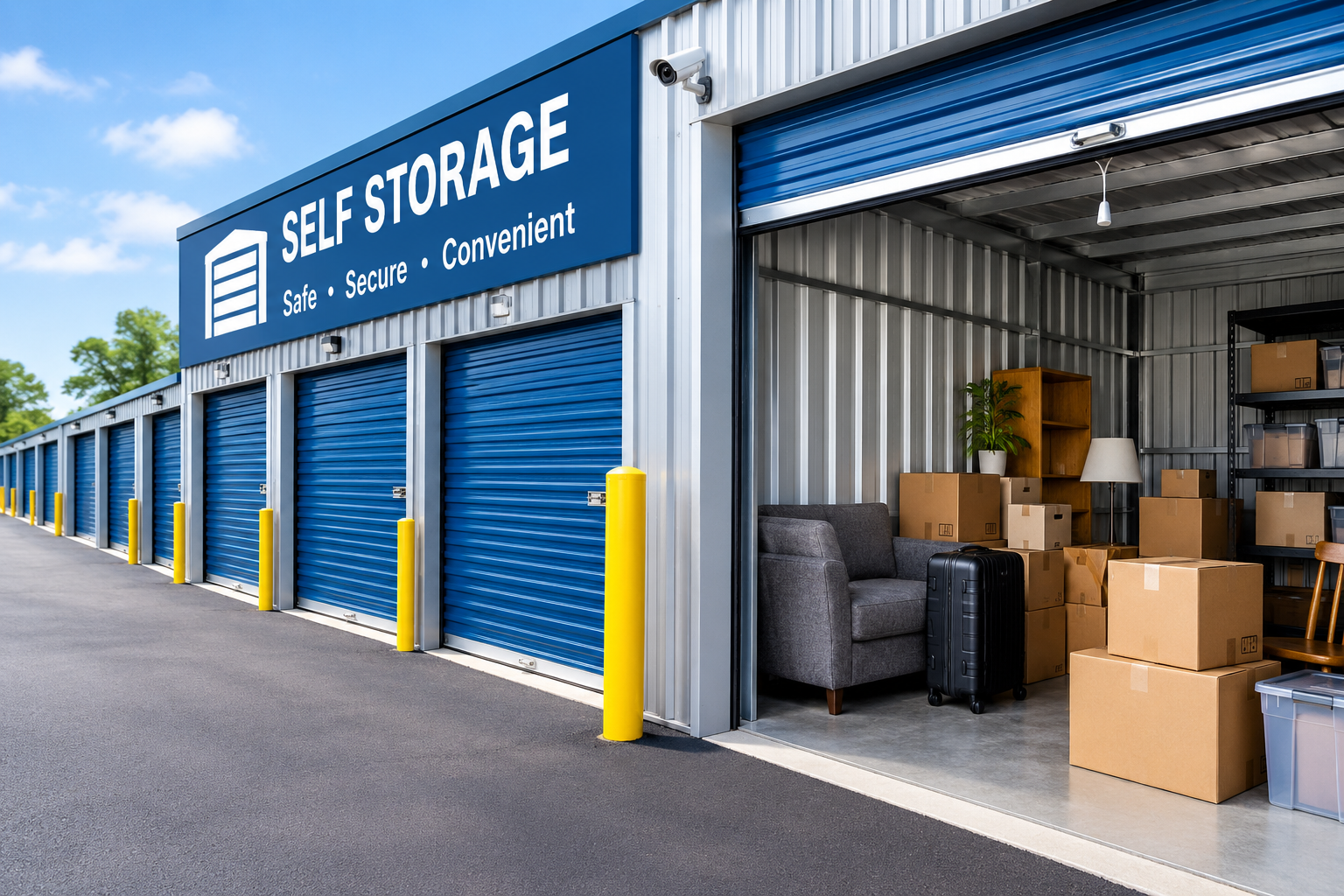
Security remains one of the central considerations influencing customers when selecting a self-storage facility. Customers are placing their personal belongings, household goods, business inventory, documents, and equipment outside their primary premises and therefore expect operators to provide controlled and secure environments. Modern self-storage facilities increasingly combine perimeter fencing, gated access, surveillance cameras, lighting, individual unit locks, electronic entry systems, alarms, security personnel, and monitoring systems. Facilities can also use access logs and digital credentials to track entry activity. These technologies provide operators with additional tools for managing facility security while offering customers greater confidence in storing their belongings. Accessibility is equally important because self-storage differs from traditional warehousing where customers may not have direct access to stored goods. Customers generally expect to access their units according to facility rules and operating hours, making convenient location and easy entry important factors in facility selection. Drive-up units, elevators, wide corridors, loading areas, vehicle access, and extended access hours can improve the overall customer experience. The combination of security and accessibility creates a central value proposition for self-storage: customers receive dedicated space while maintaining direct access to their possessions. Operators therefore increasingly design facilities around convenience, security, visibility, and ease of movement rather than simply maximizing storage density.
Climate-Controlled Storage Influencing Product Development
Climate-controlled storage represents an important area of development within the Self-Storage Market. These facilities maintain more controlled temperature and humidity conditions than conventional storage units, making them suitable for belongings that may be sensitive to extreme temperatures, humidity, or environmental fluctuations. Furniture, electronics, documents, artwork, clothing, musical instruments, and other sensitive items can benefit from controlled storage conditions. Demand for climate-controlled units can therefore increase in regions experiencing high humidity, extreme temperatures, seasonal weather changes, or other environmental conditions that may affect stored goods. The development of climate-controlled facilities is also connected to changing customer expectations. As consumers become more familiar with organized self-storage, they increasingly compare facilities based on security, cleanliness, accessibility, unit condition, technology, and environmental controls rather than simply price and available square footage. The Asia-Pacific market illustrates this trend. According to the 2025 SSAA regional survey, climate-controlled storage accounted for nearly half of facilities across the region, with higher penetration in markets including Hong Kong, Singapore, South Korea, and Japan. Emerging markets continue to have a greater presence of non-climate-controlled facilities because of affordability and building-format considerations.
Unit Size and Storage Formats Creating Market Diversity
The Self-Storage Market offers multiple unit sizes because customers have significantly different storage requirements. Small units can accommodate boxes, documents, clothing, seasonal items, and other personal belongings, while medium and larger units can accommodate furniture, appliances, business inventory, equipment, and other bulky goods. Medium-sized units between 50 and 100 square feet represent an important part of demand because they provide sufficient space for a broad range of household and small-business requirements. Larger units can support customers storing the contents of larger homes, business equipment, commercial inventory, or other bulky possessions. Portable container storage is another evolving segment. Portable containers can provide greater flexibility because the storage container can be delivered to a customer's location or managed through a dedicated storage facility. This format can be useful during residential moves, renovation projects, construction activity, business transitions, and temporary storage requirements. Vehicle storage represents another specialized application. Customers can use dedicated areas to store cars, recreational vehicles, boats, trailers, motorcycles, and other vehicles that may not fit within residential properties. Vehicle storage can therefore provide an additional revenue opportunity for operators with suitable land and zoning conditions. The diversity of storage formats allows operators to target multiple customer segments while maximizing the use of available real estate. Facilities can combine traditional units, climate-controlled rooms, drive-up units, portable containers, vehicle spaces, and business-oriented storage areas depending on local demand and property characteristics.
Personal and Business Applications Expanding the Customer Base
Personal customers represent the largest application segment within the Global Self-Storage Market. Households use self-storage for relocation, renovation, downsizing, travel, temporary housing, family transitions, seasonal storage, and general space management. The ability to rent a private unit without purchasing additional residential space makes self-storage a flexible option for customers facing temporary or long-term space constraints. Business customers represent another important source of demand and include small businesses, retailers, contractors, e-commerce sellers, service providers, professionals, and other commercial users. Business customers may require storage for inventory, tools, equipment, documents, furniture, promotional materials, seasonal merchandise, or operational supplies. Small and medium-sized enterprises can particularly benefit from self-storage because they may experience changing inventory and space requirements. Instead of signing a large warehouse lease, a business can rent one or more storage units and increase or decrease capacity according to operational needs. E-commerce is also creating opportunities for self-storage operators. Small online sellers can use storage units for product inventory, packaging materials, and fulfillment supplies. Facilities located close to urban consumers can provide businesses with convenient local inventory space without requiring large distribution facilities. The distinction between personal and business demand is also becoming less rigid. Home-based businesses, independent professionals, online sellers, contractors, and entrepreneurs may use the same storage facility for both household and business-related purposes. This creates opportunities for operators to develop flexible unit formats and services that can accommodate a wide range of customers.
Rental Duration Supporting Recurring Revenue
Rental duration is a defining characteristic of the self-storage business model. Customers can rent units for short periods during relocation, renovation, travel, or temporary space constraints, while other customers maintain storage for several months or multiple years. Mid-term rentals between three and twelve months represent an important segment because they can provide stable occupancy while accommodating customers experiencing extended transitions. These customers may include households undergoing renovation, individuals relocating, students, businesses adjusting inventory levels, and customers temporarily living in another location. Short-term rentals below three months can increase during periods of residential mobility, moving activity, seasonal demand, and temporary projects. Operators can serve this segment through flexible agreements and convenient online rental processes. Long-term customers can contribute recurring rental revenue and stable occupancy. Customers may retain storage for years when the contents are difficult to replace, when residential space remains constrained, or when belongings have sentimental or practical value. The mixture of rental durations provides operators with a diversified occupancy base. Operators increasingly use pricing, promotions, digital marketing, customer communication, and revenue-management tools to balance new customer acquisition with retention and occupancy optimization.
Online Booking and Digital Customer Journeys Supporting Growth
The customer journey for self-storage is becoming increasingly digital. Customers can search for facilities, compare unit sizes, review prices, check availability, reserve units, sign agreements, make payments, and receive access credentials through online platforms. Online booking is particularly relevant for customers who want to complete the rental process without visiting a facility beforehand. Digital availability information can also reduce friction because customers can identify an appropriate unit size and location before arriving at the property. Offline booking remains important because some customers prefer visiting facilities, inspecting storage units, speaking with staff, or receiving assistance before signing an agreement. Physical facility visits can also provide customers with an opportunity to evaluate cleanliness, security, accessibility, parking, loading areas, and general property conditions. Operators are therefore combining online and offline channels rather than relying exclusively on one approach. Digital marketing can generate leads, while facility teams can support customers who require additional information or assistance. This omnichannel approach can improve customer acquisition and allow operators to serve different demographic groups and purchasing preferences. The growth of digital booking is also supporting remote-managed facilities. Customers can complete many stages of the rental process online while facility access and security are managed through digital systems. This model can enable operators to serve customers beyond conventional office hours and reduce the operational requirements of individual facilities.
Regional Insights: North America Leads, Asia Pacific Expands
North America represents the largest regional market for Self-Storage, supported by an established facility base, mature operator networks, widespread consumer awareness, high adoption of organized storage, and extensive use by both households and businesses. The United States represents the largest country market within the region, while Canada and Mexico provide additional opportunities supported by urbanization, business activity, residential mobility, and expanding organized storage infrastructure. The mature nature of the North American market has also encouraged significant consolidation and professionalization. Large operators are expanding through acquisitions, new development, technology investment, and portfolio optimization. Public Storage completed its acquisition of National Storage Affiliates in July 2026, bringing its combined platform to more than 4,500 properties and approximately 327 million rentable square feet at closing. Europe represents another significant Self-Storage Market, supported by urbanization, limited residential space in major cities, increasing awareness of self-storage, business demand, and continued professionalization of the industry. The United Kingdom, Germany, France, Spain, Italy, and the Netherlands represent important markets within the region. The European market is also experiencing continued technology adoption and operational development. The 2025 FEDESSA report found that revenue per square meter increased by 5.4% across Europe, while average occupancy was 78%. The report also identified increasing use of AI, remotely managed stores, and growing personal-use demand. Asia Pacific represents one of the most dynamic regional opportunities within the Global Self-Storage Market. The region includes mature markets such as Japan, Hong Kong, Singapore, South Korea, and Australia alongside emerging markets such as India, China, Vietnam, Thailand, Indonesia, and the Philippines. Urban population growth, limited residential space, increasing consumer awareness, digital booking, and business demand are supporting market development. The Asia-Pacific self-storage sector is increasingly diversifying its product and facility formats. The SSAA 2025 survey reported average regional occupancy of approximately 86% and identified continued development of climate-controlled facilities, remote management, and digitally enabled operations. Individual customers remained the primary source of occupied space, while business demand continued to strengthen as markets matured. South America is developing as an emerging self-storage market as urbanization, changing housing patterns, business activity, and consumer awareness of organized storage increase. Brazil represents the largest country market in the region, while Argentina, Colombia, Chile, and Peru provide additional opportunities. The development of facilities in major metropolitan areas is expected to remain important as operators target households and small businesses seeking flexible storage capacity. The Middle East and Africa represent emerging opportunities for organized self-storage. The United Arab Emirates and Saudi Arabia represent important markets in the Middle East, supported by urban development, expatriate populations, business activity, and demand for flexible space. In Africa, South Africa represents a comparatively mature organized self-storage market, while countries such as Egypt and Nigeria provide opportunities associated with urbanization and expanding business activity.
Competitive Landscape: Scale, Technology and Facility Expansion
The Global Self-Storage Market includes large public operators, regional companies, private operators, REITs, specialist storage companies, and technology-enabled platforms. Major companies associated with the industry include Public Storage, Extra Space Storage, U-Haul Holding Company, CubeSmart, SmartStop Self Storage REIT, StorageMart, Safestore Holdings, Big Yellow Group, Stor-Age Property REIT, Kennards Self Storage, Storefriendly, and other regional operators. Competition is increasingly moving beyond the availability of storage units toward location, price, occupancy management, customer experience, technology, security, facility quality, and digital convenience. Operators are investing in modern facilities that incorporate electronic access, surveillance, online rental processes, climate control, automated payments, and remote management. Scale is also becoming increasingly relevant. Large operators can use centralized technology platforms, standardized operating procedures, brand recognition, purchasing capabilities, and portfolio-level revenue management across multiple properties. Acquisitions provide another pathway for companies to expand their geographic presence and increase operating scale. Public Storage's 2026 acquisition of National Storage Affiliates illustrates the continuing importance of consolidation among large operators. At closing, Public Storage reported more than 4,500 properties and approximately 327 million rentable square feet, demonstrating the scale that can be achieved through portfolio expansion and consolidation. At the same time, regional and independent operators continue to play an important role, particularly in markets where local knowledge, property-level relationships, specialized customer service, and flexible facility formats provide competitive advantages. In emerging markets, smaller operators may also establish facilities before larger institutional companies enter the market.
Investment, Development and Adaptive Reuse Supporting Market Expansion
Real estate availability is an important consideration for self-storage development. Operators require locations that provide sufficient population density, visibility, accessibility, suitable zoning, and an appropriate balance between land cost and achievable rental revenue. In mature markets, limited availability of development land can encourage operators to consider redevelopment, conversion, vertical construction, and adaptive reuse. Existing commercial, industrial, retail, and other underutilized properties can sometimes be converted into self-storage facilities where zoning and building characteristics permit. Adaptive reuse can be particularly relevant in dense urban markets where acquiring large greenfield sites is difficult. Converting existing buildings can provide operators with access to established neighborhoods and transportation networks while reducing the need for entirely new construction. However, development costs remain an important challenge. Rising land prices, construction expenses, financing costs, planning requirements, and competition from other real estate uses can affect project economics. The 2025 FEDESSA report identified increasing land costs as a major concern among European self-storage operators. Operators are therefore increasingly evaluating facility design, unit mix, automation, energy efficiency, location, parking, accessibility, and technology infrastructure together when planning new properties. The objective is to create facilities that can achieve attractive occupancy while maintaining efficient operating costs.
Future Outlook
The Global Self-Storage Market is expected to maintain steady expansion through 2031 as households and businesses increasingly seek flexible storage capacity and operators continue investing in modern facilities, technology, security, and digital customer experiences. The market's development will be influenced by urbanization, residential space constraints, household mobility, small-business activity, e-commerce, changing lifestyles, and the increasing professionalization of self-storage operations. Technology will remain an important part of the industry's future development. Online booking, digital contracts, automated payments, electronic access, smart locks, remote monitoring, AI-supported operations, customer relationship management, and revenue-management systems are expected to become increasingly integrated into modern facilities. The growing use of remote management can also change the economics of facility operations. Operators can manage access, security, customer communication, payments, and other functions from centralized locations, potentially allowing facilities to operate with fewer on-site personnel while maintaining digital customer support. Climate-controlled storage, compact urban facilities, portable storage, and vehicle storage are also expected to create opportunities for product diversification. Operators can develop different unit formats according to local demographic characteristics, weather conditions, land availability, customer income, and business requirements. The customer base is expected to remain diversified. Personal customers will continue to represent a major source of demand as households manage limited living space, relocation, renovation, downsizing, and lifestyle transitions. Business customers are expected to contribute additional demand as small businesses, e-commerce sellers, contractors, retailers, and independent professionals seek flexible inventory and operational space. Regional growth will remain uneven. North America will continue to benefit from its established self-storage ecosystem and mature operator base, while Europe will be influenced by urban demand, professionalization, technology adoption, and changing supply conditions. Asia Pacific is expected to provide significant opportunities as organized self-storage becomes more established across major cities and emerging markets. South America and the Middle East & Africa are also expected to develop as awareness of organized self-storage increases. Growth in these regions will depend on urbanization, real estate development, consumer education, business activity, facility availability, and the ability of operators to provide affordable and accessible storage solutions. The Global Self-Storage Market is therefore evolving from a conventional space-rental model into a flexible, technology-enabled service ecosystem. The combination of private storage space, security, accessibility, flexibility, and convenience provides a distinct value proposition for households and businesses. With the Global Self-Storage Market projected by Bonafide Research to increase from more than USD 62.75 billion in 2025 to more than USD 87.73 billion by 2031, the industry is expected to remain an important component of the broader flexible real estate market through the forecast period.






 We are friendly and approachable, give us a call.