

Top Companies Global Street Sweepers Market
Global Street Sweepers Market Outlook, 2030 are expected to reach a market size of more than USD 5.47 Billion by 2030

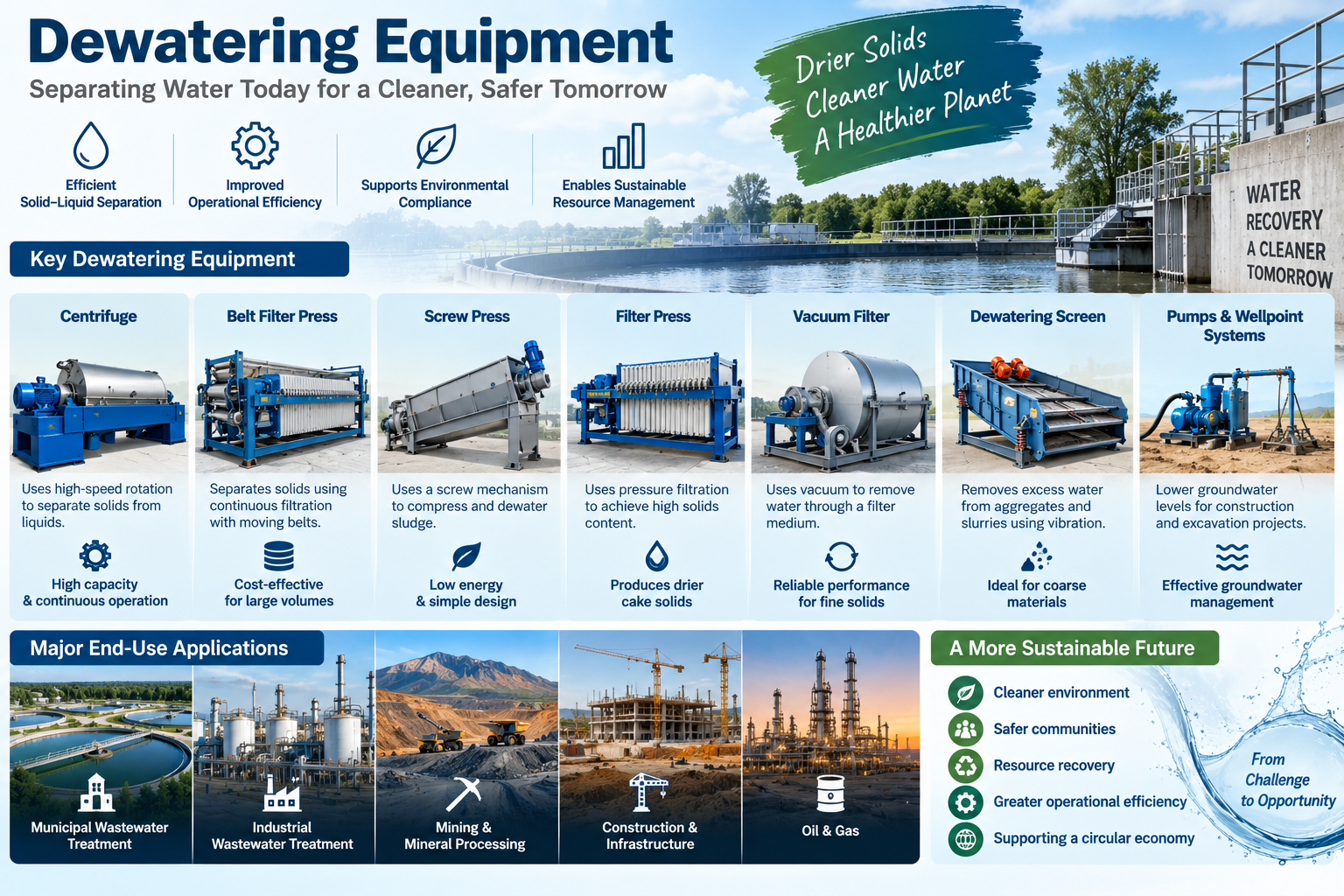
The global dewatering equipment market is entering a period of sustained expansion as municipalities, industrial facilities, mining companies and construction projects increasingly require efficient solutions for removing water from sludge, slurry, excavated areas and other water-laden materials. The market is projected to reach USD 13.55 Billion by 2031, reflecting a CAGR of 8.65% from 2026 to 2031.
Dewatering equipment plays a critical role across wastewater treatment, mining and mineral processing, construction, oil and gas, and industrial applications. Growing regulatory requirements for wastewater management, increasing infrastructure development and the expansion of mining activities are creating demand for equipment capable of improving solids handling, reducing water content and supporting efficient downstream processing.
Rising Wastewater Treatment Requirements Support Market Growth
One of the major factors driving the dewatering equipment market is the increasing volume of municipal and industrial wastewater requiring treatment. Rapid urbanization is increasing wastewater generation, while governments and municipalities are investing in treatment capacity and modernization of existing wastewater infrastructure.
Dewatering is an important stage in sludge management because it reduces sludge volume and water content before transportation, disposal, reuse or further processing. As wastewater treatment plants adopt more advanced treatment processes, demand for mechanical dewatering technologies is expected to increase.
Technologies such as centrifuges, belt filter presses, screw presses and filter presses provide different approaches depending on sludge characteristics, throughput requirements, space availability and desired dryness levels.
Mining Industry Creates Strong Demand for Dewatering Equipment
Mining represents another important demand center for dewatering equipment. Mining operations generate large quantities of water-containing slurries, tailings and process wastewater that require effective separation and handling.
Expansion of mining activities for minerals used in energy transition technologies is further increasing the need for water management solutions. Dewatering systems can help mining operators manage process water, improve solids handling and recover usable water for recycling.
In underground and open-pit mining, groundwater management is also essential for maintaining safe and productive operations. Pumps, wellpoint systems and deep-well systems are therefore used alongside mechanical dewatering technologies depending on site conditions.
Construction and Infrastructure Development Boost Groundwater Dewatering
Large-scale construction projects frequently encounter groundwater accumulation and water infiltration, particularly during excavation and foundation work. Effective groundwater dewatering enables contractors to maintain relatively dry and stable working conditions.
The expansion of transportation infrastructure, commercial buildings, residential developments, industrial facilities and urban infrastructure is therefore contributing to demand for pumps, wellpoint systems and deep-well dewatering systems.
Infrastructure modernization is particularly important in regions experiencing rapid urban development, where large excavation projects require reliable temporary or permanent water-management systems.
Technology Trends Are Reshaping Dewatering Solutions
The industry is increasingly moving toward technologies that improve energy efficiency, automation, monitoring and operational reliability.
Modern dewatering equipment can incorporate automated controls and monitoring systems that allow operators to track parameters such as flow, pressure, moisture content and equipment performance. These capabilities can help reduce manual intervention and improve process consistency.
Energy efficiency is also becoming increasingly important. Equipment manufacturers are developing systems designed to achieve higher throughput while controlling electricity consumption, particularly for continuously operating wastewater and industrial facilities.
Another important trend is the integration of dewatering systems into broader wastewater and sludge-management processes. Rather than treating dewatering as an isolated operation, end users are increasingly considering the complete chain from sludge generation through thickening, dewatering, transportation, disposal, treatment and potential resource recovery.
Mechanical Dewatering Equipment Remains a Key Technology Segment
Mechanical dewatering equipment includes several established technologies, each suited to different operating conditions. Centrifuges use centrifugal force to separate water from sludge and slurry and are widely applicable where continuous operation and relatively high throughput are required. Filter presses use pressure-driven filtration to achieve high solids concentration and are particularly suitable for applications requiring relatively dry filter cake. Belt filter presses continuously separate water from sludge through gravity drainage and mechanical pressure and are commonly used in wastewater treatment applications. Screw presses provide continuous sludge dewatering and can offer relatively low energy consumption and simplified operation for suitable sludge types. Dewatering screens are used for applications involving coarse solids and slurry separation, particularly where screening and water removal are required together.
Groundwater Dewatering Remains Important for Construction and Mining
Unlike sludge and slurry dewatering, groundwater dewatering addresses the removal or control of groundwater from construction sites, mines and other excavation environments. Pumps and wellpoint systems are commonly deployed for shallow groundwater conditions, while deep-well systems can be used where groundwater levels or excavation depths require greater pumping capacity. The growing complexity of construction sites is encouraging contractors to evaluate groundwater conditions earlier during project planning. This creates opportunities for specialized dewatering contractors and equipment suppliers offering engineered solutions rather than standalone equipment.
Competitive Landscape
The global dewatering equipment industry includes diversified water technology companies, industrial equipment manufacturers, pumping solution providers and specialized dewatering companies.
Key companies operating across different areas of the market include Veolia Water Technologies, SUEZ, Alfa Laval, Xylem, ANDRITZ, Atlas Copco and Sulzer. Companies compete through equipment performance, energy efficiency, system integration capabilities, geographic reach, aftermarket services and application-specific solutions.
The competitive environment is also characterized by increasing demand for customized systems. End users often require equipment selected according to sludge characteristics, flow rates, solids concentration, site conditions and regulatory requirements rather than standardized equipment alone.
See how you can up your career status

Global Street Sweepers Market Outlook, 2030 are expected to reach a market size of more than USD 5.47 Billion by 2030
Global Solar Tracker Market Outlook, 2030 is projected to reach market size of USD 25.43 Billion by 2030.

The global utility poles market was valued at USD 46.17 billion in 2025 and is projected to reach USD 70.42 billion by 2031, reflecting a compound annual growth rate (CAGR) of 7.48%.

The global bifacial solar market was valued at more than USD 22.84 billion in 2025 and is expected to reach more than USD 52.65 billion by 2031, growing at a CAGR of 15.33% from 2026 to 2031.
 We are friendly and approachable, give us a call.