

 By Sunny Keshri
 Top 6 Land Surveying Equipment Companies in the Global Market
Global Land Surveying Market Outlook, 2030 is projected to reach market size of USD 12.90 Billion by 2030.

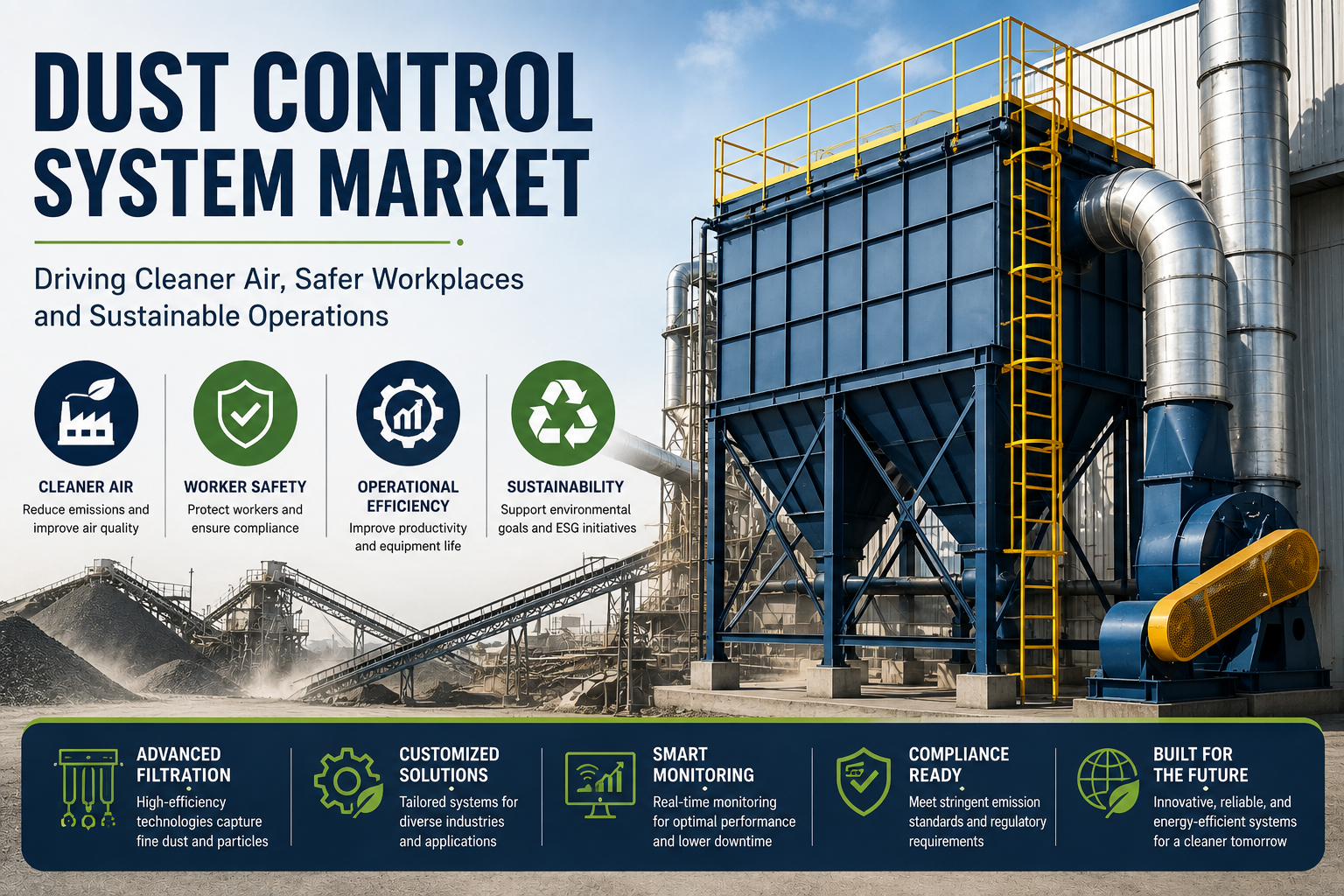
The Global Dust Control Systems Market was valued at more than USD 19.09 Billion in 2025 and is projected to reach more than USD 25.35 Billion by 2031, at a 4.97% CAGR from 2026-2031.
The Global Dust Control Systems Market is undergoing a fundamental transformation, driven by the convergence of the most stringent environmental regulations in industrial history and an unprecedented wave of infrastructure development. Regulatory bodies across the world have established measurable compliance thresholds that are elevating dust control from optional equipment to mission-critical industrial infrastructure. From baghouse dust collectors and wet scrubbers to cartridge collectors and electrostatic precipitators, dust control solutions ensure that industrial emissions are effectively captured before they reach the atmosphere. The adoption of advanced technologies such as IoT and AI for efficient dust collection systems, coupled with the demand for eco-friendly and energy-efficient solutions, continues to shape the competitive landscape.
Evolving global regulatory frameworks are accelerating dust control deployment worldwide
Governments across the globe are implementing increasingly rigorous air quality standards and occupational health regulations that mandate substantial reductions in particulate emissions from industrial operations. In the United States, the Environmental Protection Agency strengthened the annual PM2.5 National Ambient Air Quality Standard in 2024, marking the first tightening in over eight years. The Mine Safety and Health Administration's respirable crystalline silica standard, effective June 2024, set a permissible exposure limit over an 8-hour time-weighted average, with coal mines required to comply by April 2025 and metal and non-metal mines by April 2026. In Europe, the revised Ambient Air Quality Directive mandates a significant reduction in fine PM2.5 particles. From 1 January 2025, new emission limit values for dust, sulfur oxides, and nitrogen oxides took effect for existing medium combustion plants under the Industrial Emissions Directive. China implemented the National Ambient Air Quality Standard effective March 2026, tightening PM2.5 annual secondary limits with a phased transition through 2030. India's National Clean Air Programme targets substantial particulate reduction across 130 non-attainment cities, while South Korea's Second Comprehensive Plan for Fine Dust Management commits significant investment toward achieving a national annual PM2.5 average target. These regulatory benchmarks have elevated engineered dust collection, wet suppression, enclosure, filtration, and real-time monitoring from optional equipment to mission-critical industrial infrastructure.
Investment activity and technological advancement are reshaping industry standards
The Global Dust Control Systems Market is characterized by significant consolidation and continuous technological innovation, with major players strengthening their positions through strategic acquisitions and next-generation product launches. In the mergers and acquisitions landscape, Donaldson Company completed the acquisition of Filtration Group's Facet Filtration division in February 2026, enhancing its fuel and fluid filtration capabilities. In March 2025, Nederman acquired Euro-Equip S.L., strengthening its Process Technology division in foundry and metal recycling markets. On the technology front, Camfil APC launched the Gold Series III dust collector, featuring OptiCone filter cartridges with OmniPleat filter media engineered to maximize filtration performance. Donaldson introduced IoT-enabled filtration monitoring services providing predictive maintenance alerts and performance analytics. ANDRITZ completed the acquisition of LDX Solutions in February 2025, strengthening its environmental technology portfolio by adding established brands including Dustex, Geoenergy, and Western Pneumatics. Major players are focusing on product innovations, strategic partnerships, and acquisitions to expand their market presence.
Sustainability and advanced technologies are reshaping dust management practices
The market is shifting toward integrated solutions combining source capture, high-efficiency filtration, misting or foam suppression, and automated controls, driven by regulatory pressure, combustible dust risk, and sustainability targets. Operators are prioritizing lower pressure-drop filters, variable-frequency drives, and optimized airflow to reduce energy consumption. Manufacturers are designing collectors with variable-frequency drives on fan motors and improved pulse-jet cleaning to lower operational energy consumption. The integration of IoT-enabled monitoring and predictive maintenance capabilities is enhancing the value proposition of fixed systems, enabling operators to optimize performance, reduce downtime, and demonstrate verifiable compliance. Modern systems integrate differential pressure sensors, vibration detection, and cloud-connected IIoT platforms. Predictive maintenance replaces fixed schedules by analyzing operational data to optimize filter replacement intervals and improve efficiency.
Asia Pacific leads the global dust control systems market
Asia Pacific leads the Global Dust Control Systems Market owing to its position as the world's industrial powerhouse, its implementation of the most aggressive air quality standards, the sheer scale of its infrastructure investment, and its dominance in high-growth sectors like semiconductor and battery manufacturing that demand ultra-clean production environments. China, the region's largest economy, operates the world's most extensive manufacturing network, spanning steel production, cement manufacturing, chemical processing, power generation, and semiconductor fabrication. The semiconductor manufacturing boom across Taiwan, South Korea, and China has created specialized demand for high-efficiency cleanroom filtration and wet electrostatic precipitator systems capable of achieving ultra-clean conditions. The region's construction sector is unparalleled in scale, with massive infrastructure pipelines across China, India, and Southeast Asia driving demand for both fixed and portable dust control systems. The region's manufacturing output, particularly in steel and cement, generates immense particulate emissions requiring continuous, high-capacity filtration. This convergence of industrial scale, regulatory intensity, and technological advancement has firmly established Asia Pacific as the global epicenter of dust control systems demand.
The future of the Dust Control Systems Market will be shaped by evolving regulations, technological innovation, and sustainability imperatives across the global industrial sector. As industries accelerate mechanization and adopt smart factory principles, the need for efficient particle capture, air purification, and regulatory compliance has intensified across heavy industries including metalworking, cement, mining, pharmaceuticals, and woodworking. The semiconductor and lithium battery manufacturing boom across Asia-Pacific, North America, and Europe creates specialized demand for high-efficiency cleanroom filtration and wet electrostatic precipitator systems. The construction sector remains a major end-user, driven by massive infrastructure pipelines across developing economies, while the mining sector's ongoing expansion generates sustained demand for ventilation systems, water sprays, and collection equipment. Companies that successfully combine technological excellence with operational efficiency, regulatory expertise, and sustainable practices will be well-positioned to capitalize on the market's long-term growth opportunities.
See how you can up your career status

Global Land Surveying Market Outlook, 2030 is projected to reach market size of USD 12.90 Billion by 2030.

Global Cable Management Market Outlook, 2030 are expected to reach a market size of more than USD 42.10 Billion by 2030

The global flanges market is becoming increasingly important to industrial piping and mechanical connection systems, supporting oil and gas, chemical and petrochemical, power generation, water treatment, mining, marine, and manufacturing applications. The market was valued at USD 6.32 billion in 2025 and is projected to exceed USD 8.81 billion by 2031, growing at a 5.84% CAGR during 2026–2031.

According to the research report Global Automotive Manufacturing Equipment Market Outlook, 2031, published by Bonafide Research, the global automotive manufacturing equipment market was valued at more than USD 32.59 billion in 2025 and is projected to exceed USD 44.04 billion by 2031, registering a compound annual growth rate (CAGR) of 5.28% during 2026–2031.
 We are friendly and approachable, give us a call.