The global
power tools market is a dynamic and essential segment of the broader tools industry, encompassing a wide range of
motor?driven devices used in manufacturing, construction, maintenance, and DIY applications. Power tools, by definition, are tools driven by an additional power source such as electricity, compressed air, hydraulics or electronics, rather than solely by human effort. Over the past decade, these tools have become increasingly sophisticated embedding
battery systems, brushless motors, smart connectivity and ergonomics moving well beyond simple hand?held drills and saws. Their growth is anchored in the twin engines of industrial proliferation and do?it?yourself (DIY) enthusiasm factories, construction sites and renovation projects all require higher productivity, precision and portability, and power tools deliver. At the same time, hobbyists and homeowners are increasingly investing in tools that offer professional?grade performance at accessible prices. In such an environment, manufacturers are innovating rapidly with cordless systems,
digital monitoring, modular batteries, and even rental/subscription models. Moreover, with global infrastructure development, rising urbanization and expanding manufacturing in emerging economies, the demand for reliable, efficient power tools continues to accelerate. Companies are re?thinking distribution (including online channels), sustainability (eco?friendly materials and power systems) and user ergonomics (lighter, safer, smarter tools) to stay competitive. The market is therefore not only about size and volume, but about the technological evolution, shifting end?user behaviours, and regional growth dynamics that are reshaping how tools are designed, sourced and used around the world.
According to the research report "Global Power Tools Market Outlook, 2031," published by Bonafide Research, the Global Power Tools market was valued at USD 51.08 Billion in 2025.The market encompasses a wide variety of tools, including drills, saws, grinders, sanders, and fastening equipment, which are used across construction, manufacturing, and maintenance activities. The industrial sector remains a key driver, as factories, assembly lines, and production plants rely heavily on power tools to enhance efficiency, accuracy, and safety. Infrastructure development projects, including residential, commercial, and transportation construction, further fuel demand by creating large-scale requirements for high-performance tools. Simultaneously, the consumer segment continues to expand, supported by the growing popularity of DIY projects and home renovations, which has led to increased adoption of compact, easy-to-use tools that offer professional-grade results. Technological innovation is reshaping the market landscape. Cordless tools powered by advanced
lithium-ion batteries have become increasingly prevalent due to their portability, longer battery life, and enhanced power output. Brushless motors,
smart sensors, and connectivity features are enabling more precise operation and
predictive maintenance, particularly in industrial environments. Manufacturers are also focusing on modular systems, ergonomic designs, and energy-efficient solutions to meet evolving user preferences. The rise of online sales channels and
e-commerce platforms has transformed distribution strategies, providing customers with convenience, competitive pricing, and access to product information and reviews, which further drives market growth. The market faces challenges, including high upfront costs for premium tools, the need for skilled operation in industrial settings, raw material price fluctuations, and increasing environmental regulations, particularly regarding battery disposal and energy consumption. Manufacturers that innovate, provide efficient service networks, and adapt to changing consumer and industrial needs are expected to gain a competitive edge.
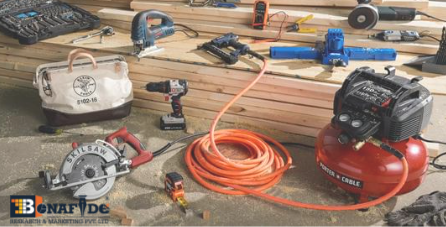
The Drilling & Fastening Tools segment holds the largest share of the global power tools market because drilling and fastening are fundamental operations across almost every industry. From construction and automotive assembly to metalworking, woodworking, and
general maintenance, these tools are essential for creating holes and securing materials together. The high frequency of these tasks ensures a consistent demand for drills, screwdrivers, impact drivers, and related fastening equipment, making this segment the backbone of the power tools market. These tools are highly versatile and adaptable, covering a wide range of subtypes to meet different professional and consumer needs. Corded and cordless drills, impact drivers, torque wrenches, and screwdrivers can be applied in construction, manufacturing plants, repair operations, and DIY projects. This wide applicability contributes to their large market share, as they are used in multiple end-use sectors, from infrastructure construction to home improvement. Infrastructure development, construction activity, and the rise of DIY culture are also driving demand. In emerging markets, new construction projects and renovation work boost industrial and residential tool use, while homeowners increasingly rely on these tools for
furniture assembly, shelving, and other DIY tasks. This combination of professional and consumer demand amplifies the market for drilling and fastening tools. Technological advancements have further strengthened this segment. Innovations such as brushless motors, high-torque cordless drills, smart torque controls, and ergonomic designs improve productivity and reliability, encouraging both professionals and DIYers to upgrade older tools. The efficiency and performance gains offered by modern drills and fastening tools make them indispensable, sustaining their dominant position in the market.
The Electric mode of operation dominates the global power tools market because electric tools are highly versatile, accessible, and suitable for a wide range of applications. They are used in professional industries, workshops, and residential settings alike, spanning tools such as drills, grinders, saws, and screwdrivers. Unlike
pneumatic, hydraulic, or fuel-powered tools, electric tools do not require additional infrastructure like air compressors or fuel tanks, making them convenient for both industrial and home users. Recent advances in battery and motor technology have significantly boosted the popularity of electric tools. Lithium-ion batteries, brushless motors, and cordless designs provide greater portability, higher efficiency, and longer run times. These innovations allow professionals to use electric tools in locations without easy access to electricity, increasing their practicality and broadening the market reach. Electric tools also have a lower maintenance and operational burden compared to other power sources. They are easier to set up, safer to use, and do not emit harmful gases like fuel-powered tools. These advantages appeal to both industrial operators and DIY enthusiasts, further solidifying the electric segment’s market dominance. The growth of sustainability awareness and regulatory compliance supports the electric segment. Electric tools produce no direct emissions, helping companies meet environmental and workplace safety standards. Coupled with the large-scale industrial adoption and DIY market expansion,
electric power tools continue to command the largest market share.
The industrial application segment dominates the global power tools market due to the sheer scale of industrial usage. Sectors such as manufacturing, automotive, aerospace, construction, and
shipbuilding rely heavily on power tools for their daily operations. Unlike residential or DIY users, industrial organizations purchase tools in large volumes to support assembly lines, maintenance tasks, and production operations. Market studies indicate that industrial applications account for over 60% of the total revenue in the global power tools market, reflecting the high demand and consistent usage in professional environments. Industrial applications also require heavy-duty and specialized tools. These tools are built to withstand harsh environments, such as
metal fabrication plants, automotive assembly lines, and large construction sites. They offer higher precision, durability, and safety features compared to consumer-grade tools. Examples include high-torque wrenches, industrial drills, and impact tools designed for continuous use. The advanced specifications and rugged designs of these tools result in higher unit prices, contributing significantly to the market’s value. The growth of key industrial sectors further fuels demand. Rapid industrialization in regions like Asia-Pacific, expansion of automotive and aerospace manufacturing, and large-scale infrastructure projects drive the need for high-quality power tools. Industrial users are investing in modern, efficient tools to enhance productivity, streamline operations, and meet project deadlines. The increasing industrial activity in emerging economies, combined with ongoing modernization in developed markets, ensures that the industrial segment remains the largest contributor to the global power tools market.
















 We are friendly and approachable, give us a call.