Introduction to the Hydrogel Market
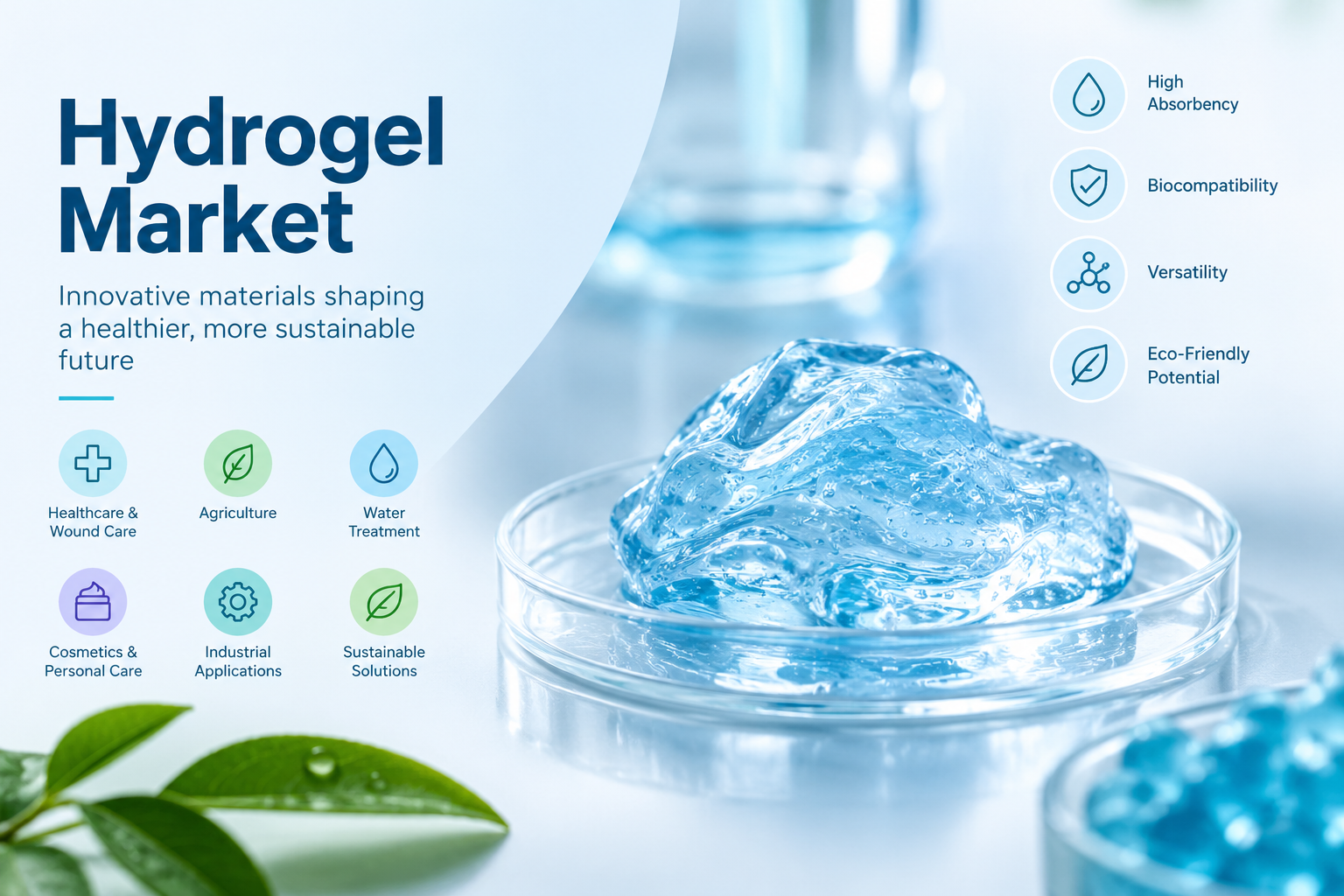
Hydrogels are three-dimensional polymer networks capable of absorbing and retaining substantial quantities of water without dissolving, making them valuable materials across healthcare, agriculture, personal care, and industrial applications. Their distinctive structure allows them to maintain a hydrated environment while offering flexibility, softness, and the potential for controlled responses to external conditions. Depending on their chemical composition and manufacturing process, hydrogels can be designed with different absorption capacities, mechanical properties, degradation characteristics, and levels of biocompatibility. These features have made them useful in applications ranging from wound dressings and contact lenses to agricultural water-retention products and specialized biomedical materials.
Healthcare Applications Driving Material Innovation
Healthcare represents an important area of hydrogel development, particularly in wound management, tissue engineering, drug delivery, and medical devices. Hydrogel-based wound dressings can help maintain a moist environment around a wound, supporting the natural healing process when appropriately selected for the wound type. In drug delivery research, hydrogel structures are being investigated for their ability to encapsulate active ingredients and regulate their release under specific conditions. Researchers are also exploring hydrogel scaffolds that can support cell attachment and tissue development. However, the suitability of these materials depends on factors such as biocompatibility, sterilization compatibility, mechanical strength, and the intended medical application. Continued research into responsive polymers and advanced formulations is creating opportunities for more specialized healthcare products.
Synthetic and Natural Hydrogels Expanding Product Possibilities
Hydrogels are broadly developed using synthetic polymers, natural polymers, or combinations of both. Synthetic hydrogels offer opportunities to engineer properties such as strength, swelling behaviour, durability, and consistency, making them relevant to applications that require controlled material performance. Natural polymer-based hydrogels, which may incorporate materials such as alginate, gelatin, cellulose derivatives, or hyaluronic acid, are attracting attention in applications where biological interactions and material compatibility are important. Hybrid formulations combine selected characteristics of different materials to achieve application-specific performance. Manufacturers and researchers continue to evaluate these formulations according to cost, processing requirements, stability, environmental considerations, and end-use specifications. As a result, product development increasingly focuses on matching hydrogel characteristics with the precise functional requirements of individual applications rather than relying on a single formulation for multiple uses.
Agriculture and Water Management Creating New Opportunities
Agricultural applications provide another important avenue for hydrogel utilization. Certain superabsorbent hydrogel formulations can absorb water and release it gradually as surrounding conditions change, helping improve water availability around plant roots. These materials are being explored for use in soil conditioning, horticulture, nursery cultivation, landscaping, and selected agricultural environments where moisture management is important. Their potential value depends on soil characteristics, irrigation practices, climate, crop requirements, and the formulation's degradation behaviour. In regions experiencing irregular rainfall or water-management challenges, agricultural hydrogels may complement existing irrigation and soil-management practices. Nevertheless, adoption requires consideration of product cost, field performance, environmental persistence, and compatibility with local agricultural conditions. Research into biodegradable and bio-based alternatives is also encouraging the development of formulations designed to address both water-retention needs and environmental concerns.
Personal Care and Consumer Product Applications
Hydrogels are also used in personal care and consumer products because of their ability to hold moisture and provide soft, flexible material structures. Applications include selected facial masks, skincare patches, cosmetic delivery systems, and specialized hygiene products. Their formulation can influence the release of cosmetic ingredients, product adhesion, texture, and moisture retention. Product developers must balance these functional characteristics with skin compatibility, formulation stability, manufacturing efficiency, and consumer expectations. In addition, hydrogel technology is being explored in flexible sensors, wearable devices, and other emerging applications where softness, hydration, or responsiveness to environmental changes can be beneficial. These developments illustrate how hydrogel functionality extends beyond conventional medical products into applications that require adaptable material performance.
Technological Developments Shaping the Market
Research in hydrogel technology increasingly focuses on stimuli-responsive formulations, injectable hydrogels, self-healing materials, conductive hydrogels, and advanced composite structures. Stimuli-responsive hydrogels can be designed to react to conditions such as temperature, pH, or other environmental changes, depending on their chemical composition. Self-healing formulations aim to recover selected material properties after damage, while conductive hydrogels are being investigated for applications in flexible electronics, biosensing, and wearable technologies. Three-dimensional printing is also enabling researchers to investigate complex hydrogel structures for biomedical and engineering purposes. Despite these advances, challenges remain in achieving consistent manufacturing quality, long-term stability, mechanical durability, scalable production, and commercially viable costs. Translating laboratory developments into practical products therefore requires continued collaboration among material scientists, manufacturers, healthcare specialists, and end-use industries.
Challenges and Future Industry Direction
The hydrogel market faces several challenges associated with raw material costs, formulation complexity, performance consistency, and application-specific regulatory requirements. Medical-grade products may require extensive testing and validation, while agricultural and consumer applications must address cost-effectiveness, durability, safety, and environmental suitability. Some conventional synthetic formulations also raise questions regarding biodegradability and long-term environmental persistence, encouraging research into alternative polymers and improved end-of-life characteristics. At the same time, manufacturers have opportunities to differentiate products through specialized formulations, improved absorption behaviour, stronger mechanical properties, and application-focused product design. The future direction of the industry will depend on how effectively hydrogel developers balance functional performance, safety, manufacturing scalability, and sustainability. As research progresses across healthcare, agriculture, personal care, and advanced materials, hydrogels are positioned to remain an important class of materials for solving specific challenges across diverse end-use industries.






 We are friendly and approachable, give us a call.