Global Team Collaboration Software Market: AI Is Changing How Teams Work
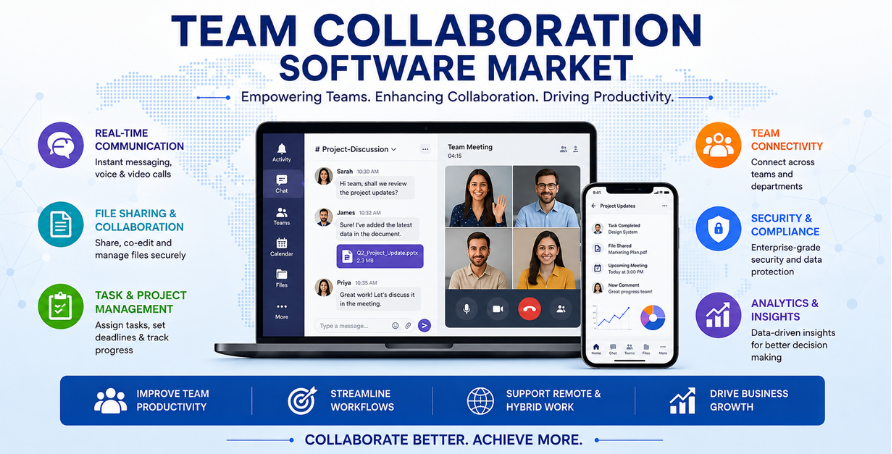
The Global Team Collaboration Software Market is evolving from simple messaging and video-conferencing tools into intelligent digital-work platforms. Businesses increasingly use collaboration software for communication, meetings, document sharing, project management, workflow automation, and enterprise information access. The rise of hybrid work and cloud-based applications has further increased the importance of platforms that allow employees to collaborate regardless of location.
According to the research report, "Global Team Collaboration Software Market Outlook, 2031," published by Bonafide Research, the Global Team Collaboration Software Market Outlook was valued at more than USD 21.35 Billion in 2025, and expected to reach a market size of more than USD 44.29 Billion by 2031 with the CAGR of 13.27% from 2026-2031. The biggest change is artificial intelligence. Microsoft Teams, Google Workspace, Slack, and Zoom are integrating AI into meetings, workplace search, content creation, task management, and workflow execution. AI can now help summarise discussions, identify action items, retrieve information, and increasingly support employees in completing routine work. This is shifting collaboration software from a communication layer toward an AI-enabled productivity environment.
Why AI Matters for Team Collaboration Software
Traditional collaboration software helped employees communicate.
The next generation is designed to help employees communicate, understand, and act.
AI agents can potentially connect conversations with documents, enterprise applications, project-management systems, and workflows. This makes AI-powered collaboration, intelligent meeting software, enterprise search, and workflow automation some of the most important emerging areas of the market.
Cloud Remains the Foundation
Cloud deployment continues to support collaboration because employees can access applications, files, meetings, and workflows from different locations. Eurostat reported that 52.7% of EU enterprises used paid cloud services in 2025, demonstrating the continuing shift toward cloud-based business infrastructure.
What Comes Next?
The future of team collaboration software will increasingly connect:
Communication → AI → Knowledge → Tasks → Workflow
The competitive advantage will therefore move beyond having better chat or video meetings. Platforms that can connect employees with organisational knowledge and automatically help convert conversations into actionable work are likely to become increasingly important.
Key Market Segments
-
By Component: Software, Services
-
By Software Type: Communication and Coordination Software, Conferencing Software, Project and Task Management Suites, Whiteboarding and Ideation Platforms
-
By End-User Industry: IT & Telecom, BFSI, Healthcare & Life-Sciences, Education, Retail & E-Commerce, Government & Public Sector, Others
-
By Organisation Size: SMEs, Large Enterprises
-
By Deployment Model: Cloud, On-Premise, Hybrid
Final Thought
The future of collaboration is no longer simply “Where do teams communicate?”
It is becoming:
“How can technology turn team communication into completed work?”
That shift from communication software to intelligent work infrastructure is what makes the Global Team Collaboration Software Market one of the more interesting areas of enterprise technology.






 We are friendly and approachable, give us a call.