

Top 6 Companies in Global Pulp And Paper Market
Global Pulp and Paper Market Outlook 2029 anticipated to cross USD 395 Billion by 2029, increasing from USD 356.19 Billion in 2023.

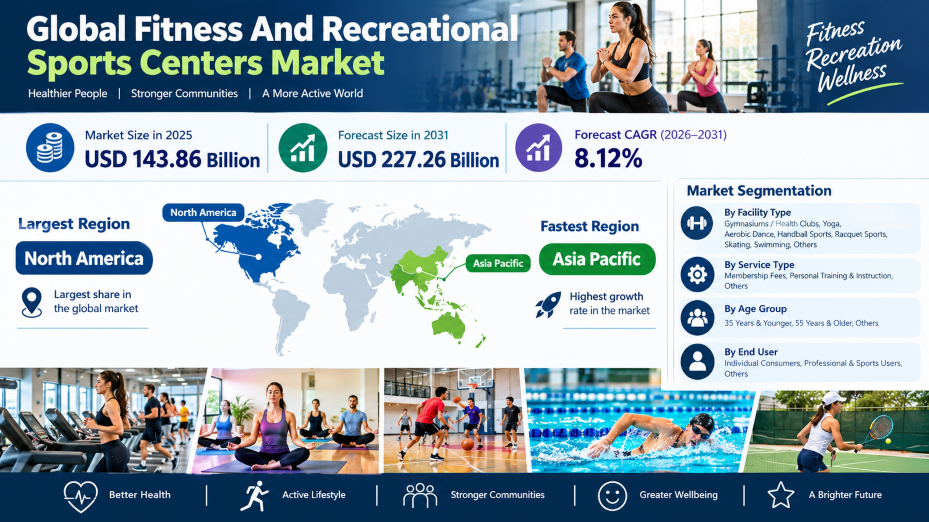
The Global Fitness And Recreational Sports Centers Market was valued at approximately USD 143.86 Billion in 2025 and is expected to reach approximately USD 227.26 Billion by 2031, expanding at a CAGR of approximately 8.12% from 2026 to 2031.
The Global Fitness And Recreational Sports Centers Market is expanding as consumers, businesses, educational institutions, communities, and sports organizations increasingly prioritize physical activity, preventive health, wellness, and active lifestyles. Fitness and recreational sports centers provide organized environments where users can access exercise equipment, instructor-led activities, sports facilities, swimming, skating, yoga, group fitness, coaching, and other recreational programs. Demand varies according to population demographics, disposable income, health awareness, urbanization, sports participation, workplace wellness initiatives, facility availability, and consumer preferences. Gymnasiums/Health Clubs remain the largest facility type, while Yoga is the fastest-growing facility type. Membership Fees represent the largest service type, whereas Personal Training & Instruction is the fastest-growing service category. The 35 Years & Younger age group represents the largest segment, while 55 Years & Older is the fastest-growing age group. Individual Consumers remain the largest end-user segment, while Professional & Sports Users are expected to record the fastest growth. North America remains the largest regional market, while Asia Pacific is the fastest-growing region.
Gymnasiums/Health Clubs remain the largest facility type, while Yoga is the fastest-growing facility type as consumers increasingly seek comprehensive and specialized fitness experiences
Gymnasiums and Health Clubs maintain their leading position because they offer broad fitness solutions under one roof, including cardiovascular and strength-training equipment, functional training areas, group exercise programs, personal training, wellness services, and recreational activities. Their broad customer base and recurring membership structures allow operators to serve consumers with different fitness goals and spending levels. The segment also benefits from the continued expansion of commercial fitness chains, corporate wellness programs, and flexible membership models. Meanwhile, Yoga is emerging as the fastest-growing facility type as consumers increasingly connect physical exercise with stress management, flexibility, mindfulness, mental wellbeing, and preventive health. Yoga facilities are also expanding their offerings through meditation, specialized classes, wellness coaching, prenatal programs, therapeutic sessions, and hybrid formats.
Membership Fees remain the largest service type because recurring subscriptions provide stable revenue, while Personal Training & Instruction is the fastest-growing service category
Membership Fees represent the dominant revenue stream across fitness and recreational sports centers because recurring subscriptions provide operators with predictable revenue and encourage regular facility utilization. Membership structures range from low-cost gym access to premium memberships combining fitness equipment, group classes, swimming, recovery facilities, sports activities, and wellness services. Membership models are increasingly being enhanced through flexible contracts, loyalty programs, digital booking, mobile applications, personalized recommendations, and access to multiple locations. Meanwhile, Personal Training & Instruction is the fastest-growing service category as consumers increasingly seek customized exercise programs, professional guidance, measurable fitness outcomes, sports-specific training, rehabilitation support, and individualized coaching. Grand View Research also identifies personal training and instruction as the fastest-growing service category.
The 35 Years & Younger age group represents the largest user segment, while 55 Years & Older is the fastest-growing group as fitness centers increasingly address preventive health and active aging
Consumers aged 35 Years & Younger represent a major source of demand because this demographic includes students, young professionals, early-career workers, and younger adults increasingly focused on physical fitness, appearance, strength, stress management, and active lifestyles. This group has strong adoption of gym memberships, group fitness, yoga, aerobic dance, recreational sports, and technology-enabled fitness experiences. At the same time, the 55 Years & Older population is becoming an increasingly important growth opportunity as aging consumers place greater emphasis on mobility, strength, balance, cardiovascular health, injury prevention, and maintaining independence. Fitness operators are responding by developing age-specific programs, low-impact exercise, swimming, yoga, personal training, rehabilitation-oriented activities, and wellness services. The broader industry is increasingly positioning fitness centers as part of preventive health and healthy-aging strategies, supporting stronger participation among older consumers.
Individual Consumers remain the largest end-user segment, while Professional & Sports Users are expected to experience the fastest growth as specialized training and sports performance demand increases
Individual Consumers represent the largest end-user segment because most fitness and recreational sports centers depend primarily on memberships and direct payments from consumers. Individuals use these facilities for weight management, strength development, cardiovascular fitness, recreation, stress reduction, social interaction, and general wellness. The segment encompasses users across different age groups and fitness levels, ranging from casual gym members to regular participants in organized sports and instructor-led programs. Corporate Users are also contributing to demand as employers increasingly introduce wellness benefits and fitness memberships as part of employee wellbeing programs. Educational Institutions and Government & Community Users create additional demand through school sports, community recreation, public fitness initiatives, and municipal facilities. Meanwhile, Professional & Sports Users represent a high-growth opportunity because athletes, sports teams, coaches, and performance-oriented users increasingly require specialized training environments, sports coaching, strength and conditioning programs, recovery services, and sport-specific facilities. The expansion of organized sports and professional training is supporting demand for specialized recreational and performance infrastructure.
North America leads the global market through high fitness participation, established facility infrastructure, strong consumer spending, and widespread adoption of organized fitness and recreational services
North America represents the leading regional market for Fitness And Recreational Sports Centers, supported by established fitness infrastructure, high consumer spending on health and wellness, widespread gym participation, developed recreational facilities, and strong awareness of preventive health. The United States provides the largest demand base within the region, supported by a broad network of commercial gyms, health clubs, boutique studios, swimming facilities, racquet-sports centers, skating facilities, and multipurpose recreational centers. The region also benefits from the presence of major fitness operators and a mature ecosystem of equipment suppliers, trainers, sports organizations, and wellness providers. Corporate wellness programs and employer-sponsored fitness benefits further support facility utilization. Consumers are increasingly seeking personalized training, specialized classes, connected fitness experiences, and comprehensive wellness offerings, encouraging operators to expand beyond conventional gym access. Canada and Mexico also contribute to regional growth through expanding commercial fitness infrastructure and increasing consumer interest in organized exercise and recreational sports.
Asia Pacific is the fastest-growing regional market as urbanization, rising incomes, health awareness, and sports infrastructure investment accelerate fitness participation
Asia Pacific is expected to record the fastest growth in the global Fitness And Recreational Sports Centers Market, supported by rapid urbanization, rising disposable incomes, expanding middle-class populations, increasing health awareness, and growing investment in sports and recreational infrastructure. China, India, Japan, South Korea, Australia, and Southeast Asian markets are creating diverse opportunities for commercial gyms, yoga studios, sports centers, swimming facilities, racquet sports venues, and multipurpose recreational facilities. India is benefiting from increasing fitness awareness and initiatives such as the Fit India Movement, while China is supported by continued development of sports infrastructure and participation programs. The region is also experiencing increased adoption of boutique fitness concepts, instructor-led programs, digital booking platforms, wearable technologies, and premium wellness services.
See how you can up your career status

Global Pulp and Paper Market Outlook 2029 anticipated to cross USD 395 Billion by 2029, increasing from USD 356.19 Billion in 2023.

Global Playground Equipment Market Outlook, 2029 anticipated to cross USD 8 Billion by 2029, increasing from USD 5.73 Billion in 2023.

Global Travel Accessories Market Outlook, 2029 is anticipated to cross USD 78.26 Billion by 2029, increasing from USD 53.41 Billion in 2023.

Global Bean Bag Chair market is projected to reach market size of USD 5.47 Billion by 2030
 We are friendly and approachable, give us a call.