The Global Dry Mix Mortar Market was valued at more than USD 48.72 Billion in 2025 and is expected to reach a market size of more than USD 65.88 Billion by 2031, expanding at a CAGR of approximately 5.29% from 2026 to 2031.
The Global Dry Mix Mortar Market is expanding as construction industries increasingly shift toward factory-produced mortar solutions that provide consistent quality, controlled formulations, easier handling, and efficient application. Dry mix mortar is used across masonry, plastering, rendering, tile installation, flooring, grouting, waterproofing, insulation, repair, restoration, and specialty applications. Demand is influenced by urbanization, residential development, infrastructure investment, renovation activity, labor availability, construction standards, and the adoption of modern building practices. Factory-produced mortar reduces the need for extensive on-site material proportioning and supports improved construction consistency. Tile Adhesives represent the largest product segment, while Tile & Stone Installation leads applications. Residential Construction remains the largest end-user segment, supported by housing development and renovation activity. Asia-Pacific represents the largest regional market, while Middle East & Africa records strong growth.
Tile Adhesives remain the largest product segment due to widespread installation demand
Tile Adhesives represent the largest product segment in the Global Dry Mix Mortar Market because tiles are extensively used across residential, commercial, hospitality, institutional, and infrastructure buildings. Ceramic, porcelain, stone, and other decorative surfaces require reliable bonding solutions that provide appropriate adhesion, workability, flexibility, and durability. Increasing use of large-format tiles and premium finishing materials is encouraging demand for specialized adhesive formulations. Residential kitchens, bathrooms, floors, balconies, and living spaces provide a substantial demand base, while hotels, shopping centers, offices, hospitals, and restaurants contribute through commercial construction and renovation. Factory-produced adhesives provide controlled formulations and consistent performance compared with conventional site-mixed solutions. Renovation and refurbishment projects further support demand in mature markets. Manufacturers are increasingly developing specialized adhesives according to substrate, tile type, environmental conditions, and application requirements.
Tile & Stone Installation remains the largest application segment across construction projects
Tile & Stone Installation represents the largest application segment because tiles and stone products are widely incorporated into residential and commercial building interiors and exteriors. Applications include kitchens, bathrooms, flooring, walls, balconies, façades, hotels, retail spaces, hospitals, offices, restaurants, and public buildings. The increasing preference for large-format porcelain, decorative surfaces, natural stone, and premium finishes is creating greater requirements for technically advanced installation materials. Dry mix adhesives help contractors achieve consistent bonding, workability, coverage, and application performance across different substrates. Renovation activity also generates recurring demand as property owners upgrade kitchens, bathrooms, floors, and commercial interiors. Product selection depends on tile dimensions, substrate characteristics, moisture exposure, temperature conditions, and project requirements. The shift toward complete installation systems is also supporting demand for compatible primers, waterproofing products, adhesives, grouts, and leveling solutions.
Residential Construction remains the largest end-user segment because of extensive housing demand
Residential Construction represents the largest end-user segment because dry mix mortar is required across multiple stages of home development, including masonry, plastering, rendering, tile installation, flooring, grouting, waterproofing, repair, and finishing. New houses, apartments, multifamily developments, and residential communities create substantial demand, particularly in rapidly urbanizing economies. Mature markets contribute through remodeling, refurbishment, and maintenance of existing housing. Developers and contractors increasingly prefer factory-produced mortar because standardized formulations can improve consistency, simplify procurement, and reduce preparation requirements at construction sites. Affordable housing projects generally emphasize cost-effective products, while premium residential developments create opportunities for specialized adhesives, waterproofing systems, repair mortars, and high-performance finishes. Growing urban populations and household formation continue to support construction activity, while renovation provides a recurring demand base. Residential construction therefore remains central to global dry mix mortar consumption.
Asia-Pacific leads the global market through strong construction and urban development
Asia-Pacific represents the largest regional market for dry mix mortar because of its extensive construction base, rapid urbanization, housing requirements, infrastructure investment, and expanding manufacturing capacity. China and India provide significant demand through residential, commercial, industrial, and infrastructure development, while Southeast Asian countries contribute through urban expansion, tourism, manufacturing investment, and transportation projects. Japan, South Korea, and Australia provide additional opportunities through renovation, refurbishment, infrastructure maintenance, and demand for higher-performance construction materials. The region also benefits from established cement, aggregate, chemical additive, and building-material supply chains that support local dry mortar production. Increasing adoption of factory-produced mortar is helping contractors improve material consistency and construction efficiency. Demand is also expanding beyond traditional masonry and plastering products toward tile adhesives, waterproofing mortars, grouts, repair solutions, flooring products, and specialty formulations.
Middle East & Africa is experiencing strong growth from large-scale construction activity
The Middle East & Africa Dry Mix Mortar Market is supported by expanding urban development, infrastructure investment, residential construction, hospitality projects, tourism facilities, and large-scale commercial developments. Countries across the Gulf are undertaking major development programs that require substantial volumes of construction materials and specialized mortar solutions. Extreme climatic conditions also influence product requirements, increasing demand for formulations capable of maintaining performance under high temperatures, moisture exposure, and demanding environmental conditions. African markets provide additional opportunities through housing development, urbanization, commercial construction, and infrastructure investment. Increasing adoption of factory-produced mortar is encouraging manufacturers to strengthen regional production and distribution capabilities. Local manufacturing can improve product availability and reduce transportation requirements. Demand is developing across masonry, plastering, tile adhesives, waterproofing, grouting, repair, flooring, and specialty applications as construction practices become increasingly standardized.
Factory-produced mortar is gaining importance through improved consistency and construction efficiency
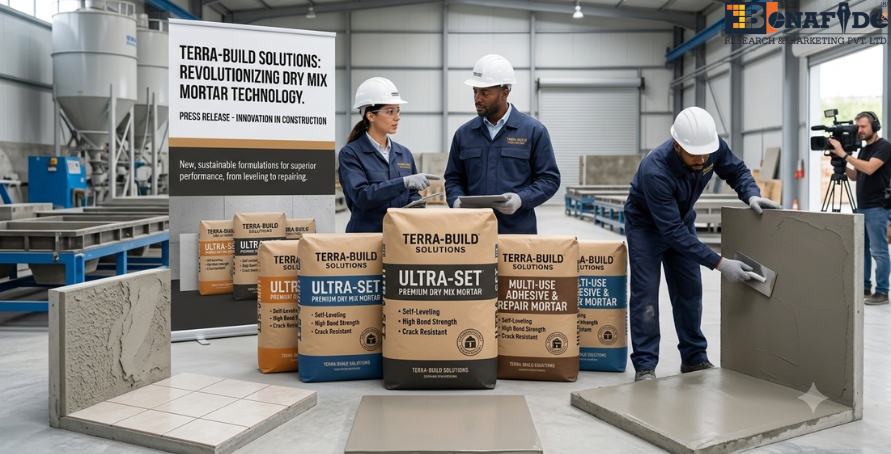
The transition from conventional site-mixed mortar toward factory-produced dry mix solutions is supporting market development as contractors increasingly seek consistent material quality and simplified construction processes. Dry mix mortar is manufactured under controlled conditions, allowing manufacturers to maintain more precise proportions of cement, aggregates, polymers, additives, and performance-enhancing components. This consistency can improve workability, adhesion, strength, setting characteristics, and application performance. Factory production also reduces the need for extensive material storage and manual proportioning at construction sites. These advantages are particularly relevant for large residential developments, commercial buildings, infrastructure projects, and construction environments where productivity and quality control are important. Manufacturers are increasingly offering application-specific formulations rather than basic mortar products. Tile adhesives, waterproofing systems, repair mortars, grouts, flooring solutions, and specialty products are expanding the overall range of factory-produced construction materials.
Product specialization is creating opportunities across repair, waterproofing, flooring, and specialty applications
Beyond conventional masonry and plastering, manufacturers are increasingly developing specialized dry mix mortar products for applications requiring specific performance characteristics. Waterproofing mortars serve bathrooms, basements, foundations, terraces, pools, and other moisture-exposed areas, while repair and restoration mortars address damaged concrete, masonry, façades, and aging structures. Flooring and screeding products support surface preparation and finishing across residential, commercial, and industrial buildings. Grouts provide joint filling and finishing solutions for tile and stone installations. Specialty products can be formulated for particular substrates, environmental conditions, setting requirements, durability needs, or application methods. This diversification allows manufacturers to participate in higher-value applications and reduces dependence on traditional masonry products. Renovation and refurbishment activity is particularly important because existing buildings frequently require repair, waterproofing, surface restoration, tile replacement, and other specialized construction interventions.
Construction modernization and renovation are supporting long-term demand for dry mix mortar
The modernization of construction practices is creating favorable conditions for dry mix mortar adoption across both developing and mature markets. Contractors increasingly require products that can support faster installation, predictable performance, reduced material waste, and improved quality control. New construction provides demand across masonry, plastering, flooring, tiling, waterproofing, and finishing, while renovation creates opportunities across repair and restoration applications. Mature markets such as Europe, North America, Japan, and Australia benefit from refurbishment of existing buildings, whereas developing markets across Asia-Pacific, Latin America, and Africa are supported by urbanization and new housing requirements. Changing construction methods are also increasing the importance of specialized products that can accommodate modern substrates, larger tiles, improved façades, and higher performance expectations. Manufacturers that combine consistent product quality with technical support, distribution reach, and application-specific solutions are positioned to benefit from these trends.





 We are friendly and approachable, give us a call.